

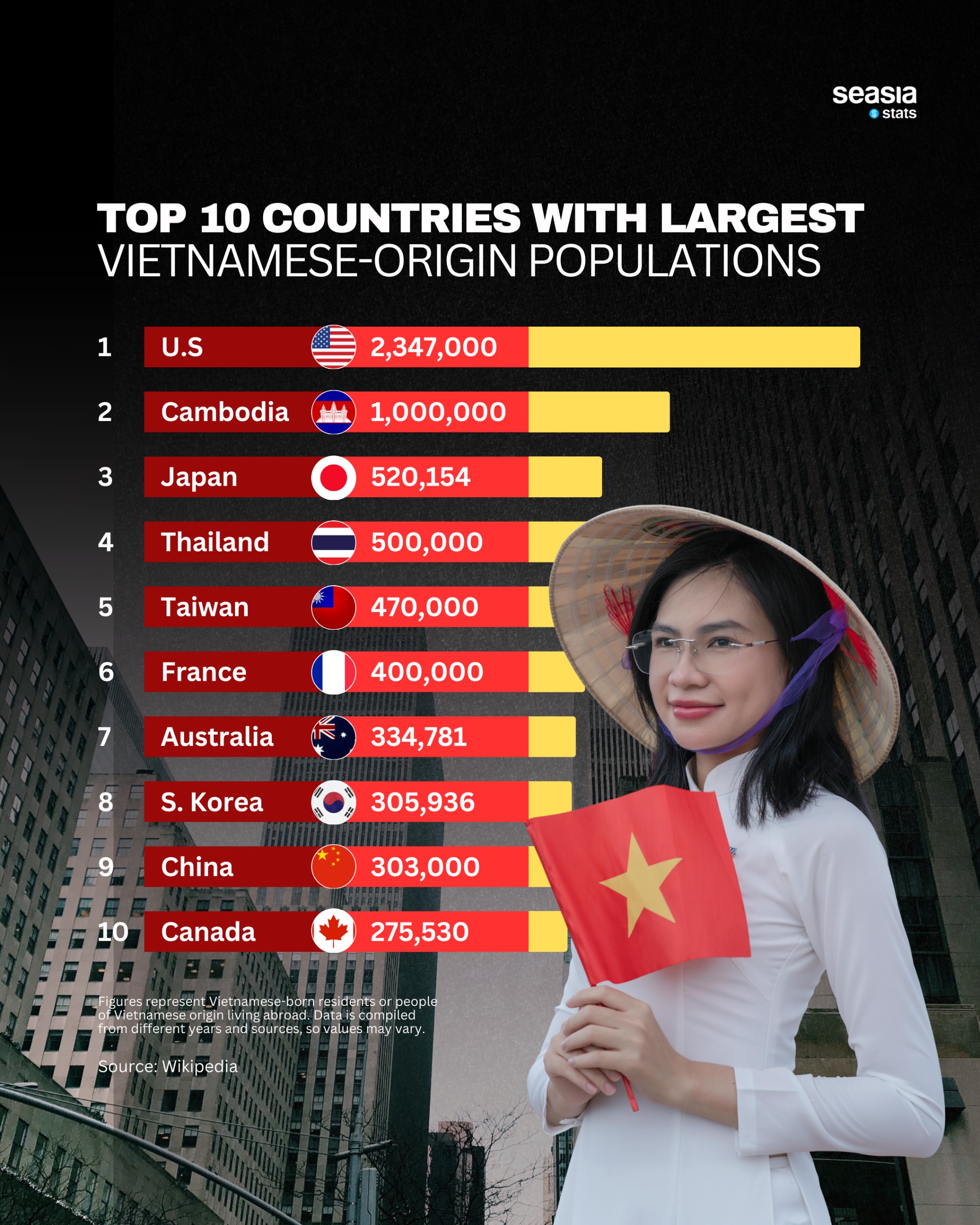
The story of the Vietnamese diaspora is one of resilience, mobility, and global connection. From Southeast Asia to North America and beyond, communities of Vietnamese origin have built vibrant lives abroad while preserving strong cultural ties to their homeland. Today, millions of people of Vietnamese descent live outside Vietnam, forming one of Asia’s most dynamic and widely dispersed diasporas.
A Global Community Rooted in History
Modern migration patterns of Vietnamese communities have been shaped by several waves of history—from colonial-era movement and regional trade to post-war displacement and contemporary labor migration. The largest overseas Vietnamese population is found in the United States, where around 2.3 million people of Vietnamese origin live today. Cities like Westminster and San Jose in California, as well as Houston in Texas, have become cultural centers often referred to as “Little Saigon,” where Vietnamese language, food, and traditions continue to thrive.
In Europe and Oceania, countries like France, Australia, and Canada host long-established Vietnamese communities that date back to the late 20th century refugee movements. These communities have become deeply integrated into local societies while maintaining strong cultural institutions such as temples, community associations, and language schools.
Southeast Asia’s Historic Connections
Closer to home, Southeast Asia plays a central role in the Vietnamese diaspora. Cambodia hosts one of the largest Vietnamese-origin populations in the world, estimated at around one million people. This presence is deeply rooted in centuries of shared geography, trade, and cultural exchange along the Mekong region.
Thailand is another key destination, with roughly 500,000 people of Vietnamese descent. Many trace their ancestry to earlier migration periods, including political exile communities in northeastern Thailand. Laos also maintains a notable Vietnamese community, particularly in urban centers like Vientiane, where cross-border ties and economic activity continue to sustain migration flows.
Beyond mainland Southeast Asia, smaller Vietnamese communities can also be found in Malaysia and Singapore, often linked to professional work, education, and business opportunities in the region’s more developed economies.
Rising Migration in East Asia
In recent years, East Asia has become one of the fastest-growing destinations for Vietnamese migrants. Japan now hosts more than half a million people of Vietnamese origin, largely driven by labor programs and technical internships. Similarly, Taiwan and South Korea have seen significant increases in Vietnamese populations, reflecting the region’s demand for skilled and semi-skilled workers.
These newer migrant communities often represent a younger generation, contributing to sectors such as manufacturing, caregiving, and technology. Over time, many settle permanently, forming new cultural networks and diaspora hubs in cities like Tokyo, Seoul, and Taipei.
A Bridge Between Nations
What makes the Vietnamese diaspora unique is its ability to act as a bridge between countries. Remittances sent home from overseas Vietnamese workers continue to play a major role in Vietnam’s economy, while diaspora entrepreneurs and professionals help connect Vietnam to global markets and innovation networks.
Cultural exchange also flows in both directions. Vietnamese cuisine, fashion, and language are now globalized, while overseas communities continue to celebrate traditions such as Tết (Lunar New Year), maintaining a shared identity across borders.
A Future Defined by Connectivity
As global mobility continues to expand, the Vietnamese diaspora is likely to grow even more diverse and interconnected. Whether in California, Phnom Penh, Tokyo, or Paris, Vietnamese-origin communities continue to contribute to the cultural and economic fabric of their host countries.
In many ways, the Vietnamese diaspora is more than a demographic trend—it is a living testament to adaptability, endurance, and the enduring human desire to build new lives while staying connected to one’s roots.


