

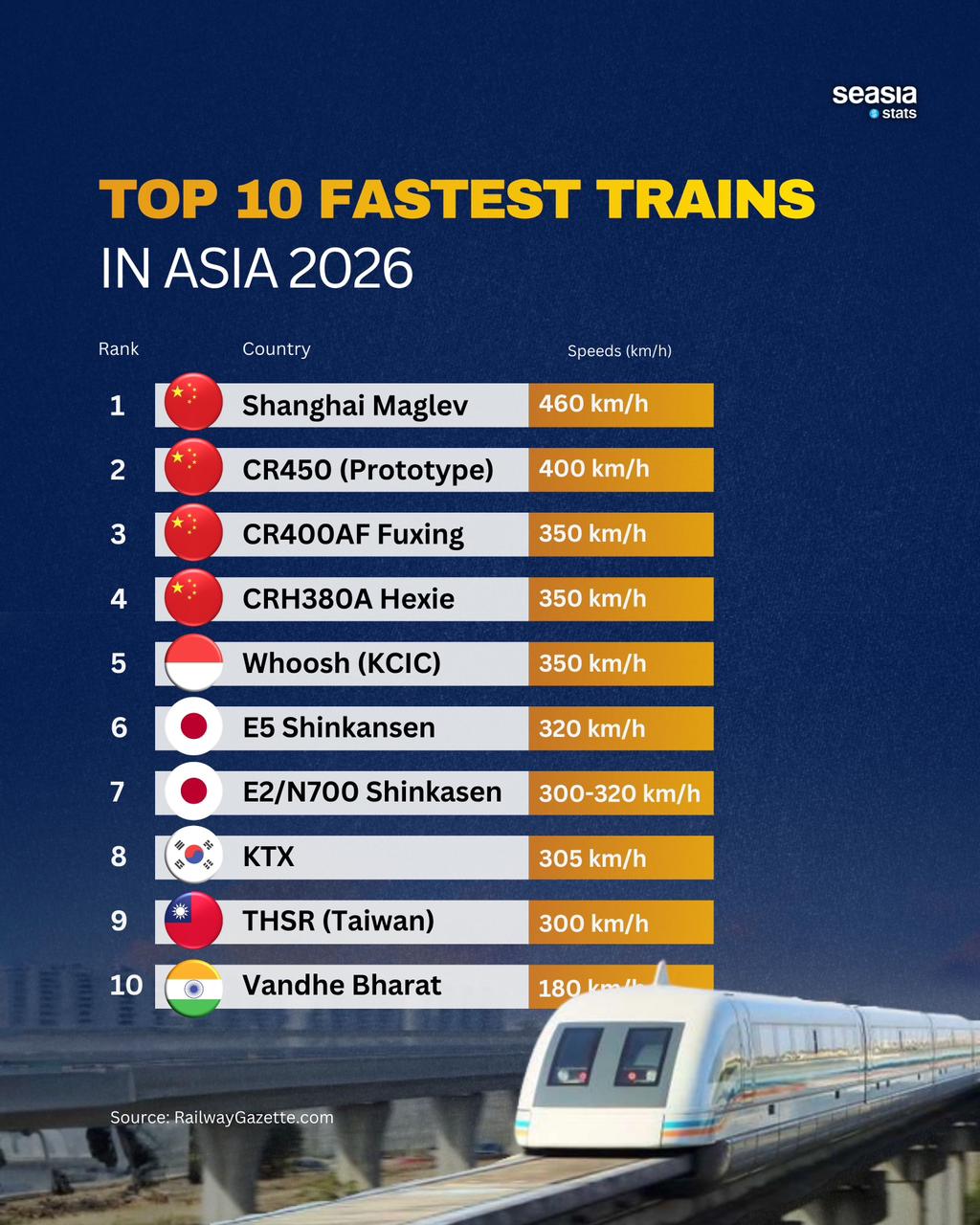
Asia’s fastest trains are more than symbols of speed. They are statements of national ambition. Every kilometer per hour on this ranking represents decades of engineering, billions in infrastructure, and a quiet competition over who will define the future of mobility in the world’s most densely populated continent. And in that race, China is clearly setting the pace—while Southeast Asia is finally beginning to catch up.
China’s rail supremacy is no longer a surprise
The Seasia Stats ranking, based on Railway Gazette data, places China in the top four positions, and that dominance is hard to overstate. The Shanghai Maglev remains the fastest operational train in Asia at 460 km/h, a machine that still feels futuristic even two decades after it began running. Then comes the CR450 prototype, designed for a maximum test speed of 450 km/h and an operating speed of 400 km/h, signaling that China is not slowing down even after building the world’s largest high-speed rail network. Railway Gazette described the new CR450 as part of China’s push to bring “400 km/h operation” closer to reality.
Behind it sit the CR400AF Fuxing and CRH380A Hexie, both operating at 350 km/h, proving that China’s speed advantage is not limited to one showcase line. It is systemic. High-speed rail there is no longer a prestige project. It is becoming ordinary public transport on a national scale.
That is what makes China different from most of Asia. Elsewhere, high-speed rail still feels exceptional. In China, it increasingly feels normal.
Indonesia’s Whoosh changed Southeast Asia’s rail imagination
Then comes the most important name for Southeast Asia: Whoosh. Ranked fifth at 350 km/h, it is not just Indonesia’s fastest train. It is the fastest train in Southeast Asia—and perhaps the clearest sign yet that the region is entering a new transport era.
Whoosh matters because it shattered an old assumption: that true high-speed rail was something Northeast Asia had, and Southeast Asia merely talked about. Indonesia changed that. Suddenly, a Jakarta-to-Bandung journey that once symbolized congestion and delay became a marker of modernity and compressed geography.
Its significance is larger than transport. It is political, economic, and psychological. Once a country builds one credible high-speed line, the public starts imagining what else could be possible. Not just faster trains, but new commuter belts, tourism corridors, logistics chains, and investment zones.
Japan, Korea, and the old masters of rail reliability
Japan’s presence in the ranking is less flashy but no less important. The E5 Shinkansen operates at 320 km/h, while other Shinkansen models continue to sit in the 300–320 km/h range. JR East notes that the E5 has operated at 320 km/h since 2013, which says something remarkable about Japan: its rail prestige comes not from novelty, but from consistency.
That has always been Japan’s advantage. China may now dominate in scale and raw speed, but Japan still owns the mythology of punctuality, comfort, and trust. The Shinkansen remains one of the few transport systems in the world that is both iconic and deeply routine.
South Korea’s KTX, ranked eighth at 305 km/h, continues that same tradition of disciplined rail engineering. Korail states that its high-speed trains are designed for 330 km/h, with a top operational speed of 305 km/h. Taiwan’s THSR and India’s Vande Bharat round out the list, showing that Asia’s rail story is becoming broader, even if it remains uneven.
Southeast Asia’s next rail chapter is already being written
What makes this ranking especially compelling is what it suggests about the future of Southeast Asia. Indonesia may be the only Southeast Asian country on the list today, but it will not be the last if current plans hold.
Thailand, Laos, Malaysia, and Vietnam are all part of a region-wide conversation about rail modernization, connectivity, and cross-border integration. Thailand’s long-delayed high-speed line linking Bangkok toward Nong Khai is part of a larger route that could eventually connect with Laos and southern China, creating one of the most important overland transport corridors in mainland Southeast Asia. Reuters recently noted that the Thai line is intended to connect Bangkok to Kunming through Laos.
That is why this ranking matters beyond train enthusiasts. It is not just about who is fastest today. It is about who is building tomorrow’s geography.
And if Asia’s rail future once belonged almost entirely to China and Japan, Southeast Asia is finally stepping onto the platform.


