

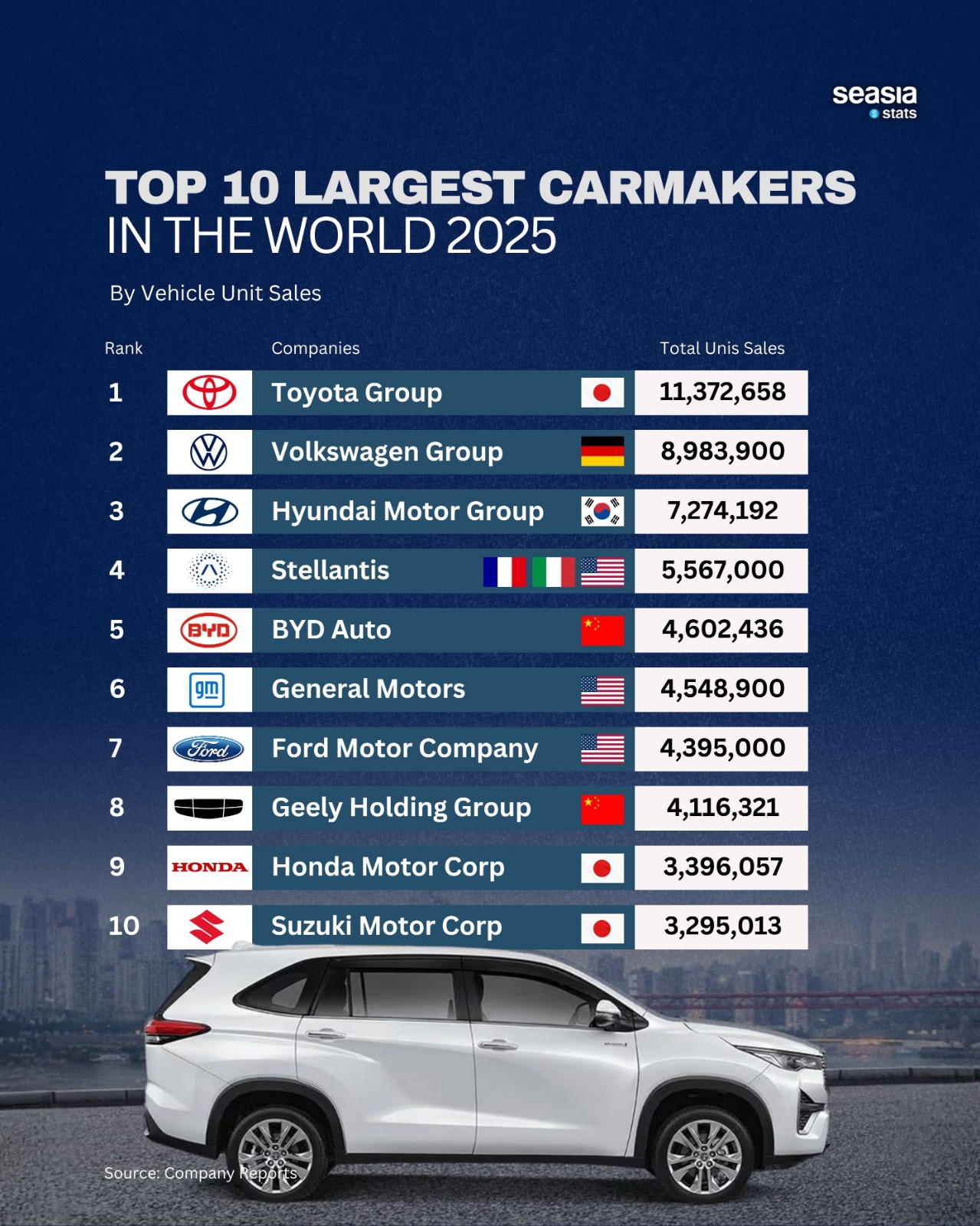
The global auto industry in 2025 looks, at first glance, like a familiar story: Toyota on top, Volkswagen close behind, Hyundai firmly in the chase. But look a little closer and the rankings reveal something much bigger than brand prestige. They show where manufacturing power is shifting, where electric vehicles are accelerating, and why Southeast Asia is becoming one of the most important battlegrounds in the future of mobility.
Toyota still rules the road
According to the figures presented in the infographic, Toyota Group remains the world’s largest carmaker in 2025 with 11,372,658 vehicle sales, comfortably ahead of Volkswagen Group’s 8,983,900 and Hyundai Motor Group’s 7,274,192. Volkswagen itself said it delivered about 9.0 million vehicles globally in 2025, while Hyundai reported global retail sales of just over 4.1 million for the Hyundai brand alone—underscoring how group-level rankings matter in this industry.
Toyota’s staying power is not just about size. It is about consistency. While the electric-vehicle race dominates headlines, Toyota has quietly kept winning with scale, hybrid technology, reliability, and an unmatched footprint across Asia, North America, and emerging markets. In many parts of the world, especially Southeast Asia, Toyota is not just a car brand—it is practically part of the transport ecosystem.
That matters because mass-market leadership is still built on trust, service networks, resale value, and affordability, not just innovation headlines.
China is no longer just manufacturing cars—it is building giants
The most dramatic shift in this ranking comes from China. BYD Auto has surged into fifth place with 4,602,436 units, while Geely Holding Group also enters the global top ten with 4,116,321. These are not symbolic appearances. They reflect a structural change in the global car market.
For years, China was seen as the world’s factory floor. Now it is producing brands with genuine global ambitions. Reuters recently reported that BYD is aggressively expanding overseas and sees international markets eventually making up around half of its business, with local production being ramped up in places including Indonesia.
That is a major story for Southeast Asia. The region is no longer just a destination for imported cars—it is becoming a strategic manufacturing and sales frontier for Chinese automakers, especially in the EV and plug-in hybrid segments.
Southeast Asia is where the real contest is heating up
If Europe and North America remain mature car markets, Southeast Asia is where many of the industry’s most consequential fights are now taking shape. Indonesia, Thailand, Malaysia, Vietnam, and the Philippines are all becoming more central to automakers’ long-term plans, though for different reasons.
Thailand remains Southeast Asia’s traditional automotive production hub, especially for pickups and Japanese brands. Indonesia, meanwhile, is becoming increasingly important as both a consumer market and an EV investment destination, helped by its nickel reserves and battery ambitions. Malaysia continues to play a strong role through domestic champions and regional supply chains, while Vietnam is trying to carve out its own place with a more nationally driven industrial strategy.
This is why the 2025 leaderboard matters beyond bragging rights. Toyota, Honda, Suzuki, Hyundai, BYD, and Geely are not just competing for global sales—they are competing for influence in the ASEAN century.
The old giants are still powerful, but the game is changing
Volkswagen, Stellantis, General Motors, and Ford are still major forces, and they continue to dominate in specific regions and segments. But the shape of competition is changing. The traditional strengths of scale, brand heritage, and combustion-engine know-how are now being tested by software, batteries, supply-chain resilience, and speed to market.
That is why this ranking feels like a snapshot of an industry in transition. Toyota still leads. Volkswagen remains massive. Hyundai is increasingly formidable. But BYD and Geely are no longer future threats—they are present realities.
And in Southeast Asia, where rising incomes, urbanization, and electrification are converging, that future is arriving fast. The roads of Jakarta, Bangkok, Manila, Ho Chi Minh City, and Kuala Lumpur may soon tell the story of who truly wins the next era of the global car business.


