

Southeast Asia is a region defined by extraordinary natural wealth—where dense rainforests, coral-rich seas, and dramatic mountain ranges converge to create some of the planet’s most biologically diverse landscapes. From Indonesia’s vast archipelagic ecosystems to Malaysia’s ancient jungles, the region’s protected areas are not only ecological treasures but also vital lifelines for climate resilience, wildlife conservation, and sustainable tourism.
A Region Dominated by Indonesia’s Natural Giants
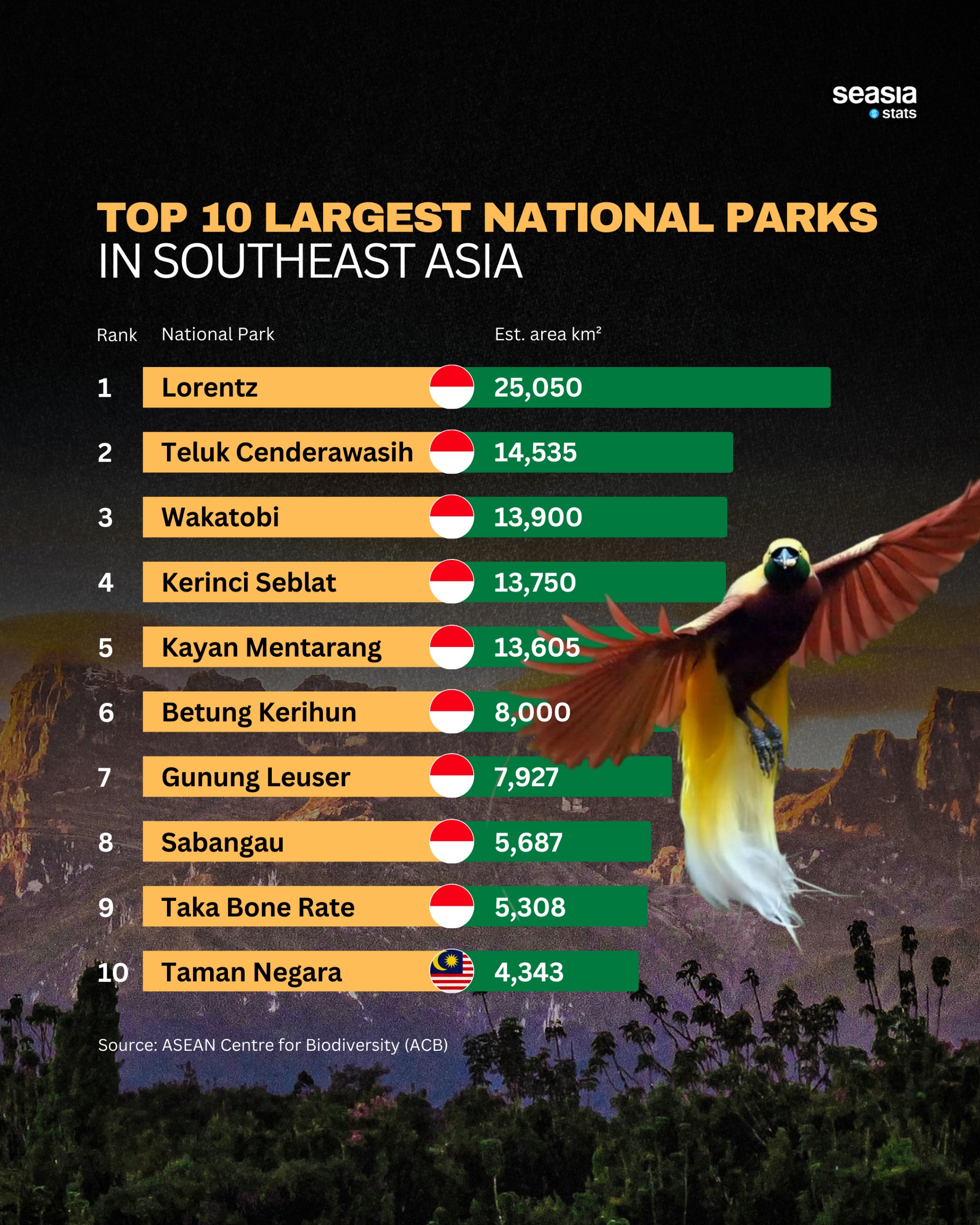
According to recent data from the ASEAN Centre for Biodiversity (ACB), Indonesia overwhelmingly dominates the list of Southeast Asia’s largest national parks, claiming nine out of the top ten positions. At the top sits Lorentz National Park in Papua, spanning a remarkable 25,050 square kilometers. This UNESCO World Heritage site is globally unique, featuring an unbroken ecological stretch from glacial peaks down to tropical marine waters—an extremely rare environmental gradient found nowhere else on Earth.
Following Lorentz are Teluk Cenderawasih and Wakatobi, two massive marine parks covering 14,535 km² and 13,900 km² respectively. These waters are part of the Coral Triangle, widely considered the global epicenter of marine biodiversity. Their reefs host thousands of fish species and vibrant coral formations that support both marine ecosystems and coastal livelihoods.
Forests, Wildlife, and Conservation Strongholds
Beyond marine environments, Indonesia’s terrestrial parks are equally significant. Kerinci Seblat National Park (13,750 km²) stretches across Sumatra and protects endangered species such as the Sumatran tiger and rhinoceros. Meanwhile, Kayan Mentarang National Park in North Kalimantan (13,605 km²) forms one of Borneo’s last intact forest ecosystems, playing a critical role in carbon storage and indigenous community livelihoods.
Further down the ranking, Betung Kerihun and Gunung Leuser stand out as biodiversity hotspots. Gunung Leuser, in particular, is one of the last places on Earth where orangutans, elephants, rhinos, and tigers coexist in the wild. Sabangau National Park protects vast peat swamp forests that are essential carbon sinks, while Taka Bone Rate National Park—home to Southeast Asia’s largest atoll—represents one of the most unique marine ecosystems in the region.
Malaysia’s Timeless Rainforest Legacy
While Indonesia dominates the list, Malaysia’s Taman Negara secures the tenth spot with an estimated area of 4,343 km². Despite being smaller in size, it carries global significance as one of the oldest rainforests in the world, estimated to be over 130 million years old. Its ancient jungle ecosystems are home to rare flora and fauna and remain a cornerstone of Malaysia’s eco-tourism industry.
Southeast Asia’s Broader Conservation Landscape
Beyond the top ten, Southeast Asia offers numerous other protected areas that contribute to regional biodiversity. Thailand’s Kaeng Krachan National Park, Vietnam’s Phong Nha–Ke Bang, and the Philippines’ Tubbataha Reefs Natural Park all serve as important conservation sites. Cambodia’s Cardamom Mountains and Laos’ Nam Et-Phou Louey also highlight the region’s growing commitment to environmental protection.
Together, these parks reflect Southeast Asia’s role as one of the world’s most important biodiversity corridors. As climate change and development pressures intensify, the protection of these landscapes becomes ever more critical—not only for wildlife, but for the millions of people who depend on these ecosystems for water, food, and economic opportunity.
In safeguarding these natural wonders, Southeast Asia is preserving not just its environment, but its future.


