

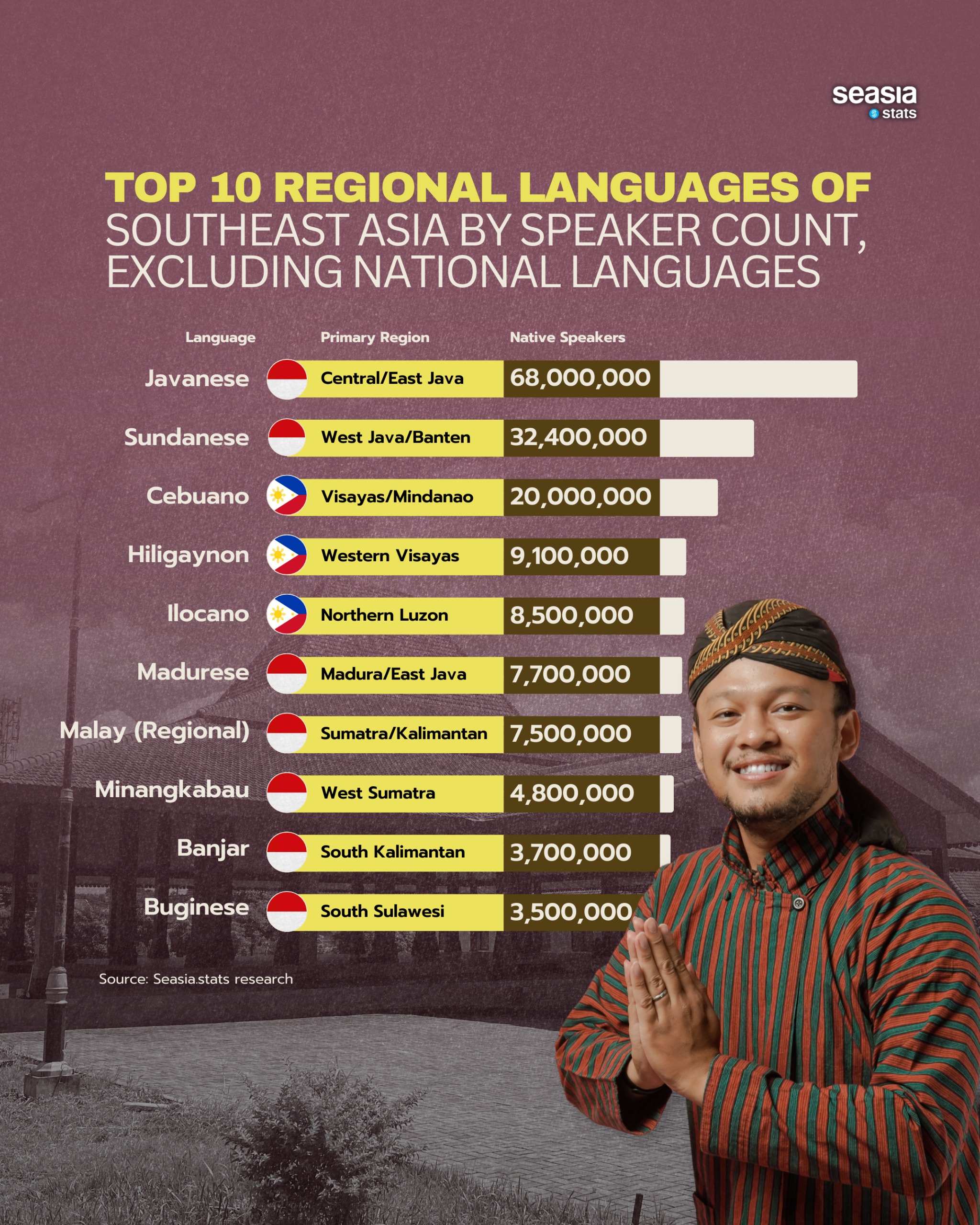
Southeast Asia is one of the world’s richest linguistic mosaics—a region where identity, history, and culture are deeply embedded in language. Beyond official national languages, hundreds of regional tongues continue to thrive, shaping daily life and preserving heritage. According to Seasia Stats research in 2026, the region’s top ten regional languages alone serve more than 160 million native speakers, underscoring their continued vitality in an increasingly globalized world.
Indonesia’s Linguistic Powerhouse
Indonesia dominates the rankings, accounting for seven of Southeast Asia’s ten most widely spoken regional languages. At the top is Javanese, spoken by around 68 million people in Central and East Java. This makes it not only Indonesia’s largest regional language but also the most widely spoken local language in the entire region. Closely following is Sundanese, used by more than 32 million people in West Java and Banten.
Other major Indonesian languages further demonstrate the archipelago’s extraordinary diversity. Madurese is spoken by 7.7 million people in East Java, while regional Malay varieties in Sumatra and Kalimantan serve 7.5 million speakers. Languages such as Minangkabau (4.8 million), Banjar (3.7 million), and Buginese (3.5 million) highlight the breadth of Indonesia’s linguistic map. Each of these languages functions not only as a communication tool but also as a marker of local identity and cultural continuity.
The Philippines’ Strong Regional Voices
The Philippines stands as the second major contributor to the region’s linguistic diversity. Cebuano ranks third overall, with approximately 20 million speakers across the Visayas and Mindanao. It remains a primary language for commerce, education, and media in many regions.
Two other Philippine languages—Hiligaynon and Ilocano—also make the top ten, with 9.1 million and 8.5 million speakers respectively. Both languages are deeply embedded in regional life, used in schools, local television, and community storytelling traditions. The continued strength of these languages reflects a broader national effort to preserve linguistic diversity alongside Filipino and English.
Regional Identity Beyond National Languages
Across Southeast Asia, regional languages serve as powerful anchors of cultural identity. In Indonesia, local governments actively support language preservation through local broadcasting and school curricula. In the Philippines, multilingual education policies promote the use of mother tongues in early childhood education.
Elsewhere in the region, countries like Malaysia and Thailand also maintain significant local dialects and minority languages such as Kelantanese Malay, Pattani Malay, and various hill-tribe languages. In Vietnam, ethnic minority languages such as Hmong and Khmer continue to be spoken in rural communities, while Myanmar and Laos also host dozens of indigenous linguistic groups.
A Living Cultural Heritage
What makes Southeast Asia unique is not just the number of languages spoken, but the way they coexist with national and global languages. In many communities, people seamlessly shift between a local language, a national lingua franca, and English or Mandarin depending on context.
These regional languages remain the heartbeat of local identity—preserving folklore, oral histories, and social traditions that might otherwise be lost. As Southeast Asia continues to modernize, the survival and celebration of these languages will play a key role in maintaining the region’s rich cultural fabric.
In a rapidly globalizing world, Southeast Asia’s regional languages stand as a testament to diversity, resilience, and the enduring power of cultural voice.


