

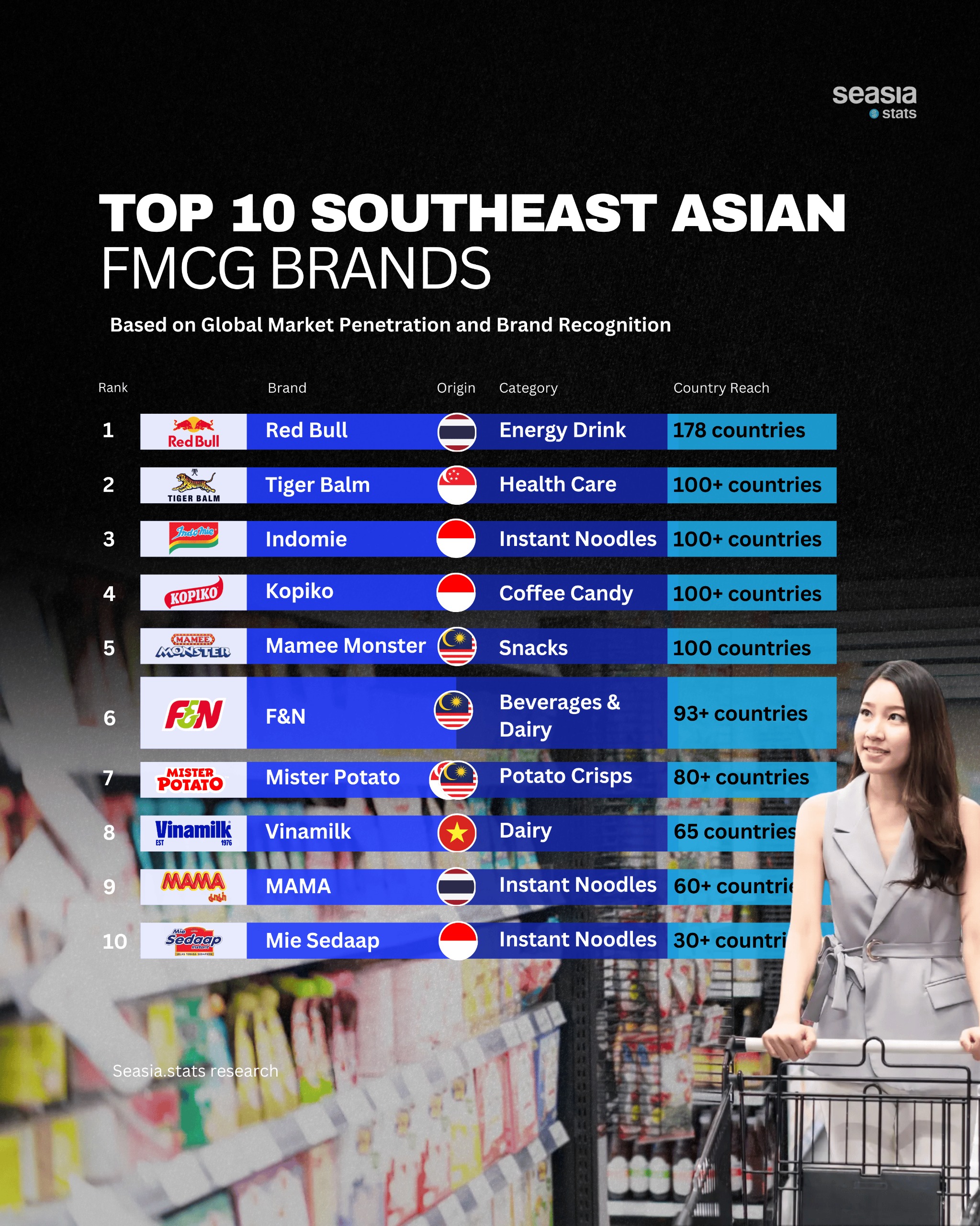
What begins as a snack aisle or pharmacy shelf in Southeast Asia increasingly ends up as a global success story. From instant noodles and potato chips to pain-relief balms and energy drinks, the region’s FMCG brands are no longer just local household names—they are international consumer giants. Their rise says something bigger about Southeast Asia itself: its products are becoming part of everyday life far beyond the region.
From Local Favorites to Global Shelf Space
According to Seasia Stats’ 2026 ranking, Red Bull, with roots in Thailand’s Krating Daeng, leads the list with reach in 178 countries. It is perhaps the clearest example of a Southeast Asian-origin product evolving into a truly global consumer empire. What began as a functional energy tonic in Thailand eventually became one of the world’s most recognizable beverage brands, showing how a regional product can be repackaged, reimagined, and scaled internationally.
In second place is Tiger Balm, a brand deeply associated with Singapore and Southeast Asia’s long tradition of over-the-counter herbal remedies. Sold in more than 100 countries, it is one of the rare Asian health-care products that has crossed generations and geographies with little loss of identity. As Forbes once noted in discussing Asian consumer brands, “trust travels farther than trend.” That may explain why Tiger Balm remains such a resilient global name: it is practical, familiar, and deeply rooted in everyday use.
Indonesia’s Everyday Empire
One of the strongest stories in this ranking belongs to Indonesia, which contributes several of the most globally visible brands on the list. Indomie, ranked third, has become more than an instant noodle—it is a cultural phenomenon. Found in supermarkets from Nigeria to the Middle East to Australia, Indomie has built a level of international emotional loyalty that many much larger global brands would envy.
Its success is not accidental. Indonesia’s huge domestic market gave brands like Indomie the scale to refine supply chains, pricing, and taste adaptation before going abroad. The same is true for Kopiko, ranked fourth, which turned a simple coffee candy into a highly exportable, affordable, and memorable product. In many countries, Kopiko became a gateway to Indonesian branding before consumers ever knew where it came from.
Indonesia’s Mie Sedaap, also on the list, further reinforces how the country has quietly become one of Southeast Asia’s strongest FMCG exporters. This matters because it shows that Southeast Asia’s global brand power is not only being driven by luxury tourism or digital startups, but also by highly affordable, mass-market goods consumed every day.
Malaysia, Vietnam, and Thailand Hold Their Ground
Malaysia stands out for the depth of its FMCG ecosystem. Mamee Monster, F&N, and Mister Potato all appear in the top ten, representing snacks, beverages, dairy, and packaged foods. This is significant because it shows Malaysia is not dependent on a single flagship export brand—it has built a broader consumer goods base.
Vietnam, meanwhile, appears through Vinamilk, which reflects the country’s increasingly sophisticated dairy and nutrition industry. Its reach across dozens of countries signals how Vietnamese manufacturing and food branding are becoming more competitive internationally.
And then there is Thailand, which may have one of the most quietly influential FMCG footprints in the region. Beyond Red Bull, MAMA instant noodles remains a familiar brand across Asian diaspora communities and neighboring markets. Thailand’s strength lies in product familiarity: many of its brands feel accessible, affordable, and culturally adaptable.
Southeast Asia’s Soft Power, One Product at a Time
This list is really about more than brand rankings. It is about soft power through consumption. Long before people visit Bangkok, Jakarta, Kuala Lumpur, or Ho Chi Minh City, they may already know these places through a can, sachet, balm jar, or noodle packet.
That is what makes Southeast Asia’s FMCG rise so powerful. These are not elite exports. They are ordinary products that entered ordinary lives—and stayed there.
And in global consumer culture, that may be the most durable influence of all.


