

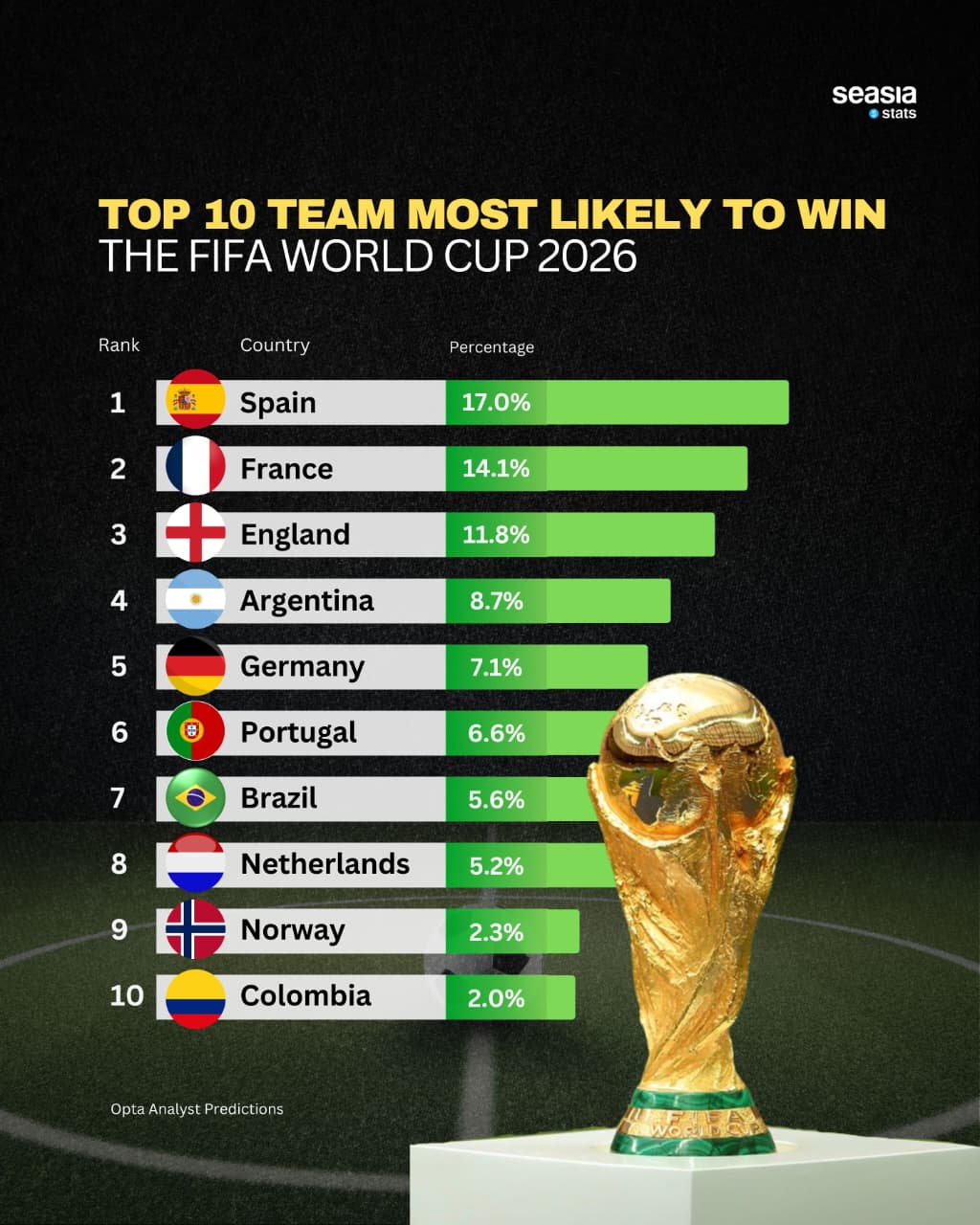
Every four years, the FIFA World Cup becomes more than a tournament—it turns into a global conversation about belief, probability, and possibility. The latest Opta Analyst projections for 2026, highlighted by Seasia Stats, offer a data-driven glimpse into who might lift football’s most coveted trophy. But as history often reminds us, football has a habit of ignoring predictions.
Europe leads the numbers game
Spain sits at the top of the projections with a 17.0% chance of winning the 2026 World Cup, followed by France at 14.1% and England at 11.8%. These are the only teams given double-digit probabilities, underlining a clear statistical gap between the frontrunners and the rest of the field.
Spain’s position reflects a new generation of technically gifted players combined with a system that has regained its fluid identity. France, meanwhile, continues to benefit from extraordinary squad depth, blending youth and experience in a way few nations can match. England’s rise is perhaps the most symbolic of modern football analytics—years of rebuilding, data-driven development, and tactical consistency finally translating into sustained tournament expectations.
Opta Analyst itself describes these projections as simulations based on team strength, recent form, and statistical modeling, emphasizing that “thousands of tournament simulations” are used to estimate probabilities. It is a reminder that these rankings are not opinions, but calculated forecasts.
The chasing pack with pedigree
Just behind the top three sits Argentina at 8.7%, still riding the momentum of its recent World Cup triumph. Germany and Portugal follow, both nations with long-standing tournament pedigree and the ability to peak at the right moment. Brazil, surprisingly lower at 5.6%, remains one of the most emotionally backed teams despite its statistical position.
The Netherlands, Norway, and Colombia complete the top ten, representing a mix of emerging momentum and traditional strength. Norway’s presence, in particular, reflects the growing impact of individual superstars translating into collective belief.
Yet, as football history repeatedly shows, rankings rarely tell the full story. Tournament football thrives on intangibles—confidence, momentum, and moments of brilliance that no algorithm can fully capture.
Southeast Asia: passion without presence
For Southeast Asia, the World Cup conversation is very different. None of the region’s national teams appear in the top projections, reflecting the current gap between ASEAN football and the global elite. But absence from the rankings does not mean absence from the story.
Few regions in the world match Southeast Asia’s passion for football. From Jakarta to Bangkok, Manila to Ho Chi Minh City, football is not just a sport—it is a cultural force. Stadiums fill, streets pause for major matches, and European clubs enjoy massive followings across the region.
Indonesia, Vietnam, and Thailand have all made significant strides in recent years, investing in youth development, coaching, and domestic leagues. Vietnam’s rise in regional competitions and Indonesia’s growing football infrastructure signal a long-term ambition to close the gap.
As FIFA continues to expand the World Cup format, opportunities for Asian teams—including Southeast Asian nations—are increasing. The 2026 edition, featuring more teams than ever, could gradually open doors that once seemed unreachable.
Beyond probabilities, the magic remains
Predictions like these shape narratives, but they do not define outcomes. The beauty of the World Cup lies in its unpredictability. Favorites fall, underdogs rise, and history is often rewritten in a matter of minutes.
For fans in Southeast Asia, the tournament will once again be a shared experience—late-night matches, crowded cafés, and collective emotions tied to teams thousands of kilometers away. But beneath that passion is a quiet hope: that one day, the region will not just watch the World Cup, but truly compete in it.
Because while data may point to Spain, France, or England, football has always reserved space for surprise. And that, more than any percentage, is what keeps the world watching.


