

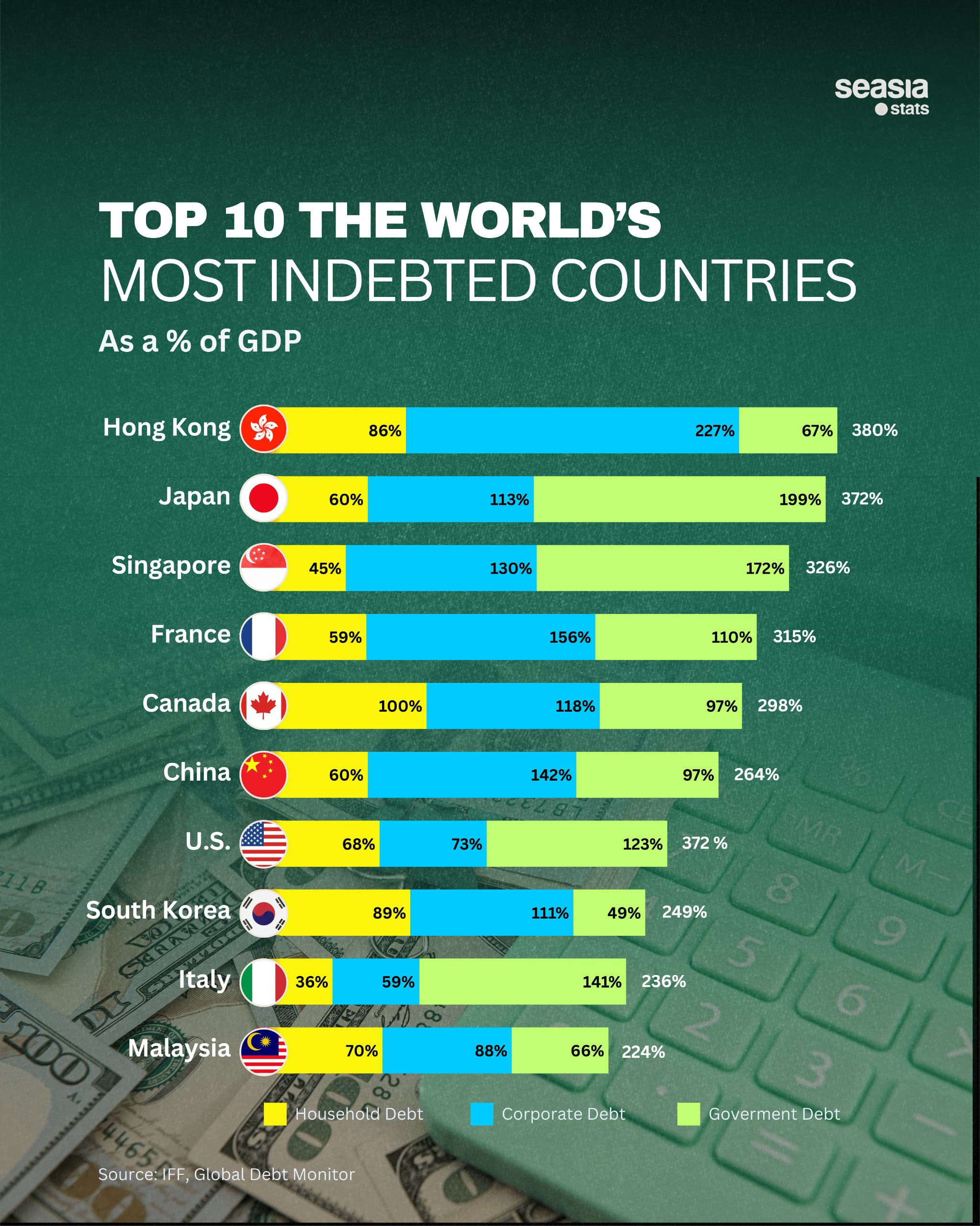
Debt has become a defining feature of the modern global economy. Governments borrow to finance infrastructure and social programs, corporations take loans to expand operations, and households rely on credit for homes, education, and consumption. While borrowing can fuel economic growth, high debt levels relative to a country’s economic output can also raise concerns about financial stability. According to data compiled in the IIF Global Debt Monitor and presented by Seasia Stats, several economies stand out for having the highest total debt burdens when measured as a percentage of GDP.
Hong Kong Tops the Global Debt Ranking
At the top of the list is Hong Kong, which holds the distinction of being the world’s most indebted territory with a total debt-to-GDP ratio of 380%. Unlike many countries where public debt dominates the picture, Hong Kong’s debt profile is largely driven by the corporate sector, which alone accounts for 227% of GDP.
As one of the world’s leading financial centers, Hong Kong hosts a vast network of banks, investment firms, and multinational corporations. High corporate borrowing often reflects strong financial market activity rather than economic distress. Many companies based in Hong Kong operate internationally, using debt as a tool for global investment and expansion.
Japan and Singapore Follow Closely
In second place is Japan, with a total debt level of 372% of GDP. Japan’s debt structure is heavily concentrated in government borrowing, which accounts for 199% of GDP, the highest public debt ratio among the countries listed.
Japan’s large government debt is often linked to decades of economic stimulus programs aimed at supporting growth and managing demographic challenges such as an aging population.
Third place goes to Singapore, with a total debt ratio of 326% of GDP. Much like Hong Kong, Singapore’s debt profile reflects its role as a global financial hub. A large portion of its debt comes from government securities, which are often issued to support financial market development and national investment funds rather than to finance budget deficits.
Western Economies and China in the Middle Tier
The middle of the ranking includes several major Western economies. France occupies fourth place with 315% of GDP, where debt is spread across government, corporate, and household sectors.
Canada follows with 298%, notable for its high household debt, which equals roughly 100% of GDP. This reflects the country’s strong housing market and widespread use of mortgage financing.
The United States also appears on the list, with a total debt ratio of 272% of GDP. Government borrowing makes up a significant portion of that figure, accounting for 123% of GDP, as federal spending has increased over the past decade.
Meanwhile, China ranks just behind the U.S. with 264% of GDP, largely driven by corporate debt at 142% of GDP. China’s rapid industrial expansion and infrastructure development have contributed to high borrowing levels among state-owned enterprises and private companies.
Asian and European Economies Round Out the List
The final three spots in the top ten are occupied by South Korea, Italy, and Malaysia.
South Korea ranks eighth with a total debt ratio of 249%, with particularly high household debt at 89% of GDP, reflecting the country’s competitive housing market and consumer credit usage.
Italy follows in ninth place with 236% of GDP, with government debt accounting for the majority of the burden. Italy’s public debt has long been a key topic in European economic policy discussions.
Completing the list is Malaysia, which ranks tenth with 224% of GDP. Among Southeast Asian nations, Malaysia stands out for its relatively high household debt level of 70% of GDP, driven largely by housing loans and consumer credit.
Southeast Asia’s Debt Landscape
Beyond Malaysia and Singapore, other Southeast Asian economies generally maintain more moderate debt levels relative to GDP. Countries such as Indonesia, Vietnam, Thailand, and the Philippines have traditionally taken a more cautious approach to public borrowing.
However, as the region continues to develop infrastructure, expand digital economies, and invest in social programs, debt levels may gradually rise. Balancing growth and fiscal sustainability will remain a key challenge for policymakers across Southeast Asia.
Ultimately, while high debt levels can pose risks, they also reflect the complexity of modern economies where borrowing, investment, and financial markets play an increasingly interconnected role in global development.


