

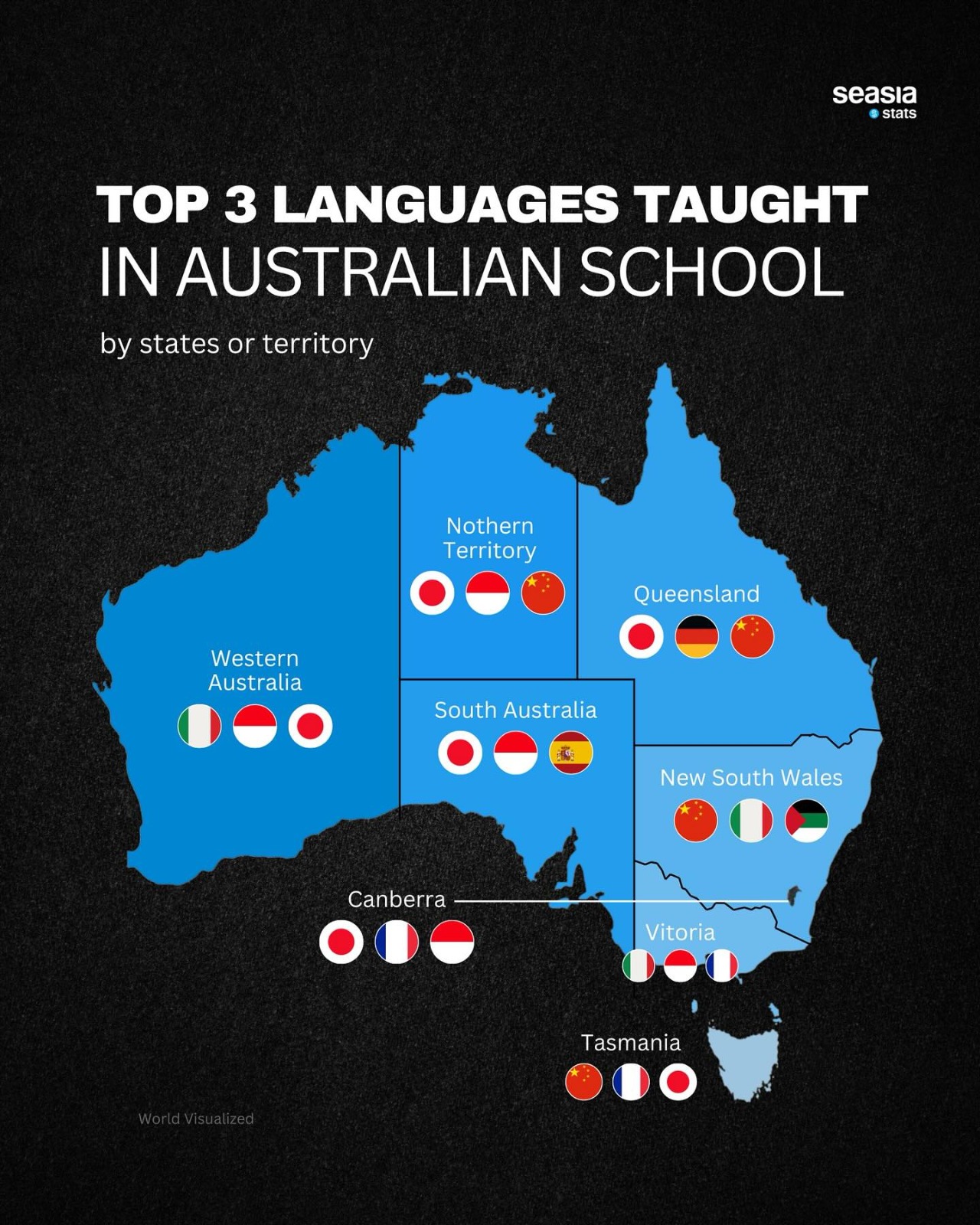
Language classrooms across Australia are quietly mapping the country’s future place in the Indo-Pacific. From Darwin to Hobart, the languages children learn in school reveal who Australia trades with, where its migrants come from, and which cultures shape its daily life. According to recent 2026 data compiled by Seasia Stats, three Asian languages—Japanese, Indonesian, and Mandarin Chinese—dominate the national curriculum, reflecting both geography and global ambition.
A Classroom Window to the Indo-Pacific
Australia’s education system has steadily shifted toward Asia-facing engagement over the past two decades. The prominence of Japanese, Indonesian, and Mandarin is not accidental. Each language corresponds to a key relationship: Japan as a long-standing strategic and cultural partner, Indonesia as Australia’s closest Southeast Asian neighbor, and China as one of its largest trading partners.
Japanese stands out as the most consistently taught language across states and territories. It appears in the top three in almost every region, underlining decades of exchange programs, tourism links, and economic cooperation. Indonesian, meanwhile, plays a strategic role in strengthening ties with Southeast Asia—particularly with Jakarta, Bali, and other Indonesian hubs that shape regional diplomacy and tourism. Mandarin Chinese reflects both economic interdependence and Australia’s large Chinese-Australian community.
Regional Patterns and Local Priorities
A closer look at each state and territory reveals how geography and demographics shape language choices.
In Northern Territory and Western Australia, Indonesian and Japanese are especially prominent. Their proximity to Southeast Asia and reliance on trade routes through Indonesia make these languages practical tools for business and diplomacy.
Queensland and New South Wales place Mandarin high on their lists, mirroring strong economic links with China and large Chinese-speaking populations in cities like Brisbane and Sydney. These states also include European languages such as German and Italian, reflecting migration patterns and long-standing cultural ties.
Victoria and South Australia show a balanced mix of European and Asian influences. Italian and French remain popular, especially in Melbourne and Adelaide where European heritage communities remain strong. Yet Indonesian and Japanese continue to grow as students prepare for careers in Asia-Pacific industries.
Tasmania and the Australian Capital Territory maintain similarly diverse offerings, combining Mandarin, Japanese, and French. Even smaller jurisdictions recognize the importance of multilingual skills in a globalized workforce.
The Southeast Asian Connection
Indonesia’s strong presence in Australian classrooms is particularly significant. As the largest country in Southeast Asia and a key ASEAN member, Indonesia represents a crucial partner in trade, tourism, and regional security. The Philippines and Vietnam—two fast-growing ASEAN economies—are also increasingly visible in community language programs and informal learning spaces, even if they are not yet among the top three formal subjects.
Beyond Indonesia, the broader Southeast Asian region is becoming more relevant in Australian education. Economic partnerships with Singapore, Malaysia, and Thailand—alongside rising student exchanges and business links—are encouraging schools to broaden cultural awareness programs. Language education is no longer just about grammar; it is about preparing students for a region that will define Australia’s economic future.
A Blended Global Curriculum
Despite the rise of Asian languages, European languages still play an important role. Italian remains strong in Victoria and Western Australia due to historic migration patterns. French is widely taught as a global diplomatic language, while German holds a unique position in Queensland’s curriculum. Arabic’s presence in New South Wales reflects the influence of Middle Eastern communities and Australia’s broader multicultural identity.
This blend of Asian and European languages highlights a key reality: Australia’s identity is both Indo-Pacific and global. Schools are not replacing one region with another—they are building a multilingual, multicultural skill set for the next generation.
Preparing Students for a Regional Future
The evolution of language education in Australia signals a broader shift in national priorities. As ASEAN economies continue to grow and regional cooperation deepens, the ability to communicate across cultures becomes a strategic advantage. Whether in business, diplomacy, tourism, or technology, multilingual Australians are better positioned to thrive in a rapidly changing world.
In classrooms today, the choice between Japanese, Indonesian, or Mandarin may seem like a simple academic decision. In reality, it is part of a much larger story—one that connects young Australians to Southeast Asia, to global networks, and to the future of the Indo-Pacific.


