

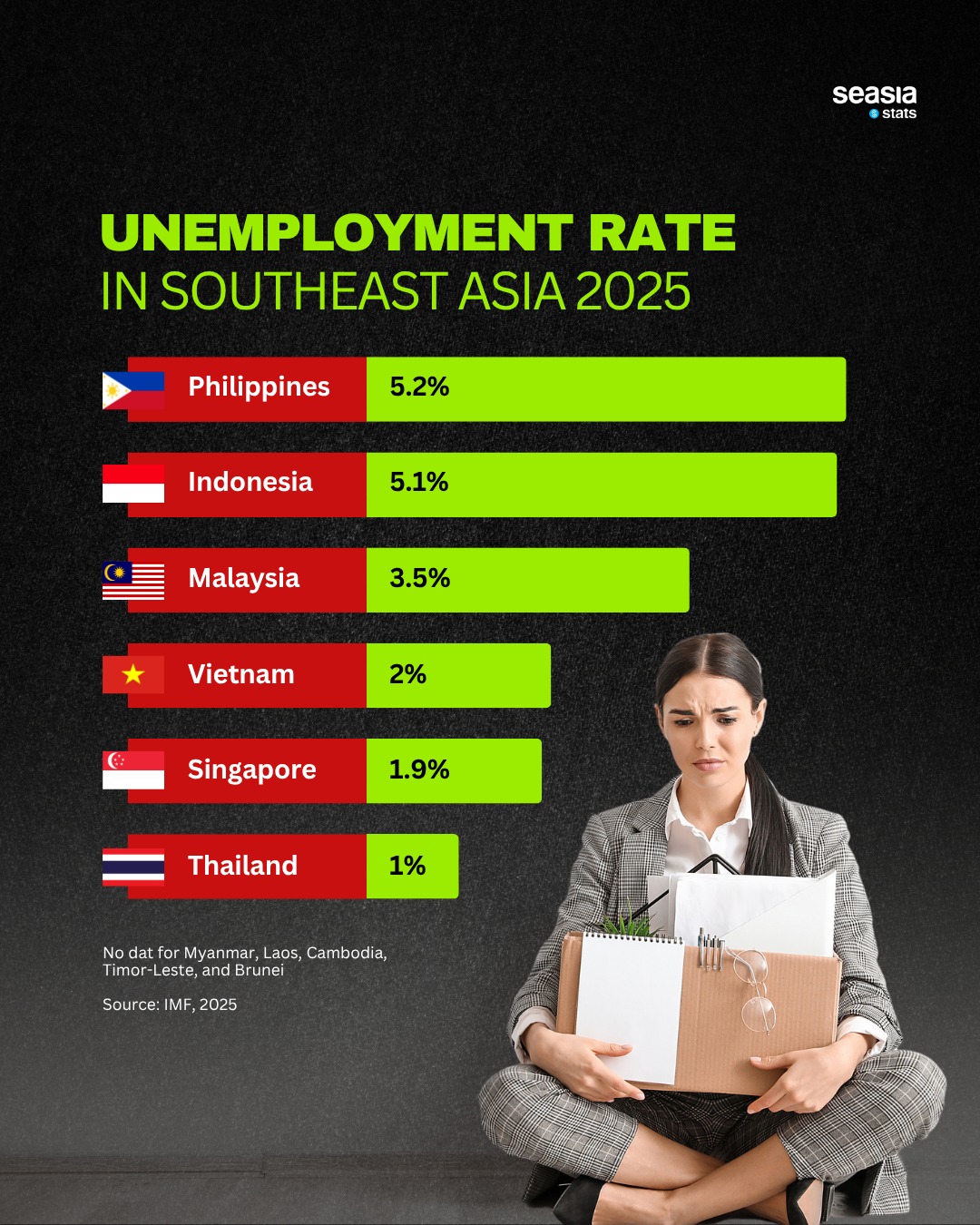
The labor market across Southeast Asia paints a mixed picture in 2025, as recent data from the International Monetary Fund (IMF) reveals varying unemployment rates among member countries. While some economies boast near full employment, others continue to grapple with persistent job market challenges — especially in the wake of global economic shifts and post-pandemic transitions.
Philippines and Indonesia Face Higher Jobless Rates
At the top of the unemployment list, the Philippines reports a 5.2% unemployment rate, the highest in the region. Indonesia follows closely at 5.1%, indicating that both countries — Southeast Asia’s most populous — are still navigating structural job market issues, such as underemployment, youth job gaps, and skills mismatches.
Despite notable economic growth in both nations, the figures suggest that the benefits are not yet fully translating into equitable job creation.
Thailand, Singapore, and Viet Nam Show Strong Labor Resilience
On the other end of the spectrum, Thailand leads with the lowest unemployment rate at just 1%. Singapore follows at 1.9%, reflecting the city-state’s robust service economy and high workforce participation. Viet Nam posts 2%, continuing its reputation for industrial growth and a relatively agile labor market.
These countries demonstrate effective employment policies, export-driven stability, and investments in skills training that help absorb labor supply.
Malaysia Balances in the Middle
Malaysia’s unemployment rate stands at 3.5%, reflecting a moderate balance between labor supply and demand. While the country benefits from strong sectors like manufacturing, finance, and tech, challenges such as youth unemployment and wage stagnation remain part of the national conversation.
Data Gaps Leave Regional Blind Spots
The IMF data does not include Myanmar, Laos, Cambodia, Timor-Leste, or Brunei, leaving a partial view of the broader ASEAN labor landscape. These omissions underscore the importance of regional transparency and stronger labor data systems — crucial for coordinated policy-making across the bloc.
A Call for Inclusive Job Strategies
The varying rates underscore one key point: Southeast Asia’s employment recovery is uneven. For countries facing higher unemployment, targeted strategies in education, upskilling, digital sectors, and green jobs will be essential to future resilience. Meanwhile, those with low jobless rates must sustain momentum through innovation and labor protections.
As Southeast Asia adapts to economic shifts, inclusive and forward-looking employment policies will determine not just GDP growth — but livelihoods.


