

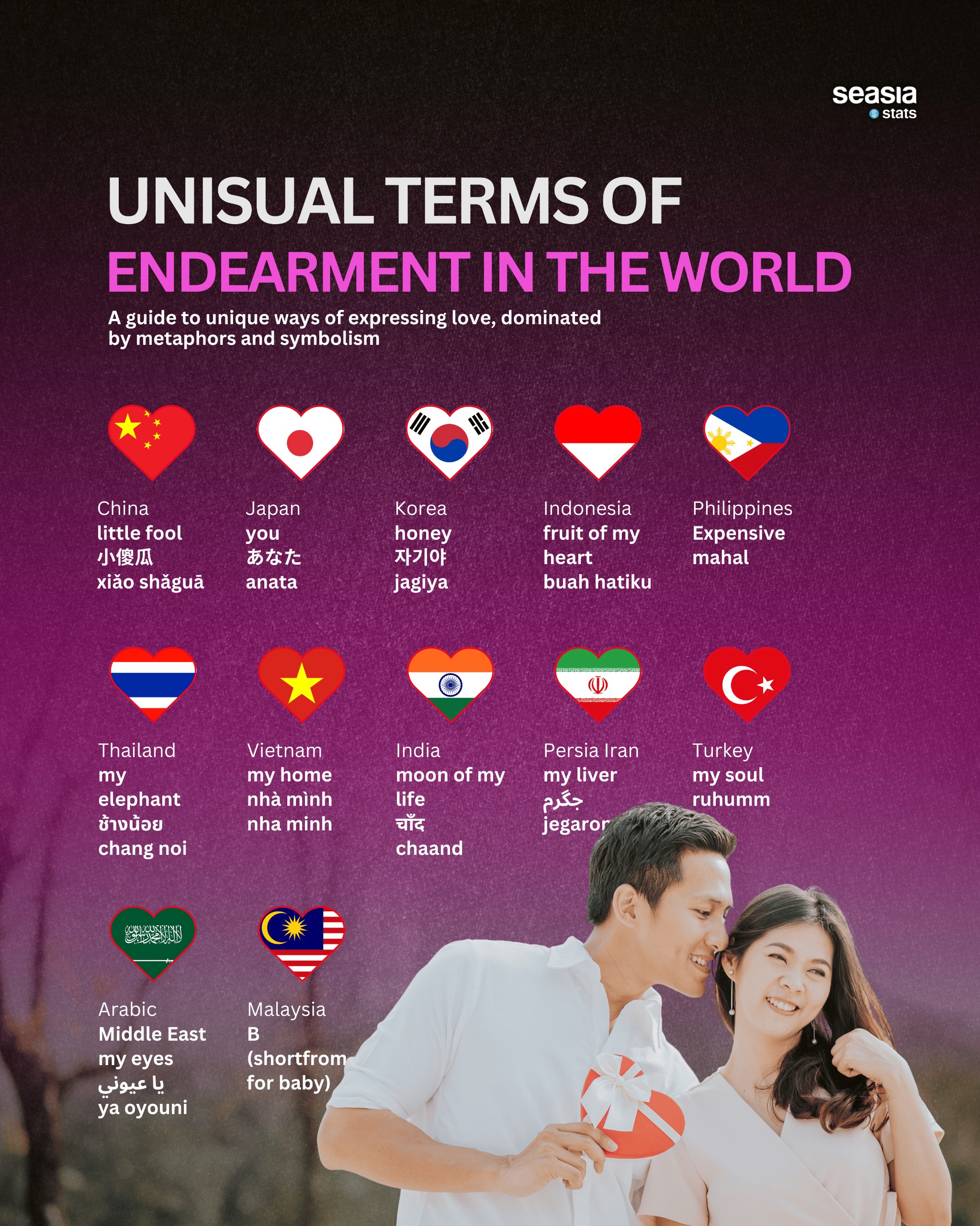
Love, it turns out, is rarely said the same way twice. Around the world, people do not just call each other “darling” or “baby”; they reach for fruits, moons, organs, homes, and even playful insults. The Seasia Stats infographic offers a charming reminder that affection is deeply cultural—and often far more poetic than literal translation allows.
When Love Becomes Metaphor
One of the most fascinating things about endearments is how often they rely on metaphor. In Indonesia, for instance, “buah hatiku”—literally “fruit of my heart”—has long been used to describe someone deeply cherished, especially a child or loved one. It is soft, intimate, and unmistakably tender.
In Iran, the Persian expression “jegar” or “jegar talâ” carries a strikingly visceral meaning: “my liver.” To English speakers, that may sound unusual, but in Persian cultural and literary tradition, the liver has historically been associated with deep feeling and life force. Similarly, in the Arabic-speaking Middle East, “ya ‘oyouni” or “my eyes” suggests that the beloved is as precious as one’s sight.
These phrases may sound surprising when translated word for word, but that is precisely what makes them beautiful. Love, in many languages, is not meant to be efficient. It is meant to be felt.
Southeast Asia’s Language of Tenderness
Southeast Asia offers some of the most evocative expressions on the list. In the Philippines, the word “mahal” is especially rich because it can mean both “love” and “expensive” or “precious.” In everyday Filipino, that overlap feels natural: what is loved is also valued.
In Vietnam, “nhà mình”—literally “my home” or “our home”—carries a warmth that goes beyond romance. It suggests belonging, comfort, and emotional shelter. It is the kind of phrase that reveals how affection in many Asian cultures is often tied not only to passion, but to safety and togetherness.
Then there is Thailand, where “chang noi” or “my little elephant” reflects the country’s symbolic relationship with elephants, animals long associated with grace, loyalty, and reverence. In Malaysia, the modern shorthand “B”—a clipped form of “baby”—shows how global pop culture and local intimacy now blend seamlessly in everyday speech.
These expressions reveal something larger about Southeast Asia: love is often spoken through closeness, domesticity, and symbolism rather than overt dramatic declaration.
Playful, Practical, and Deeply Personal
Not all endearments are overtly poetic. Some are teasing, casual, or context-specific. In China, “xiǎo shǎguā” or “little fool” is a good example of affectionate mockery—the kind of phrase that sounds insulting on paper but sweet in real life. It belongs to a broader East Asian tradition where warmth is often expressed through playful scolding rather than direct sentimentality.
In Japan, “anata”, meaning simply “you,” can become affectionate in intimate contexts, particularly between married couples. Its emotional force comes not from the dictionary definition, but from tone and relationship. In South Korea, “jagiya” remains one of the most recognizable romantic nicknames, commonly translated as “honey” or “darling.”
These examples are a reminder that language does not work only through vocabulary. It works through intimacy, history, and shared understanding.
What These Words Reveal About Culture
Terms of endearment are small windows into how societies imagine closeness. In some cultures, love is framed through the body. In others, through the home, nature, or humor. In many Asian societies, affection is often embedded in metaphor because direct emotional expression can sometimes feel too blunt or exposed.
That is why these words matter. They are not just cute linguistic curiosities. They reveal how people value tenderness, how families and couples communicate, and how culture shapes emotion itself.
In the end, whether someone is your moon, your home, your eyes, or even your little fool, the message is the same: love rarely travels in straight lines. It arrives wrapped in metaphor, memory, and meaning—and often, that makes it far more memorable.


