

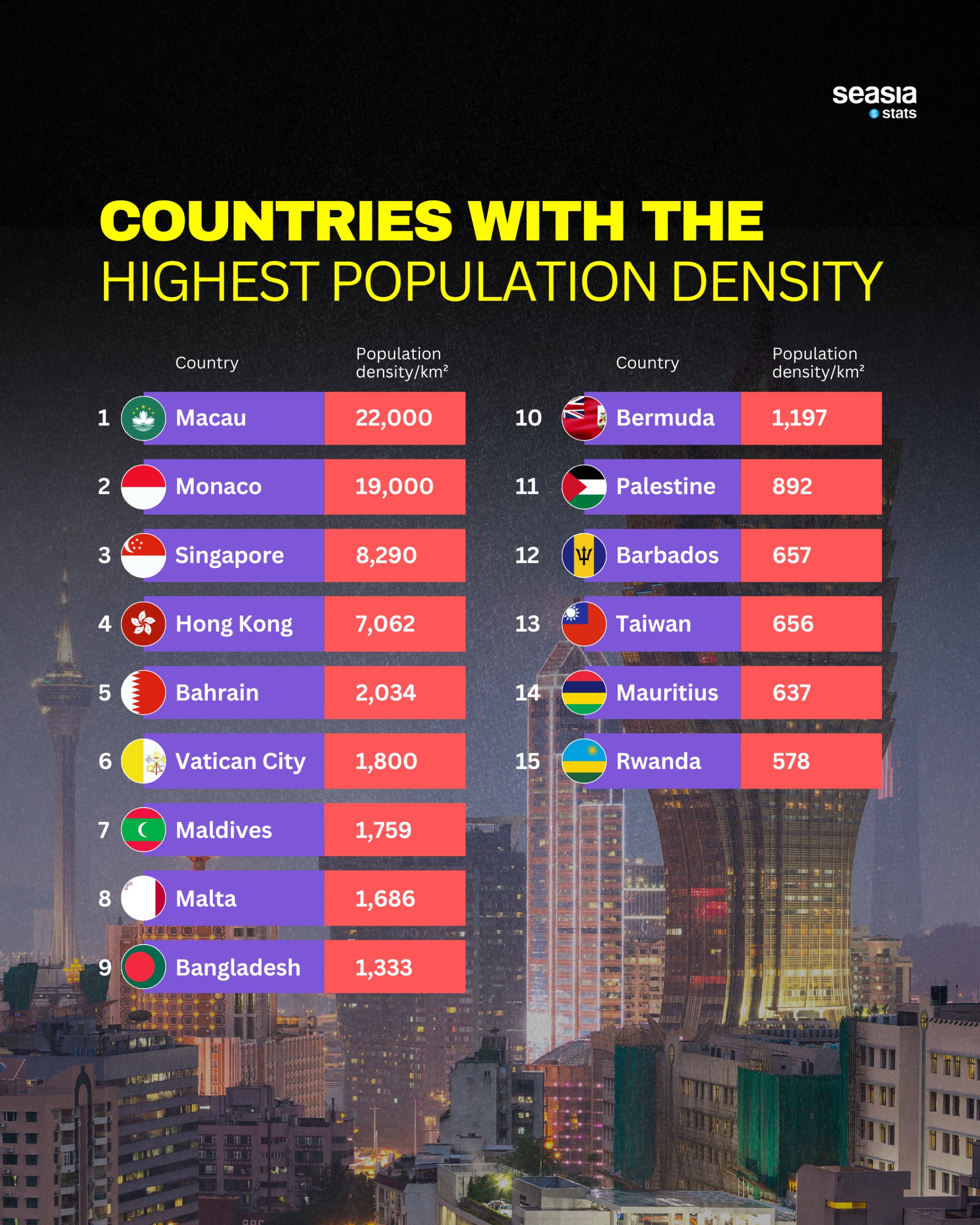
In an era of rapid urbanization, population density has become one of the defining challenges—and curiosities—of modern life. From vertical megacities to tightly packed island nations, some countries accommodate extraordinary numbers of people within remarkably small areas. Data compiled by Seasia Stats highlights where land is most scarce and human concentration is at its most intense.
Macau and Monaco: Density Taken to the Extreme
At the very top of the ranking is Macau, with an astonishing 22,000 people per square kilometer. As a global tourism and gaming hub with limited land reclaimed from the sea, Macau has embraced vertical living, stacking homes, hotels, and entertainment complexes skyward.
Close behind is Monaco at 19,000 people per square kilometer. The tiny Mediterranean principality is synonymous with luxury, but its glamour masks an extreme spatial constraint where nearly every square meter is meticulously planned.
Southeast Asia’s Urban Giants
Southeast Asia features prominently among the world’s most densely populated places, led by Singapore, which ranks third globally at 8,290 people per square kilometer. Despite this, Singapore is often cited as a model for high-density livability, balancing compact urban design with green spaces, efficient transport, and public housing.
Just behind Singapore is Hong Kong, with 7,062 people per square kilometer. Hemmed in by mountains and sea, Hong Kong’s skyline of high-rise apartments reflects decades of necessity-driven vertical development.
While not always perceived as dense in the same way, island nations in Southeast Asia also face space pressures. The Maldives, ranked seventh at 1,759 people per square kilometer, concentrates much of its population on a handful of low-lying islands, intensifying infrastructure and climate resilience challenges.
Small States, Big Numbers
Rounding out the top ten are Bahrain (2,034), Vatican City (1,800), Malta (1,686), and Bangladesh (1,333). Bangladesh stands out as the only large country on the list, where density is driven not by size constraints alone but by a massive population living on fertile but flood-prone land.
Bermuda completes the top ten at 1,197, reflecting how island geographies often amplify density even with relatively small populations.
The Rest of the Top Fifteen
Beyond the top ten, high density continues across diverse regions. Palestine ranks eleventh at 892, followed by Barbados(657), Taiwan (656), Mauritius (637), and Rwanda (578).
Living Dense, Living Smart
What unites these countries is not just limited land, but innovation. From Singapore’s urban planning to Bangladesh’s adaptive housing and Macau’s vertical expansion, high population density forces governments and communities to rethink how cities function. As global urban populations continue to rise, these places offer early lessons—both cautionary and inspiring—on how humanity adapts when space runs out.


