

Science literacy has become one of the clearest indicators of how well a country is preparing its young people for the future. In an era shaped by climate change, artificial intelligence, public health threats, and rapid technological disruption, the ability of teenagers to reason scientifically matters far beyond the classroom. That is why the latest international data has drawn attention once again to Asia—especially Singapore, which continues to set the global benchmark.
Singapore’s Youth Are Setting the Global Standard
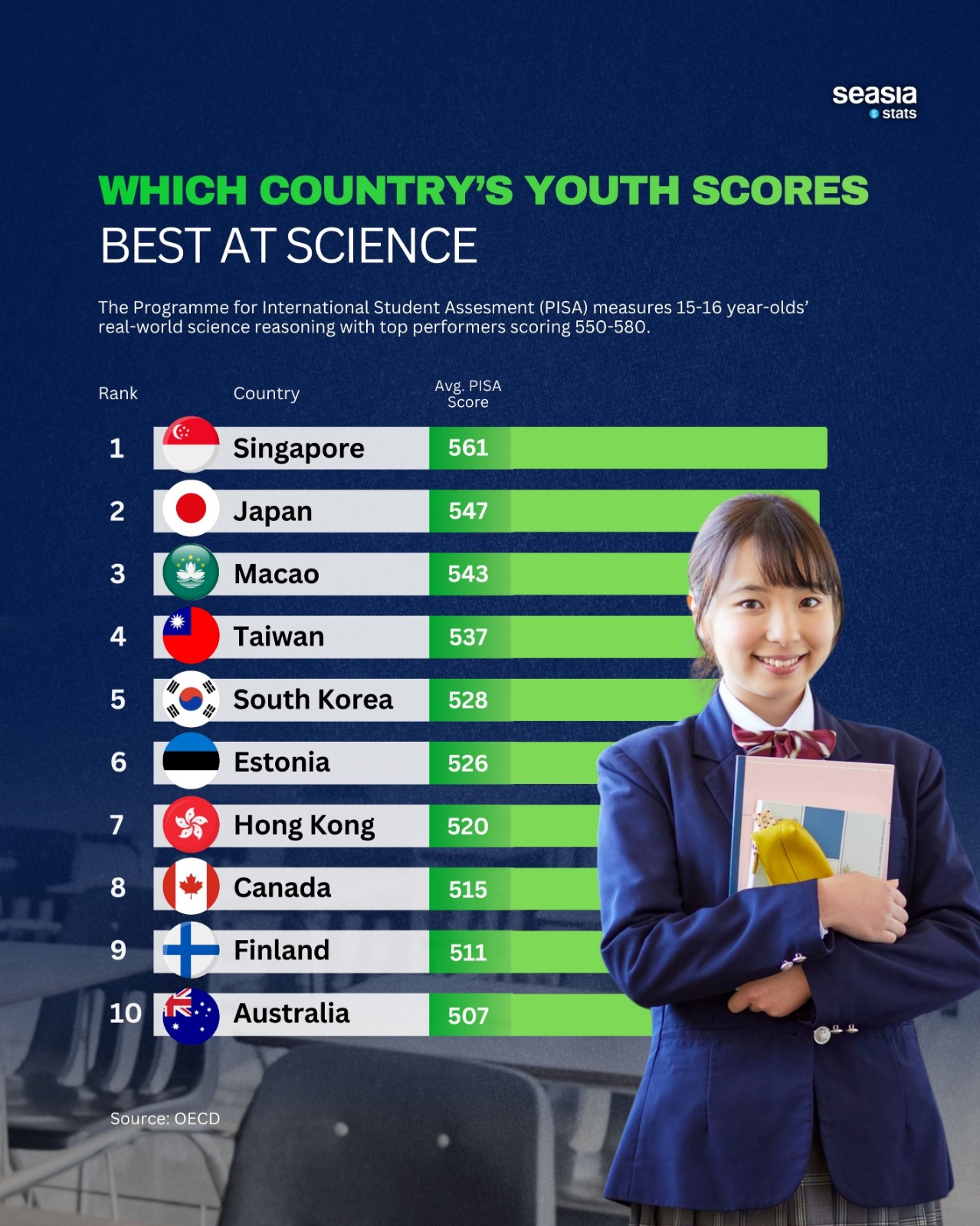
According to the latest OECD PISA 2022 science results, Singapore recorded the world’s highest average science score at 561, placing its 15-year-olds firmly at the top of global rankings. The OECD noted that Singapore “scored significantly higher than all other countries/economies in reading and science,” underlining just how far ahead its students remain in scientific reasoning and problem-solving.
That result is not just about memorizing formulas. PISA measures how well students can apply science to real-world situations—whether interpreting evidence, evaluating claims, or understanding cause and effect. In Singapore, 92% of students reached at least baseline proficiency in science, and 24% were top performers at Levels 5 or 6, far above the OECD average of 7%.
The success reflects a system that has long prioritized teacher quality, curriculum coherence, and a culture where academic discipline is taken seriously. It also shows how science education in Singapore is closely tied to national ambition: a small country investing heavily in talent because it has little margin for error.
East Asia’s Grip on the Science Leaderboard
Singapore’s lead is impressive, but it is also part of a larger regional pattern. The rest of the top five is dominated by Japan (547), Macao (543), Taiwan (537), and South Korea (528), reinforcing the strong reputation of East Asian education systems in mathematics and science. OECD analysis found that these systems consistently outperform the global average and produce large shares of high-achieving students.
This concentration is not accidental. Across much of East Asia, science is treated not as a niche subject but as a central pillar of national development. Classrooms tend to emphasize rigor, repetition, and analytical thinking, while families often place a high premium on educational achievement.
Outside Asia, the list becomes more geographically diverse. Estonia leads Europe in sixth place, followed by Hong Kong, Canada, Finland, and Australia. These countries show that strong science outcomes can emerge from different school cultures—as long as there is sustained investment in quality teaching and student support.
What This Means for Southeast Asia
For Southeast Asia, Singapore’s top ranking is both a point of pride and a mirror. It shows what is possible within the region, but it also highlights how uneven science education remains across ASEAN.
Countries such as Vietnam, Malaysia, Thailand, and Indonesia have all made efforts to strengthen STEM learning, but progress has been mixed. Vietnam, in particular, has often attracted attention in international education discussions for punching above its income level in earlier global assessments, while Malaysia and Thailand continue to pursue reforms aimed at digital learning, teacher development, and curriculum modernization.
Indonesia, however, still faces a steeper climb. OECD data shows Indonesian 15-year-olds scored 383 in science, well below the OECD average of 485. Yet the numbers also reveal a more complex story: despite structural disadvantages, some Indonesian students continue to perform with notable resilience.
That matters because science performance is not simply a test score issue—it reflects broader realities such as school quality, access to laboratories, teacher training, nutrition, internet access, and inequality between urban and rural communities.
Science Education Is Now a Strategic Issue
The bigger lesson from the rankings is that science education is no longer just an education story. It is an economic story, a technology story, and increasingly a geopolitical one. Countries that teach young people how to think scientifically are better positioned to innovate, adapt, and compete.
As OECD education chief Andreas Schleicher observed in the PISA analysis, the strongest-performing systems are those that equip students not just to recall knowledge, but to use it in unfamiliar situations. That is the real divide of the future: not simply who has more students in school, but who is producing young people capable of understanding and shaping a complex world.
For Southeast Asia, Singapore’s result is more than a headline. It is a reminder that excellence is possible in the region—but only if countries are willing to treat science education as a long-term national priority.


