

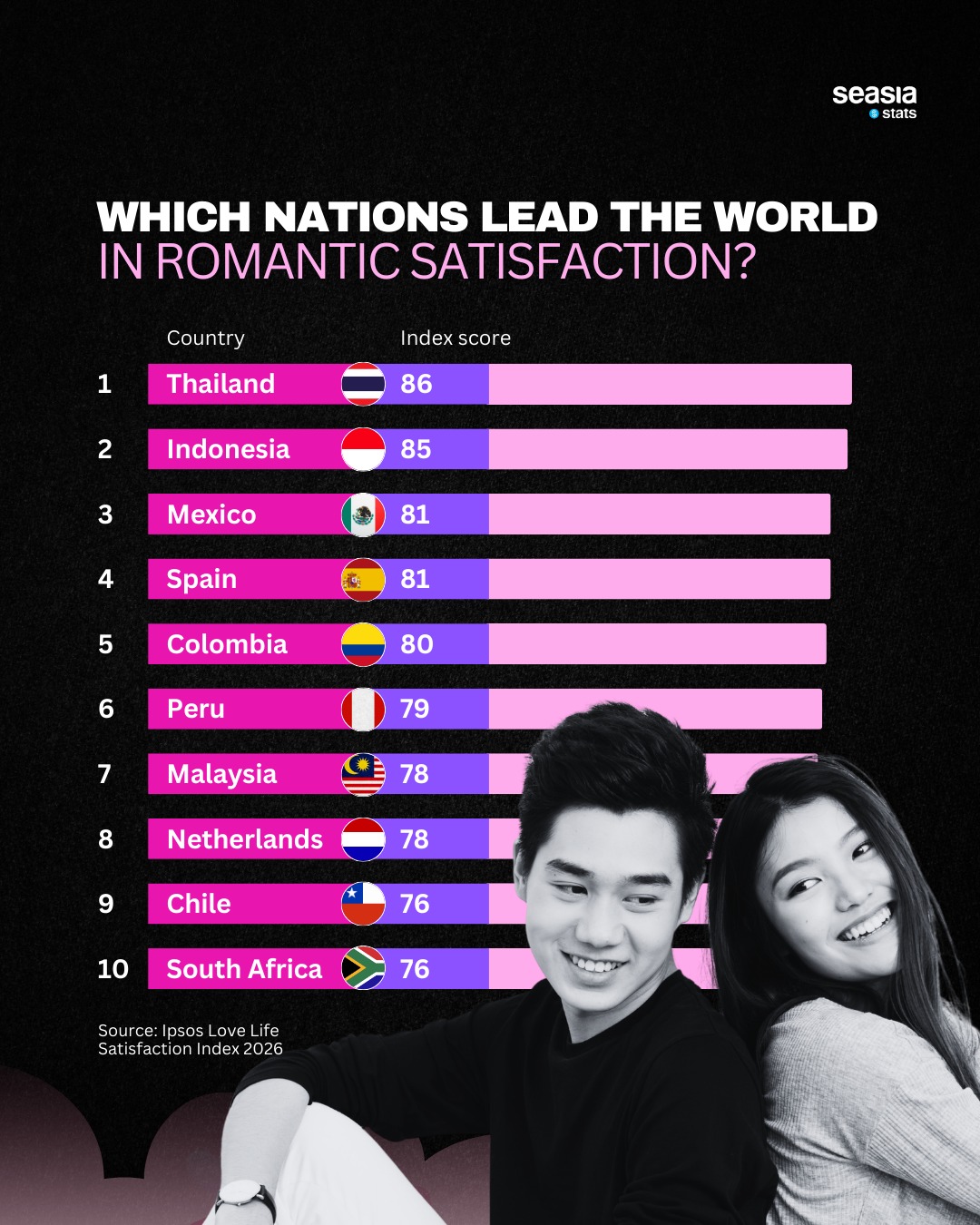
Across the globe, people define love and relationships in many different ways—but in 2026, one region stands out for how fulfilled people feel in their romantic lives. According to the Ipsos Love Life Satisfaction Index 2026, Southeast Asia leads the world in romantic satisfaction, with Thailand and Indonesia taking the top two spots globally. The results offer a fascinating glimpse into how culture, values, and modern lifestyles intersect to shape how people experience love today.
Thailand: The World’s Happiest Lovers
Thailand tops the global rankings with an impressive score of 86, making it the most romantically satisfied country in the world. The Ipsos index measures satisfaction across three key areas: feeling loved, romantic or sex life, and relationship with a partner or spouse. Thailand excels in all three—but particularly in partner satisfaction, where a remarkable 95% of partnered individuals say they are happy in their relationship.
This success reflects Thailand’s social culture, where warmth, openness, and emotional connection are deeply valued. Relationships are often supported by strong family ties and social networks, creating an environment where emotional well-being thrives alongside romantic connection.
Indonesia Close Behind
Just one point behind, Indonesia ranks second globally with a score of 85. As the world’s fourth most populous country, Indonesia’s strong performance signals that high romantic satisfaction is not limited to small or homogeneous societies. Instead, it reflects a culture where family bonds, faith, and long-term commitment play a central role in everyday life.
In cities like Jakarta, Surabaya, and Yogyakarta, modern dating cultures coexist with traditional values, creating a balance between independence and emotional closeness. This combination appears to be a powerful formula for romantic happiness.
Southeast Asia’s Strong Showing
Beyond Thailand and Indonesia, Southeast Asia continues to shine in global rankings. Malaysia enters the top ten with a score of 78, tying with the Netherlands and outperforming many Western nations traditionally associated with romance. The region’s consistent performance highlights a broader cultural pattern—one where relationships are nurtured through community, family, and shared values.
Countries like the Philippines and Vietnam, though not in the top ten this year, are often recognized in global surveys for their strong family orientation and emotional openness—traits that contribute positively to romantic satisfaction. Singapore, while more urban and fast-paced, also demonstrates rising trends in relationship fulfillment as younger generations balance career ambitions with personal well-being.
Latin Flair and European Surprises
While Southeast Asia leads, Latin American countries also dominate the upper ranks. Mexico and Spain tie for third place with scores of 81, followed by Colombia (80) and Peru (79). These countries share a cultural emphasis on expressiveness, emotional warmth, and strong social bonds.
Interestingly, some traditionally “romantic” European nations ranked lower than expected. France scored 71 and Italy 68, suggesting that historical reputations don’t always reflect modern realities. Meanwhile, Japan (51) and South Korea (60) ranked among the lowest globally, reflecting social pressures, long work hours, and changing attitudes toward relationships.
Love, Culture, and Connection
The Ipsos Love Life Satisfaction Index 2026 highlights an important truth: romantic happiness is deeply shaped by culture. In Southeast Asia, where community, family, and emotional warmth are central to daily life, people report stronger feelings of love and satisfaction.
As societies evolve and modern lifestyles continue to reshape relationships, Southeast Asia’s model—balancing tradition with modern connection—offers a compelling example of how love can flourish in a fast-changing world.


