

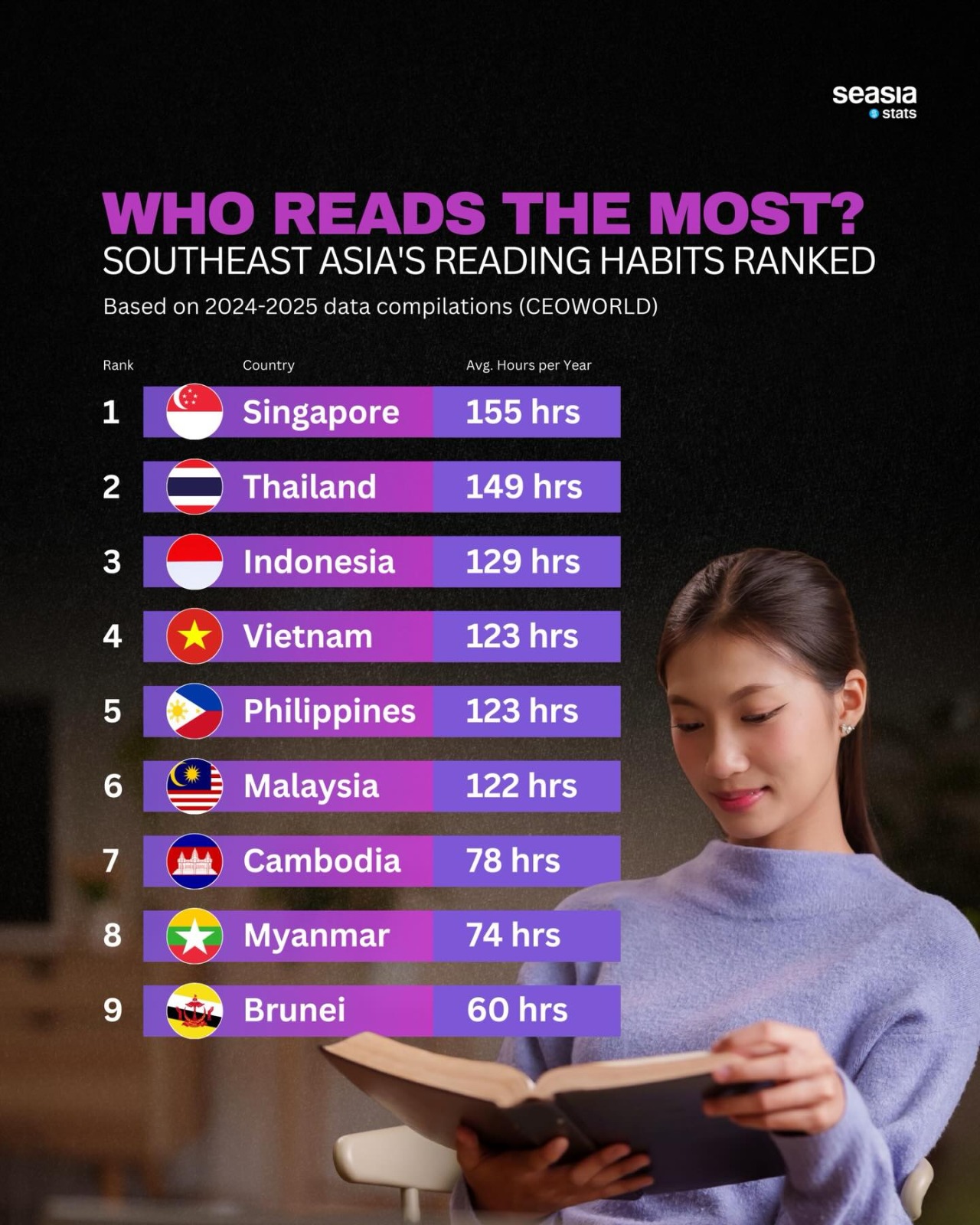
In an increasingly digital world, reading habits remain one of the strongest indicators of a society’s educational culture and intellectual engagement. Across Southeast Asia, countries show striking differences in how much time people spend reading each year. According to CEOWORLD and Seasia Stats data from 2024–2025, Singapore leads the region—setting a benchmark for literacy and lifelong learning.
Singapore Sets the Standard for Reading Culture
At the top of the rankings, Singapore stands out with an impressive average of 155 hours spent reading per person each year. This figure reflects the city-state’s long-standing investment in education, strong public library networks, and policies that promote reading from an early age. Singapore’s multilingual society—where English, Mandarin, Malay, and Tamil are widely used—also encourages reading across diverse formats, from academic texts to literature and digital media.
Thailand and Indonesia Follow Close Behind
Thailand ranks second with 149 hours annually, demonstrating that reading remains a popular habit across its population. The country’s strong print culture, along with widespread mobile reading platforms and book fairs, has helped sustain interest in both traditional and digital reading.
Indonesia, Southeast Asia’s largest country, takes third place with 129 hours per year. Given its vast population and geographic diversity, this level of engagement reflects significant progress in literacy programs and digital access. Online reading platforms, educational reforms, and community libraries have played a growing role in boosting reading culture across the archipelago.
A Strong Middle Tier Across the Region
In the middle of the rankings, several Southeast Asian nations display remarkably similar reading habits. Vietnam and the Philippines are tied for fourth place, with each averaging 123 hours per year. In Vietnam, reading is strongly tied to academic achievement and national education campaigns, while in the Philippines, English-language literacy and a strong school system support widespread reading habits.
Malaysia follows closely in sixth place with 122 hours annually. The country has made consistent efforts to promote reading through national literacy campaigns, digital libraries, and book festivals. Across these three countries—Vietnam, the Philippines, and Malaysia—the data shows a balanced and steady culture of reading that spans both educational and recreational purposes.
Lower Reading Levels in Emerging Markets
Further down the list are countries where reading habits are still developing. Cambodia averages 78 hours per year, while Myanmar records 74 hours. In both countries, improving access to education and literacy resources remains a key national priority.
Brunei ranks last among the listed nations with 60 hours per year. Despite its high income level, the relatively lower reading average suggests a stronger reliance on digital entertainment or alternative forms of information consumption.
A Region of Diverse Reading Cultures
The overall picture of Southeast Asia’s reading habits reveals a region marked by diversity—both culturally and educationally. While countries like Singapore and Thailand demonstrate high engagement, others are still strengthening their reading ecosystems through investment in schools, libraries, and digital infrastructure.
Importantly, the rise of smartphones, e-books, and online learning platforms is reshaping reading habits across the region. In countries such as Indonesia, Vietnam, and the Philippines, mobile reading apps are increasingly bridging gaps in access, allowing more people to engage with books and educational materials.
As Southeast Asia continues to grow economically and technologically, reading will remain a crucial pillar of development. Whether through printed books, digital screens, or community libraries, the region’s evolving reading culture reflects a shared commitment to knowledge, learning, and opportunity for future generations.


