

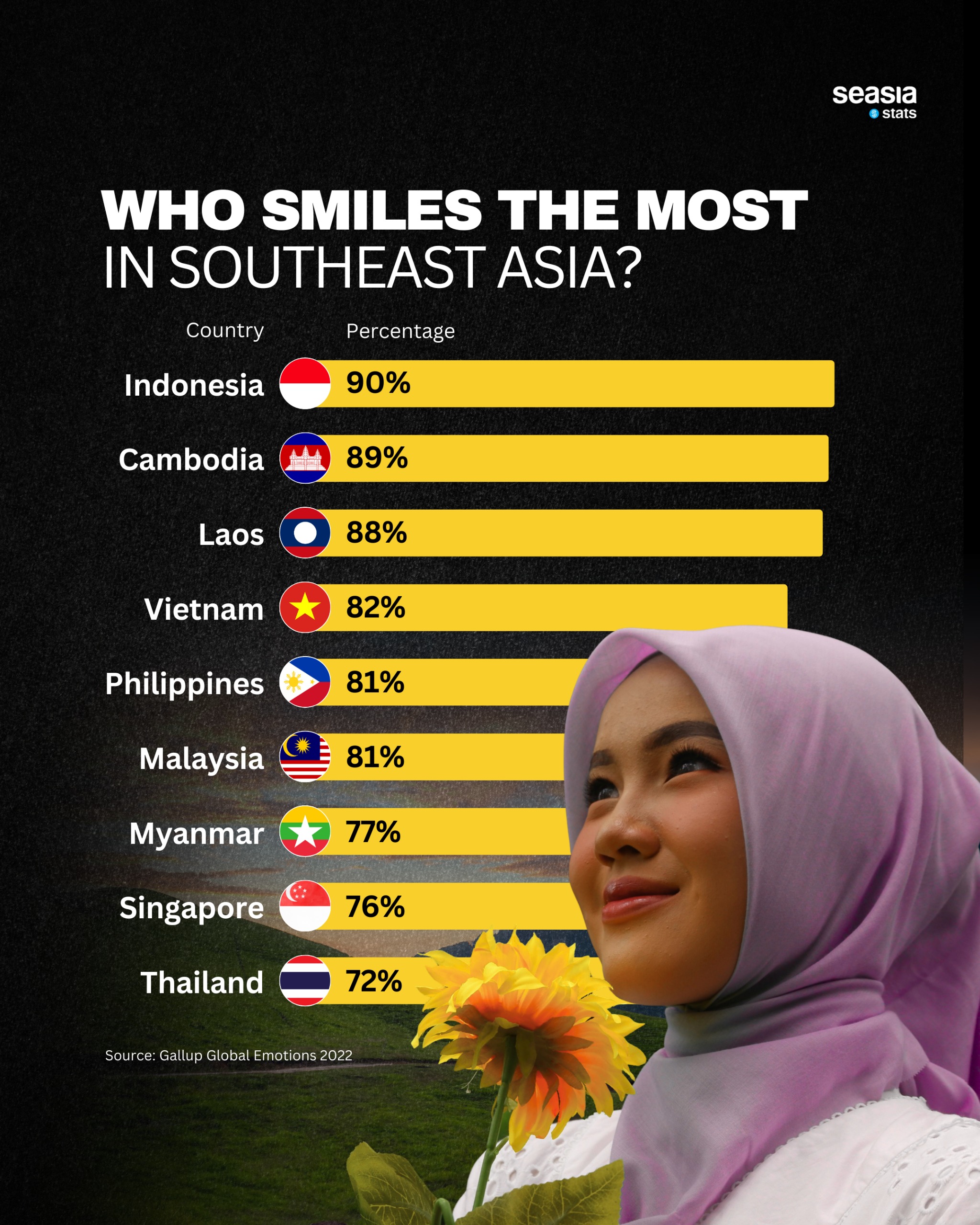
In Southeast Asia, a smile is more than a facial expression—it’s a social language, a cultural reflex, and often a quiet form of resilience. According to the Gallup Global Emotions 2022 report, visualized by Seasia Stats, people across the region rank among the world’s most frequent smilers. From bustling megacities to rural villages, everyday joy remains remarkably visible, even amid economic and political challenges.
Indonesia and Cambodia: Leading With Joy
At the top of the regional ranking is Indonesia, where 90% of respondents said they smiled or laughed a lot the previous day. This places Indonesia not only first in Southeast Asia, but among the most joyful societies globally. Cultural norms emphasizing warmth, politeness, and social harmony—often summed up in the concept of ramah tamah—play a key role in this result.
Close behind is Cambodia at 89%. Despite decades of historical trauma and ongoing development challenges, Cambodia’s strong community bonds, family-centric life, and Buddhist traditions appear to foster a deeply ingrained sense of emotional positivity.
Laos and Vietnam: Quiet Happiness
Third on the list is Laos, with 88% of respondents reporting frequent smiling or laughter. Often described as one of the most laid-back countries in the region, Laos reflects a slower pace of life and a cultural emphasis on contentment over material success.
Vietnam follows at 82%, a notable figure given the country’s fast-paced economic transformation. Vietnam’s strong family structures, vibrant street life, and communal culture continue to provide emotional grounding amid rapid urbanization and change.
The Philippines and Malaysia: Social Warmth at the Core
Both the Philippines and Malaysia register 81%, reinforcing their reputations as socially expressive societies. In the Philippines, optimism, humor, and emotional openness are deeply embedded in daily interactions, earning the country a long-standing reputation for friendliness.
Malaysia’s result reflects its multicultural fabric. Across Malay, Chinese, Indian, and indigenous communities, shared social rituals—food, festivals, and family gatherings—help sustain positive emotional experiences across diverse backgrounds.
Myanmar, Singapore, and Thailand: Different Paths to Positivity
Myanmar comes in at 77%, a figure that stands out given the country’s ongoing political and humanitarian challenges. The data suggests that interpersonal warmth and cultural traditions continue to support emotional expression even in difficult times.
In Singapore, 76% reported smiling or laughing frequently. While often perceived as high-pressure and efficiency-driven, Singapore still scores strongly, likely reflecting high social stability, personal safety, and quality of life.
Rounding out the list is Thailand at 72%. Known globally as the “Land of Smiles,” Thailand’s ranking suggests that while smiles remain culturally important, modern economic stress and urban pressures may be influencing daily emotional experiences.
Why Southeast Asia Smiles So Much
Gallup’s Global Emotions framework measures daily emotional experiences rather than long-term happiness, making these findings especially telling. Across Southeast Asia, strong community ties, expressive cultures, religious traditions, and a tendency toward social optimism all contribute to high levels of everyday joy.
In a world often focused on economic indicators alone, Southeast Asia’s smiles tell another story—one of resilience, connection, and the enduring power of human warmth.


