

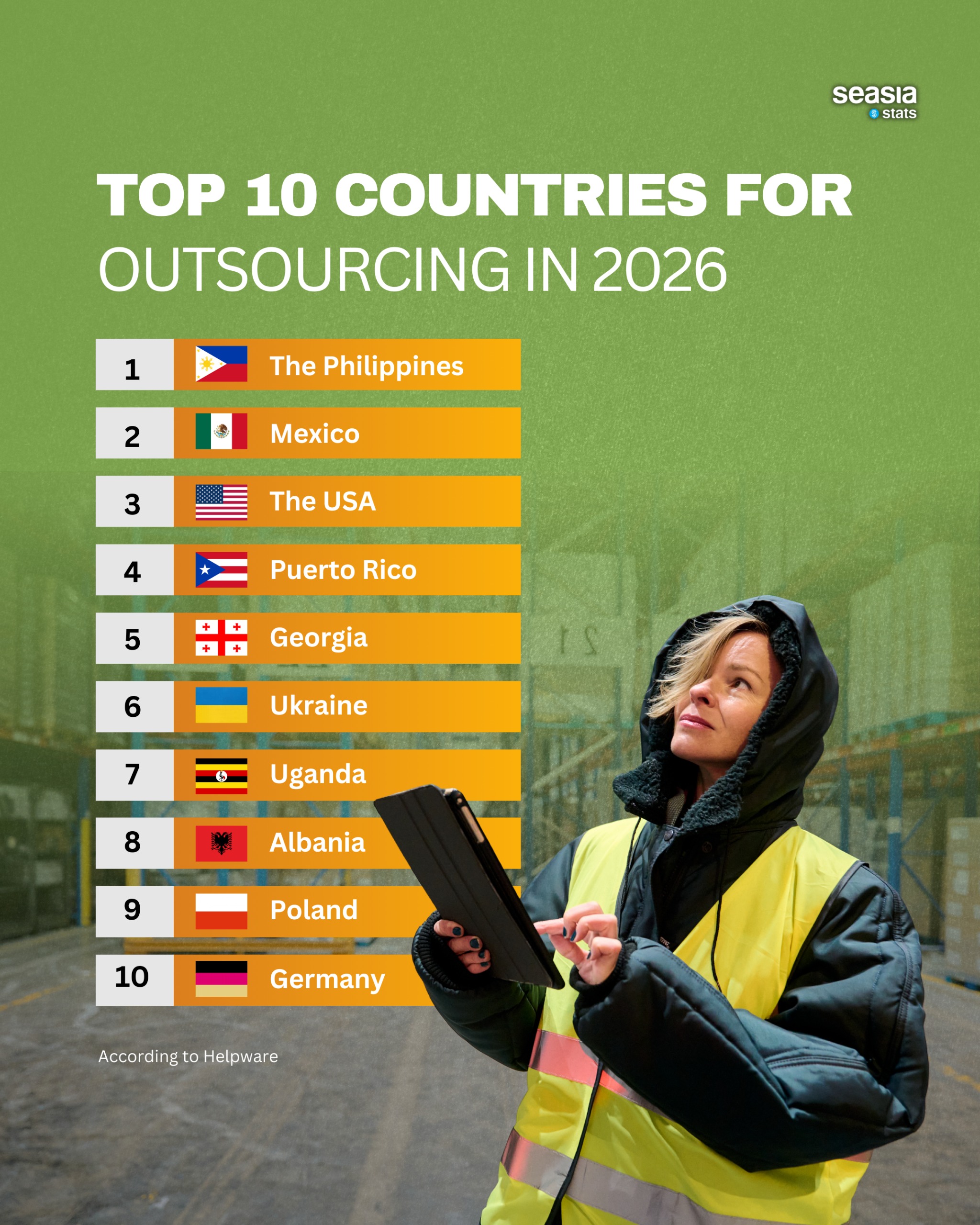
Outsourcing in 2026 is no longer just about who is cheapest. It is about who can deliver talent, trust, time-zone coverage, language compatibility, digital infrastructure, and increasingly, AI-ready workforces. That is why the latest ranking highlighted by Seasia Stats, based on Helpware’s 2026 list, feels especially timely: it reflects a global outsourcing market that is becoming more specialized, more strategic, and more competitive than ever.
Why the Philippines Still Leads
The Philippines taking the top spot is not a surprise to anyone who has watched the business process outsourcing industry over the last two decades. What is more interesting is why it still leads in a world where automation is replacing many routine tasks.
The old advantage was labor cost. The new advantage is service quality. The Philippines remains one of the strongest destinations for customer support, back-office processing, healthcare support, fintech operations, and increasingly, higher-value AI-assisted services. Helpware’s 2026 ranking specifically places the Philippines at number one, ahead of Mexico and the United States, showing that it still sets the benchmark for global outsourcing destinations.
Industry estimates also suggest the sector remains massive. Several 2026 industry analyses put the Philippine IT-BPM and outsourcing ecosystem at around $42 billion in annual revenue, employing close to 2 million workers, with strong momentum outside Metro Manila in cities like Cebu, Davao, and Iloilo.
That scale matters because outsourcing is not built overnight. It requires management culture, training systems, reliable middle management, and client confidence. The Philippines has all four.
Southeast Asia’s Real Outsourcing Story Is Bigger Than One Country
But the real Southeast Asian story goes beyond the Philippines. The region is quietly becoming one of the world’s most important outsourcing corridors, even if not every country makes this specific top-ten list.
Vietnam, for instance, is becoming increasingly attractive for tech-enabled services, digital operations, and software-linked outsourcing. The country’s rise in manufacturing and electronics has already made it a trusted base for global supply chains, and that industrial credibility often spills into services. Reuters reported earlier this year that even higher-end Google smartphone development work is being expanded in Vietnam, reinforcing its growing reputation as a serious global operations hub.
Malaysia, meanwhile, has long been one of Southeast Asia’s quieter strengths in shared services and global business services. Kuala Lumpur, Penang, and Cyberjaya have built strong reputations in finance, analytics, multilingual support, and regional headquarters operations. Malaysia may not dominate outsourcing headlines the way the Philippines does, but in higher-skill, corporate-facing functions, it often performs above its visibility.
Indonesia is another market to watch. It is not yet viewed globally as the region’s main outsourcing capital, but its scale, young workforce, and growing digital ecosystem give it long-term potential. The question is whether it can move fast enough in English proficiency, enterprise readiness, and talent specialization to compete with more mature outsourcing ecosystems.
From Call Centers to Capability Centers
What this ranking really reveals is a change in the definition of outsourcing itself. The world is moving away from the old call-center stereotype and toward what many firms now call capability centers or strategic service hubs.
That is why countries like the United States and Germany appear on the list. Their inclusion signals that “outsourcing” increasingly includes onshoring, nearshoring, and specialized service delivery—not just low-cost labor arbitrage. In 2026, companies are not merely asking, “Where is it cheaper?” They are asking, “Where can we scale without sacrificing quality, compliance, or resilience?”
This shift is especially important for Southeast Asia. The region’s winners will not just be the countries with lower wages. They will be the ones that can pair human talent with automation, communication skills, cybersecurity, and industry specialization.
The Next Battle: AI and Adaptation
The biggest test ahead is not competition from Mexico, Poland, or Georgia. It is AI. Routine voice and back-office tasks are being automated faster than many outsourcing economies expected. The countries that survive and thrive will be the ones that move up the value chain quickly.
For now, the Philippines still holds the crown. But the wider Southeast Asian race is only just beginning—and in 2026, it is becoming one of the region’s most consequential economic stories.


