


Exactly 29 years ago, on March 27, 1997, Thailand made history in a way no Southeast Asian nation has since matched: it commissioned its own aircraft carrier.
The ship, HTMS Chakri Naruebet, remains to this day the only aircraft carrier in the entire region.
Born from Disaster, Built on Ambition
The origins of HTMS Chakri Naruebet were not driven purely by military doctrine or geopolitical ambition. The turning point was Typhoon Gay, which devastated Thailand in 1989, killing hundreds and affecting more than 154,000 people.
During rescue operations, the Royal Thai Navy realized it lacked a vessel capable of operating in the rough seas of the Gulf of Thailand.
From that vulnerability, the idea of an aircraft carrier was born. A contract between Thailand and Spain was signed on March 27, 1992, with construction assigned to the Bazán shipyard in Ferrol. The project cost around US$285 million, a significant investment for Thailand at the time.
The design was based on Spain’s aircraft carrier, Principe de Asturias. The keel was laid in 1994, and the ship was officially launched on January 20, 1996, by Queen Sirikit, before being delivered to the Royal Thai Navy and entering service on March 27, 1997.
Its name, Chakri Naruebet, means “Sovereign of the Chakri Dynasty,” reflecting strong royal symbolism and national sovereignty.
Specifications and Scale
Designated with the hull number CVH-911, the carrier measures 182.65 meters in length and 22.5 meters in width, with a displacement of 11,486 tons and an operational range of up to 10,000 nautical miles.
It is powered by a combination of two GE LM2500 gas turbines and Bazán-MTU 16V1163 TB83 diesel engines. The ship can accommodate 62 officers, 393 sailors, 146 aircrew, and up to 675 Marines.
Although classified as a light aircraft carrier, the Royal Thai Navy officially designates it as an Offshore Patrol Helicopter Carrier.
In comparison, the United States’ Nimitz-class aircraft carrier stretches up to 333 meters, displaces around 100,000 tons, and can carry up to 90 fighter jets. Even France’s Charles de Gaulle is significantly larger, at 261.5 meters and 42,000 tons.
By contrast, Chakri Naruebet is far smaller, but its symbolic and strategic value for Thailand remains unmatched in Southeast Asia.
An Inevitable, Gradual Decline
At its peak, HTMS Chakri Naruebet was designed to operate V/STOL fighter jets, aircraft capable of vertical or short takeoff and landing. Thailand acquired nine refurbished AV-8S Matador jets from Spain, including two TAV-8S trainer variants.
However, the 1997 Asian Financial Crisis struck just as the carrier entered service. Thailand’s defense budget was slashed, leading to severe shortages of spare parts, limited training, and restricted operational funding. As a result, the Matador fleet became largely grounded.
By 1999, only a handful remained operational. By 2003, just three aircraft were still active and in 2006, the entire fleet was officially retired without replacement.
Since then, Chakri Naruebet has effectively functioned as a helicopter carrier. Its deck now hosts only two Sikorsky SH-60 Seahawk helicopters and four MH-60S Knighthawk units. The ski-jump ramp, once designed for V/STOL jets, now stands as a structural reminder of an ambition never fully realized.
It is from this reality that the satirical nickname “ThaiTanic” emerged—not because the ship is destined to sink, but because it is often seen as a “white elephant”: grand, expensive, yet rarely used to its full potential.
Its daily operating cost alone reaches around 2 million Thai baht, with an additional 1 million baht required for just three days of exercises. Under persistent budget constraints, the carrier spends more time docked at Sattahip Naval Base than at sea.
Between Symbol and Function: Is the “ThaiTanic” Still Relevant?
Despite the criticism, Chakri Naruebet has proven its value in times of crisis. During the 2004 Indian Ocean tsunami, the ship served as a vital floating base for humanitarian operations.
It played a similar role during Thailand’s major floods in 2010 and 2011, functioning as a floating hospital and emergency command center, capabilities unmatched in the region at the time.
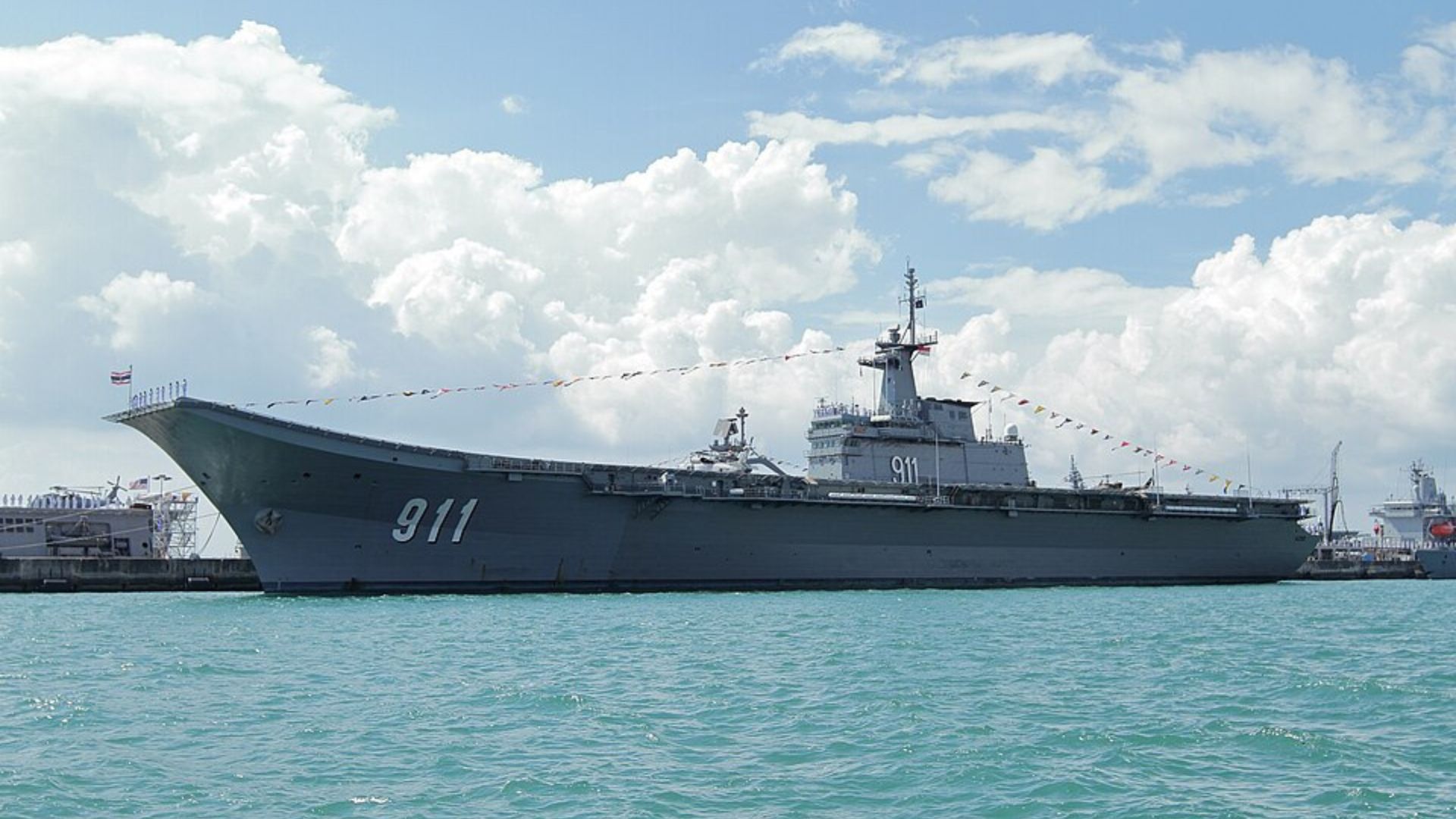
Now approaching three decades of service, Thailand has opted for gradual modernization rather than early retirement. The ship’s radar and fire control systems have been upgraded using technology from Saab.
Today, Chakri Naruebet is positioned as a strategic asset for search and rescue missions, a symbol of maritime sovereignty, and—on certain days—even a public attraction open to visitors.
With relatively stable regional security conditions in the post–Cold War era, and no pressing need for long-range naval operations, the carrier is often viewed more as a statement of prestige than a battlefield necessity.
Yet one fact remains undeniable: for 29 years, no other Southeast Asian country has dared—or been able—to follow Thailand’s path.


