


Imagine a single black peppercorn being valuable enough to pay rent, serve as a dowry, or even settle taxes to a king. In medieval Europe, this was a reality. Pepper traders were so prominent that they had their own titles in different countries: Pepperer in England, Pfeffersacke in Germany, and Poivrier in France—because their business was as lucrative as gold.
Major European cities such as Alexandria, Genoa, and Venice built their prosperity on this very commodity. The same obsession drove Vasco da Gama to sail in 1498, ultimately discovering the sea route to the Malabar Coast.
The Portuguese quickly seized control of the trade monopoly, turning Lisbon into the wealthiest port in Europe, while those once-thriving cities lost their primary source of wealth almost overnight.
Nusantara at the Center of It All
What is often overlooked in this story is that much of the pepper fought over by Europeans for centuries was grown in the Indonesian archipelago.
Banten, at the western tip of Java, was the largest pepper port in the region. Lampung in Sumatra was another major production center. Jambi, Palembang, and Banjarmasin were also key producers—each becoming contested ground for European powers.
In 1595, Cornelis de Houtman led the first Dutch expedition to the archipelago. A year later, his ships arrived in Banten.
A trade agreement was successfully signed with Sultan Maulana Muhammad. The surviving sailors returned to the Netherlands carrying spices—and more importantly, news of the immense profits to be made.
The news spread quickly. The following year, five expeditions were launched at once. Dutch trading companies competed fiercely, each seeking to control its own pepper route to the archipelago.
Competition that Gave Birth to a Giant
However, competition among the Dutch themselves soon became a problem. The price of pepper in the archipelago surged as they competed against one another, while European markets became oversupplied. Profits were squeezed from both ends.
The solution was radical: in 1602, the Dutch government forced all competing companies to merge into a single entity.
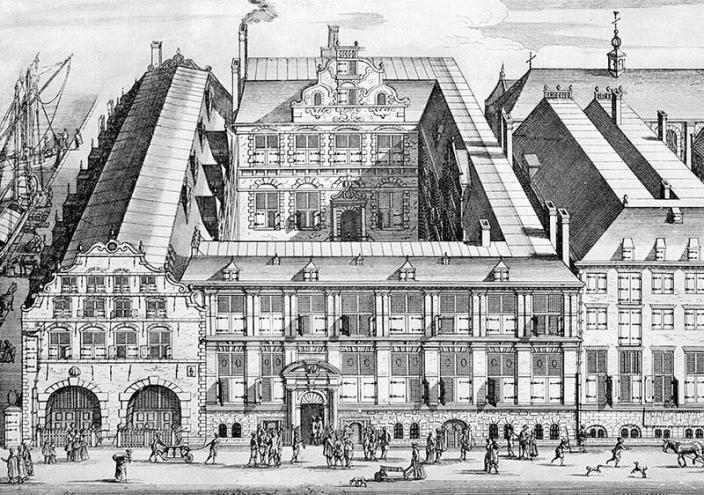
Thus was born the Vereenigde Oost-Indische Compagnie (VOC), or the Dutch East India Company. It was granted full monopoly rights over all maritime trade between the Netherlands and Asia, marking the beginning of one of the most powerful trading corporations in history.
A Corporation Unlike Anything Before
What the VOC built was unprecedented in human history. The company issued tradable shares, an innovation that gave birth to the concept of the stock market.
It possessed its own legal identity, separate from its owners. It could sue and be sued in court as an independent entity.
Even more remarkably, the VOC was granted powers typically reserved for states: it could declare war, sign treaties with foreign rulers, punish and execute criminals, establish colonies, and even mint its own currency.
It was able to accumulate wealth on a scale previously achievable only by kingdoms. With these powers, the VOC effectively became a state within a state.
At the height of its power, the VOC operated around 150 merchant ships, employed 50,000 people, and maintained a private army of 10,000 soldiers. Its network stretched from the Persian Gulf to Japan.
Between 1602 and 1796, its ships made nearly 5,000 voyages from the Netherlands to Asia, while the rest of Europe combined accounted for only a fraction of that number.
Today, historians often regard the VOC as the world’s first modern multinational corporation, the precursor to everything we now understand as a “corporation.”
A Glory That Could Not Last Forever
Even giants can fall. By the 18th century, the VOC began to weaken from within. Corruption became widespread among its officials, while administrative costs soared as its territories expanded.
Smuggling eroded the monopoly that had long been its primary source of profit. Meanwhile, wars in Java—particularly the VOC’s involvement in the Mataram succession conflicts—drained its finances to the brink of collapse.
The final blow came with the Fourth Anglo-Dutch War (1780–1784), when the British Royal Navy launched attacks on VOC trading posts across Asia. Trade was nearly paralyzed, debts mounted, and the company could no longer survive without state support.
Ironically, even as the VOC declined, the value of Indonesian pepper remained undeniable. In 1797, an American merchant named Jonathan Carnes sailed back to New York carrying Sumatran pepper worth 100,000 US dollars, an extraordinary sum for its time.
The cities of Salem and Boston soon emerged as new centers of the spice trade. Indonesian pepper was now fueling a new commercial empire.
The VOC’s charter was officially revoked on January 1, 1800, bringing an end to two centuries of what had been the largest corporation the world had ever seen.
And it all began with a single peppercorn grown in the Indonesian archipelago.
Without Nusantara pepper demonstrating just how lucrative the trade could be, there would have been no second, third, or subsequent expeditions. Without the fierce competition among Dutch companies over pepper, there would have been no pressure to unite and form the VOC.


