


When Dr. Valérie Verdier, Chairwoman and Chief Executive Officer of France's Institut de Recherche pour le Développement (IRD), arrived in Indonesia in June 2026, her visit marked more than a diplomatic engagement. It celebrated fifty years of scientific partnership between France and Indonesia, a collaboration that has advanced research on climate resilience, disaster mitigation, biodiversity, public health, agriculture, and sustainable development across the archipelago.
The anniversary was commemorated at the Residence of the French Ambassador in Jakarta, bringing together government officials, researchers, academics, and development partners. Held shortly after President Emmanuel Macron and President Prabowo Subianto adopted a Joint Declaration on Education, Research, and Mobility during the Indonesian President's state visit to Paris, the event highlighted the growing role of science and innovation in the France–Indonesia strategic partnership.
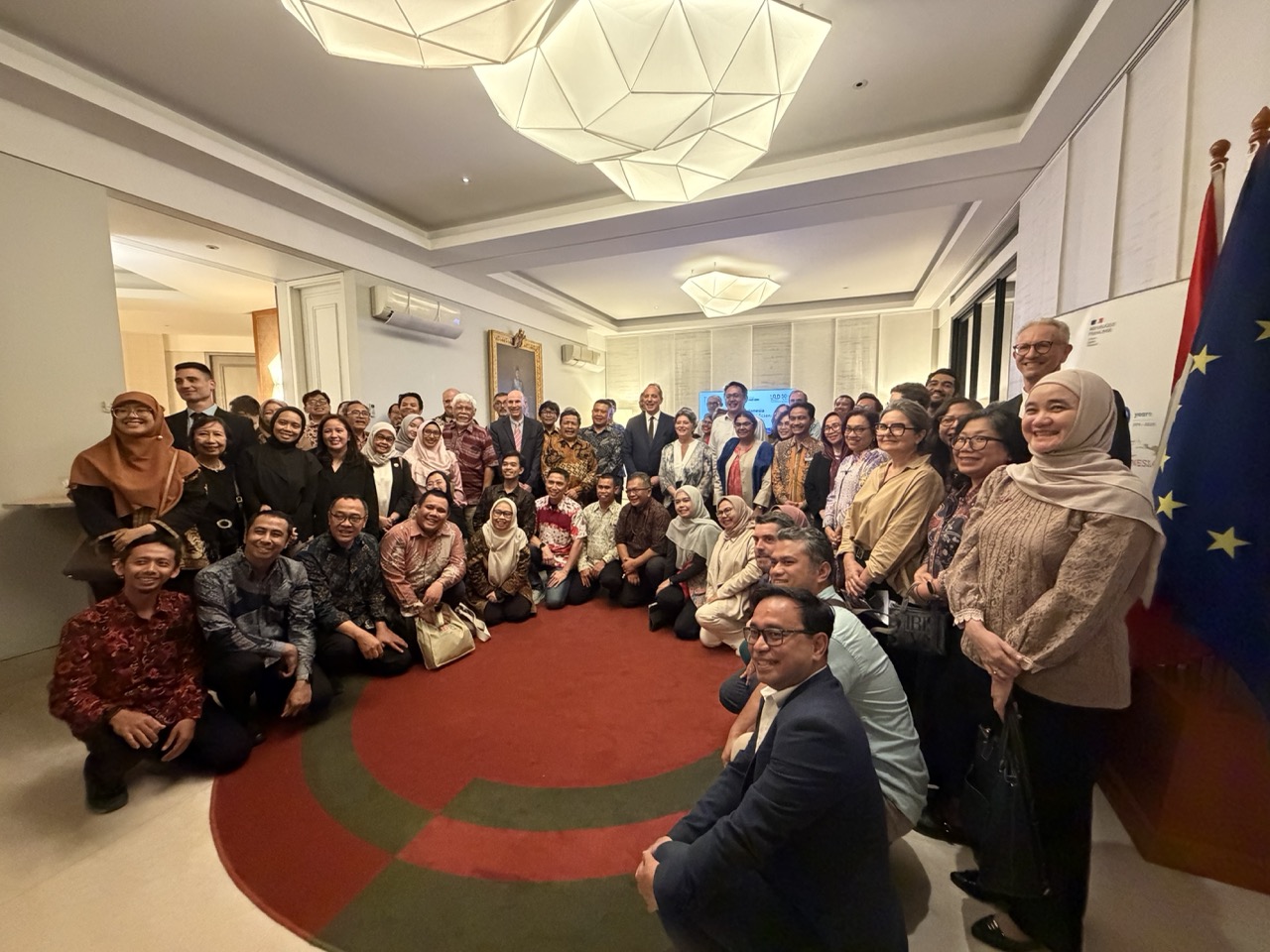
Five Decades of Scientific Collaboration
Indonesia's partnership with IRD began in 1976, making it one of the institute's longest-standing collaborations in Asia. Over the past five decades, the relationship has expanded across climate science, marine biodiversity, agriculture, geoscience, disaster-risk reduction, and public health.
The depth of the partnership is reflected in its achievements. Between 2020 and 2024, French and Indonesian researchers co-authored 266 scientific publications. IRD currently supports joint laboratories dedicated to marine biodiversity and geological hazards while collaborating closely with BRIN, BMKG, Universitas Gadjah Mada, Institut Teknologi Bandung, IPB University, and numerous research institutions throughout Indonesia.
As Dr. Verdier emphasized during the commemoration, long-term scientific cooperation can generate knowledge that directly benefits society, from strengthening tsunami warning systems to improving food security and environmental sustainability. French Ambassador to Indonesia Fabien Penone similarly noted that scientific cooperation has become one of the strongest foundations of bilateral relations, driven by a shared commitment to research, innovation, and the development of future generations of scientists.
From Research to Real-World Solutions
The partnership's impact extends far beyond academic publications.
One example is the SAMUDRA project, a Franco-Indonesian initiative designed to enhance tsunami early-warning capabilities through advanced submarine monitoring technologies and real-time data analysis. Another is the FortRiz project, which supports Indonesia's efforts to improve school nutrition through fortified rice and evidence-based food interventions.
These initiatives demonstrate how scientific research can be transformed into practical solutions that improve lives, strengthen resilience, and support national development priorities. They also reflect Indonesia's growing role as a scientific leader in Southeast Asia, particularly in areas such as marine ecosystems, climate adaptation, biodiversity conservation, and geological hazard management.
Strengthening the Innovation Bridge
A major highlight of the visit was the signing of five Memorandums of Understanding between French and Indonesian institutions, signaling a new phase of cooperation focused on scientific mobility, institutional partnerships, innovation, and sustainable development.
Among the agreements were collaborations with Indonesia's Ministry of Agriculture, the Ministry of Higher Education, Science, and Technology, the World Food Programme Indonesia, and IPB University. Together, these partnerships aim to strengthen research in sustainable agriculture, food security, biodiversity, climate resilience, and capacity building for young scientists.
The agreements also reflect a broader vision for bilateral cooperation. As part of the Indonesia–France Year of Innovation 2026, both countries have expanded collaboration in higher education, innovation, museums, literature, cinema, and scientific research. Joint university programmes and research initiatives are expected to foster greater people-to-people connections while encouraging interdisciplinary innovation.
The partnership increasingly aligns with Indonesia's development priorities. France has committed to sharing institutional expertise, logistics systems, and governance frameworks to support Indonesia's Makan Bergizi Gratis programme, demonstrating how research, innovation, and public policy can work together to address societal challenges.
Beyond science, both countries have also reaffirmed their commitment to international cooperation. During the recent state visit to Paris, Presidents Macron and Prabowo endorsed a joint declaration supporting a two-state solution for Palestine and acknowledged Indonesia's longstanding contribution to United Nations peacekeeping missions.
Looking Toward the Next Fifty Years
Scientific partnerships are often measured in decades rather than years. The success of the France–Indonesia relationship demonstrates that meaningful cooperation requires trust, continuity, and a shared commitment to solving common challenges.
As Indonesia seeks to become a high-income nation and France strengthens its engagement in the Indo-Pacific, research and innovation will play an even greater role in connecting the two countries. Yet perhaps the most significant change lies in the nature of the partnership itself.
For much of the past fifty years, Indonesia was often viewed primarily as a location for scientific observation and field research. Today, both countries are embracing a new model—one in which Indonesia and France stand as equal partners, jointly shaping research agendas, co-producing knowledge, and developing solutions to shared global challenges.
This shift is increasingly reflected in government policy. Dr. Fauzan Adziman, S.T., M.Eng., Director General of Research and Development at Indonesia's Ministry of Higher Education, Science, and Technology (Kemendiktisaintek), emphasized that Indonesia no longer sees itself merely as a host for international research projects, but as an active partner in determining their direction and outcomes. He also highlighted the Indonesian government's willingness to participate in co-funding future collaborative initiatives, reinforcing a partnership built on shared ownership, mutual responsibility, and long-term commitment.
As Dr. Verdier's visit symbolizes, the next fifty years will not simply be about continuing a successful partnership—it will be about redefining it. In a world increasingly shaped by complex global challenges, the France–Indonesia experience offers a powerful lesson: when nations invest in science together as equals, they create solutions that benefit not only themselves, but the wider world.


