


Across Southeast Asia, the first person carrying someone to safety is rarely an international specialist. More often, it is a village volunteer steering a boat through floodwater, a nurse recognizing an outbreak or a neighbour opening an evacuation shelter. World Humanitarian Day, observed on August 19, honours these people while renewing the call to protect everyone who delivers assistance in disasters and conflicts.
Local Courage at the Centre
The scale of the challenge is enormous. ASEAN has recorded more than 5,000 disasters since 2012. In the Philippines alone, an average of 20 tropical cyclones enters the surrounding region each year, with eight or nine crossing the country. Earthquakes, volcanic eruptions, floods, drought and extreme heat add further pressure across Indonesia, the Mekong basin and rapidly growing coastal cities.
Yet national statistics can obscure the people who respond first. In Boyolali, Central Java, nurse and Indonesian Red Cross volunteer Siti Imroatus began educating neighbours after anthrax affected her family and community. Her motivation was direct: “If I can help my mother, I can help my community too.” Her work illustrates localization in practice—training trusted residents to recognize danger, share accurate information and report outbreaks before they spread.
Localization should mean more than inviting community organizations to implement plans designed elsewhere. Local responders need reliable funding, decision-making authority, insurance, training and protection. They know which roads disappear during floods, which languages people trust and which families may be missed by centralized systems.
Regional Solidarity Becomes Operational
Southeast Asia has also built institutions capable of turning solidarity into coordinated action. Based in Jakarta, the AHA Centre monitors emergencies, supports assessment teams and helps ASEAN members mobilize relief. Its disaster logistics system maintains stockpiles in Subang, Malaysia, with satellite warehouses in Chainat, Thailand, and Camp Aguinaldo in the Philippines.
That network proved its value during Tropical Cyclone Yagi in 2024, when the AHA Centre coordinated assistance across Laos, Myanmar, the Philippines, Thailand and Vietnam in its second-largest response of the previous decade. National organizations then carry relief the final—and often hardest—distance. The Philippine Red Cross combines rescue teams, blood services, emergency kitchens and psychosocial support, while MERCY Malaysia deploys medical assistance and strengthens community preparedness.
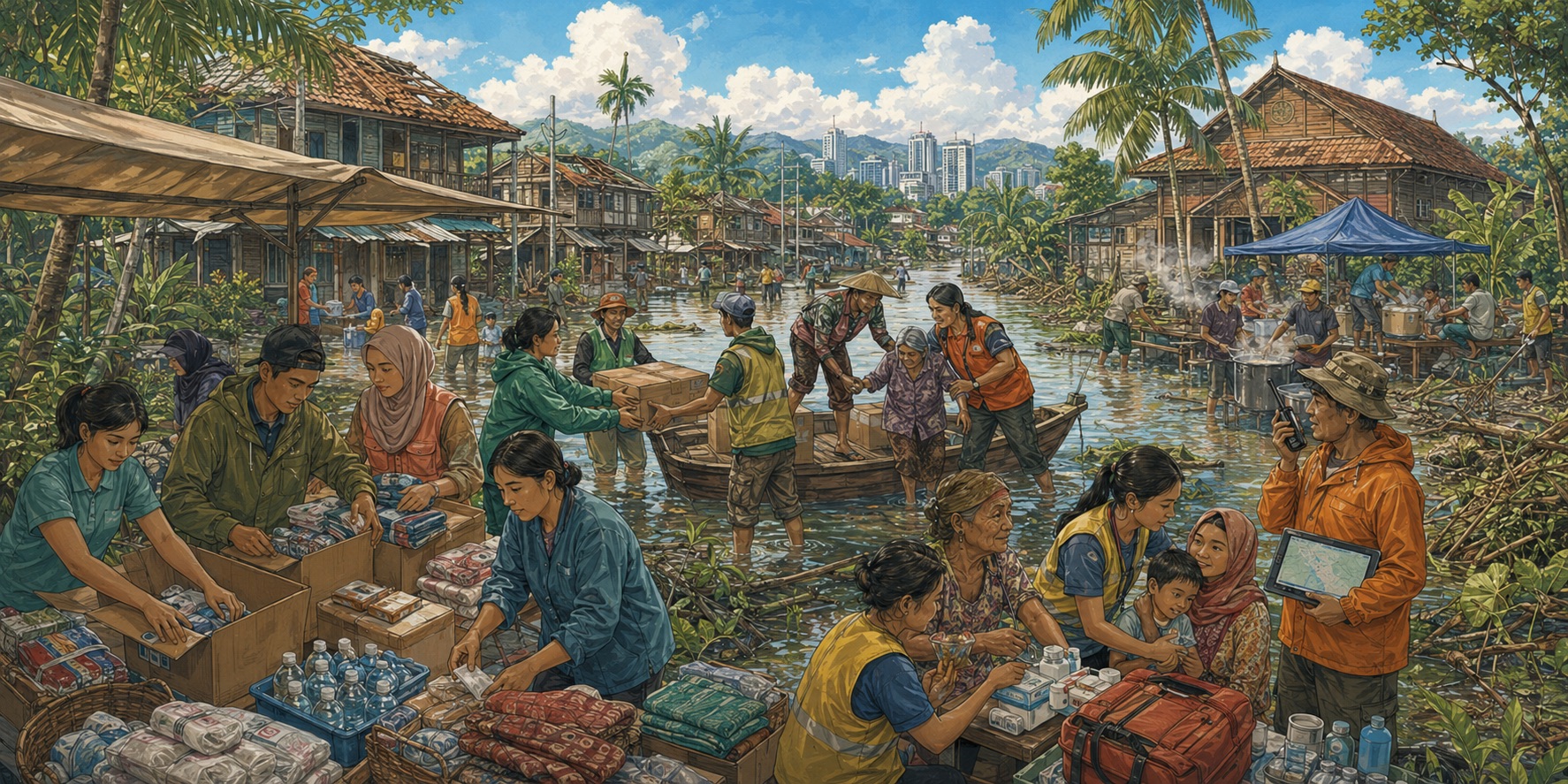
Their purpose is captured by MERCY Malaysia President Dato’ Dr Ahmad Faizal Mohd Perdaus: “We are not important, the important people are those in need.” The statement places dignity, rather than institutional visibility, at the centre of humanitarian work.
Myanmar Tests the Region’s Resolve
No crisis exposes the limits of the regional system more starkly than Myanmar. The 2026 humanitarian plan estimates that 16.2 million people need life-saving assistance and protection, while conflict and the effects of the 2025 earthquake have displaced about 3.6 million. Humanitarian partners aim to reach 4.9 million people, but insecurity, access restrictions, damaged transport routes and funding shortages continue to obstruct delivery.
The danger is personal as well as logistical. Globally, at least 326 humanitarian workers were killed in 2025, according to the United Nations. Protecting local aid workers in Myanmar therefore requires sustained diplomatic pressure for safe, impartial access—not simply praise after lives have been lost.
From Emergency Relief to Readiness
Climate change is pushing humanitarian agencies beyond short-term response. Saltwater intrusion, stronger rainfall extremes, coastal erosion and crop losses can repeatedly displace the same families. Communities need early-warning systems, heat plans, resilient clinics, mangrove restoration, livelihood support and safe relocation pathways before the next emergency.
Technology can improve that work through satellite mapping, mobile alerts, drones and digital cash transfers. It also creates responsibilities: personal data belonging to displaced people must not expose them to surveillance, discrimination or exploitation. The most effective innovation is therefore technology combined with community consent and local knowledge.
World Humanitarian Day is ultimately a call to act before headlines appear. Southeast Asia’s strongest defence is already present in its neighbourhoods: people who understand the risks, earn local trust and refuse to leave anyone behind. Supporting them with resources, protection and authority is not only fair—it is the fastest route to a safer and more resilient region.


