


As dawn breaks over the waters of Raja Ampat, fishermen prepare their boats while schools of fish move through vibrant coral reefs beneath the surface. Thousands of kilometers away, seaweed farmers in the southern Philippines begin their daily work, while mangrove forests along the coasts of Vietnam quietly protect communities from storms and rising seas.
For Southeast Asia, the ocean is far more than a geographical feature. It is a source of food, livelihoods, culture, transportation, and identity. As the world commemorates World Oceans Day on June 8, the region finds itself at the center of a global conversation about how humanity can protect the marine ecosystems that sustain life on Earth.
Home to some of the richest marine biodiversity on the planet, Southeast Asia carries both an extraordinary responsibility and a remarkable opportunity. The choices made across its seas today will influence not only the future of the region but also the health of the global ocean.
The Heart of the Marine World
Southeast Asia occupies a unique position within the world's ocean system. The region encompasses much of the Coral Triangle, often described as the "Amazon of the Seas." Spanning Indonesia, Malaysia, the Philippines, Timor-Leste, Papua New Guinea, and the Solomon Islands, the Coral Triangle contains approximately 76 percent of the world's coral species and 37 percent of all known coral reef fish species.
These waters support one of the most productive marine ecosystems on Earth. Millions of people depend directly on fisheries, aquaculture, tourism, and maritime industries for their livelihoods. Fish remains a primary source of protein for hundreds of millions of Southeast Asians, making healthy oceans essential not only for environmental sustainability but also for food security.
Indonesia alone, the world's largest archipelagic nation, manages more than 17,000 islands and possesses one of the longest coastlines globally. The Philippines, Vietnam, Malaysia, Thailand, and other ASEAN nations similarly depend on healthy marine ecosystems to support local economies and coastal communities.
Renowned Filipino marine biologist and conservationist Angel Alcala once said, "Marine protected areas are investments in the future." His words continue to resonate across a region increasingly aware that ocean conservation is inseparable from economic prosperity.
The Growing Challenges Beneath the Surface
Despite their immense ecological value, Southeast Asia's oceans face mounting pressures.
One of the most visible challenges is marine plastic pollution. Several rivers in the region, including Indonesia's Brantas River and the Philippines' Pasig River, have been identified as significant pathways through which plastic waste enters the ocean. Once in the marine environment, plastics gradually break down into microplastics that are consumed by fish and other marine organisms, eventually entering the human food chain.
Climate change presents another serious threat. Rising ocean temperatures have triggered repeated coral bleaching events across Southeast Asia. During prolonged marine heatwaves, corals expel the algae that provide them with nutrients and color, turning entire reef systems white and leaving them vulnerable to disease and death.
Scientists warn that continued warming could significantly reduce coral reef coverage across the Coral Triangle, threatening biodiversity, fisheries, and tourism industries worth billions of dollars annually.
At the same time, illegal, unreported, and unregulated fishing continues to challenge marine management efforts. Destructive practices such as dynamite fishing and cyanide fishing, although declining in some areas, still damage fragile coral ecosystems and reduce fish populations faster than they can naturally recover.
Mangrove forests, another critical coastal resource, also face pressure from urban development, industrial expansion, and unsustainable aquaculture practices. Their loss reduces natural coastal protection and weakens one of the world's most effective carbon storage systems.
Communities Leading Ocean Solutions
Despite these challenges, Southeast Asia is emerging as a global leader in innovative marine conservation.
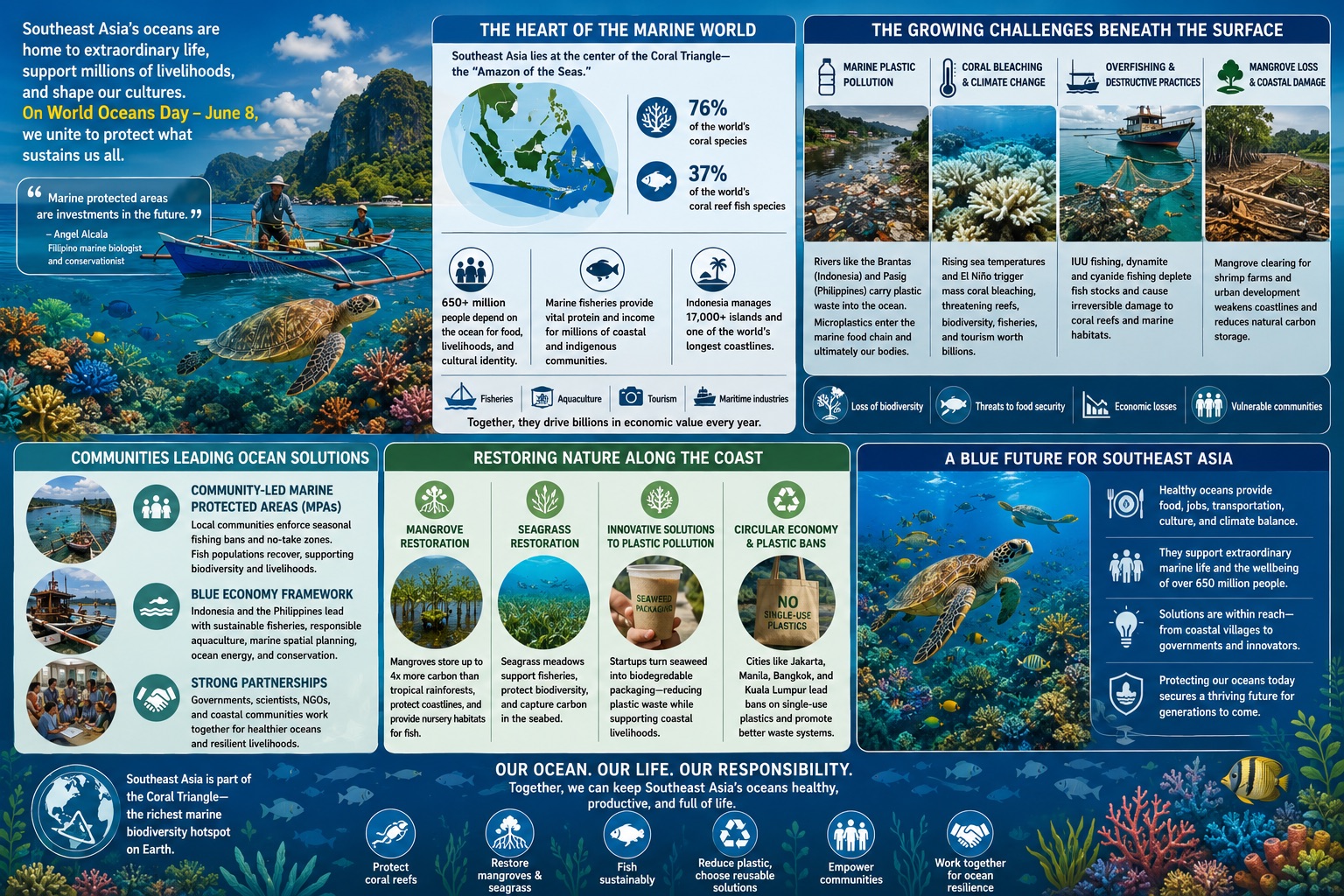
Across Indonesia and the Philippines, community-managed Marine Protected Areas have demonstrated remarkable success. Local fishing communities enforce seasonal fishing restrictions, protect spawning grounds, and establish no-take zones that allow fish populations to recover naturally.
In many cases, fish biomass within protected areas has increased significantly, benefiting both biodiversity and local livelihoods. These community-based approaches show that conservation can succeed when local stakeholders become active stewards of marine resources.
Indonesia's Blue Economy strategy has further accelerated efforts to balance economic growth with ocean protection. The approach promotes sustainable fisheries, responsible aquaculture, marine conservation, and ocean-based renewable energy while reducing pressure on vulnerable ecosystems.
The Philippines has similarly expanded marine protected areas and strengthened coastal resource management programs that involve local governments, fishermen, scientists, and civil society organizations.
Restoring Nature Along the Coast
Beyond protecting marine habitats, Southeast Asian countries are increasingly investing in restoring them.
Mangrove reforestation programs have expanded significantly in Indonesia, Vietnam, Thailand, and Malaysia. These ecosystems provide breeding grounds for fish, stabilize coastlines, reduce erosion, and store up to four times more carbon than tropical rainforests per hectare.
Seagrass restoration is also gaining attention as governments and environmental organizations recognize its role in supporting fisheries, protecting biodiversity, and capturing carbon.
Alongside these efforts, innovative startups across the region are developing alternatives to conventional plastics. Several companies are now producing biodegradable packaging derived from seaweed, offering a sustainable solution that simultaneously supports coastal livelihoods and reduces marine pollution.
Circular economy initiatives, including single-use plastic restrictions and improved waste management systems, are becoming increasingly common in major cities such as Jakarta, Manila, Bangkok, and Kuala Lumpur.
A Blue Future for Southeast Asia
World Oceans Day serves as a reminder that the future of Southeast Asia is deeply connected to the future of its seas.
The region's oceans provide food, employment, transportation, cultural identity, climate regulation, and economic opportunity. They support some of the world's most extraordinary marine life while sustaining hundreds of millions of people.
The challenges facing these waters are significant, but so too are the solutions emerging from coastal villages, research institutions, government agencies, and private-sector innovators throughout the region.
From coral reef restoration in Indonesia to community-managed fisheries in the Philippines and mangrove rehabilitation across ASEAN, Southeast Asia is demonstrating that ocean protection and economic development can move forward together.
Beneath the waves lies one of the world's greatest natural treasures. Protecting it is not merely an environmental obligation. It is an investment in food security, economic resilience, biodiversity, and the wellbeing of future generations.
As Southeast Asia looks toward the future, its oceans remain both a responsibility and a source of hope—a reminder that healthy seas are essential to a thriving region and a sustainable planet.


