


In Cambodia, art carries memory forward. Cambodian Living Arts estimates that 90 percent of the country’s artists did not survive the Khmer Rouge era, leaving generations of knowledge at risk of disappearing. Nearly five decades later, classical dancers, musicians, filmmakers, craftspeople and digital creators are transforming that loss into one of Southeast Asia’s most compelling cultural revivals.
Ancient Traditions Return to the Stage
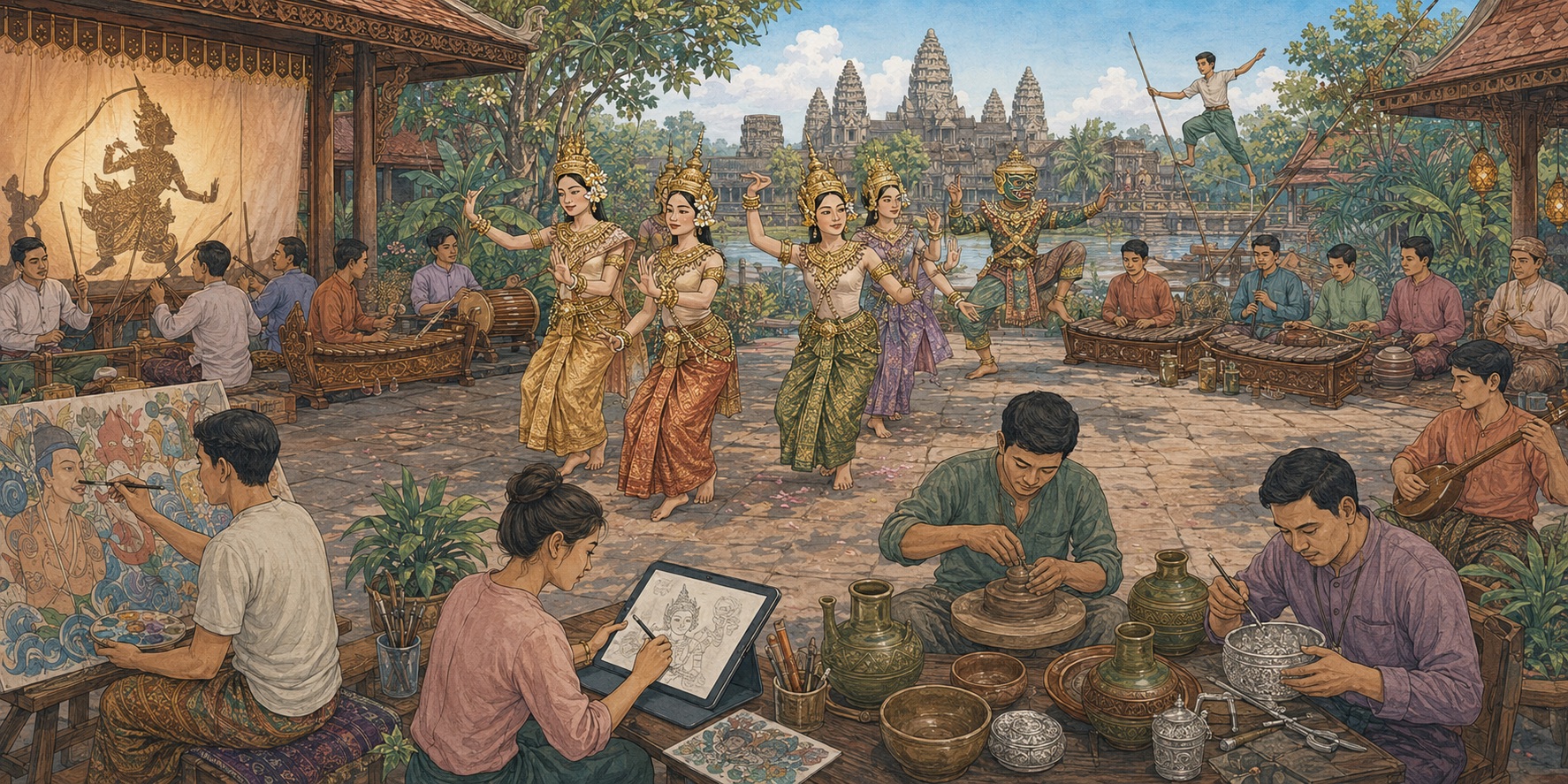
Cambodia’s classical performing arts remain inseparable from its spiritual and royal history. In the Royal Ballet of Cambodia, dancers use controlled movements and precise hand gestures to embody the Apsaras carved into the walls of Angkor Wat. Their silk costumes, gilded ornaments and elaborate headdresses turn ancient stone imagery into living theatre.
The country’s performance heritage also includes Lkhon Khol, an all-male masked drama based on the Reamker, Cambodia’s interpretation of the Ramayana. At Wat Svay Andet near Phnom Penh, performers portray gods, demons and heroic monkeys to the powerful rhythms of a Pinpeat orchestra.
Sbek Thom shadow theatre brings another dimension to this storytelling tradition. Puppeteers hold large cowhide figures against an illuminated screen while narrators and musicians recount epic scenes. UNESCO currently lists seven Cambodian elements on its Intangible Cultural Heritage registers, including the Royal Ballet, Sbek Thom, Chapei Dang Veng and Lkhon Khol Wat Svay Andet.
Artists Rebuild Identity and Confidence
The revival has depended on surviving masters sharing their knowledge with younger Cambodians. Musician and genocide survivor Arn Chorn-Pond founded Cambodian Living Arts in 1998 to support that exchange. His belief that “restoring the arts restores identity, restores dignity” captures why cultural recovery remains closely connected to national healing.
The Chapei Dang Veng illustrates this relationship between preservation and renewal. Playing a long-necked, two-stringed lute, musicians improvise verses containing humour, moral lessons and observations about everyday life. The form preserves oral history while remaining flexible enough to speak about contemporary society.
Traditional crafts are undergoing a similar resurgence. In Kompong Luong, silversmiths continue hammering floral and mythological patterns into bowls and jewellery. Ceramic workshops around Siem Reap have revived the brown and green ash glazes associated with pottery from the Angkorian period, introducing historic techniques to new markets and collectors.
Young Creators Redraw Cambodia’s Cultural Map
Cambodia’s newest artistic energy can be felt most strongly in Battambang, Siem Reap and Phnom Penh. Phare Ponleu Selpak in Battambang provides arts education to more than 1,000 students annually. Its professional circus productions combine acrobatics, theatre, music and visual storytelling to explore family, migration, poverty and personal ambition.
In Phnom Penh, murals bring Khmer lettering, Buddhist symbols and Apsara figures into conversation with graffiti and graphic design. Areas such as Boeung Kak have become informal outdoor galleries, while independent spaces offer platforms for illustration, photography, installation art and experimental performance.
This movement is not rejecting classical culture. Instead, young artists are treating it as a creative vocabulary. Contemporary painter Chhim Sothy has described art as “a mirror reflecting society,” an idea visible in works that connect Cambodia’s difficult history with urbanisation, technology and changing identities.
Archives and Creative Hubs Shape the Future
At Phnom Penh’s Bophana Audiovisual Resource Center, archival preservation has become a foundation for future creativity. Established by filmmaker Rithy Panh, the centre safeguards films, photographs and sound recordings while training young Cambodians in documentary production and digital media. Its collection includes more than 700 hours of video, 210 hours of audio and 10,000 images, and the centre has welcomed over 240,000 visitors since 2006.
For cultural travellers, the country’s creative story extends far beyond the temples. Siem Reap combines independent galleries, artisan workshops and contemporary performance, while Phnom Penh offers archives, artist-run spaces and street art. Battambang contributes a strong community-based movement centred on education and experimentation.
Cambodia’s arts scene is no longer defined only by what was lost. From an Apsara’s measured gesture to a mural painted on a capital-city wall, Cambodian artists are protecting memory while confidently imagining what comes next.


