


Southeast Asia is often celebrated for its cultural diversity, economic dynamism, and rich civilizations. Yet behind the region's remarkable growth lies another story—one shaped by individuals who dedicated their lives to peace, democracy, human rights, and national reconciliation. Across decades marked by war, political upheaval, and struggles for self-determination, a handful of Southeast Asians emerged as global symbols of courage and hope.
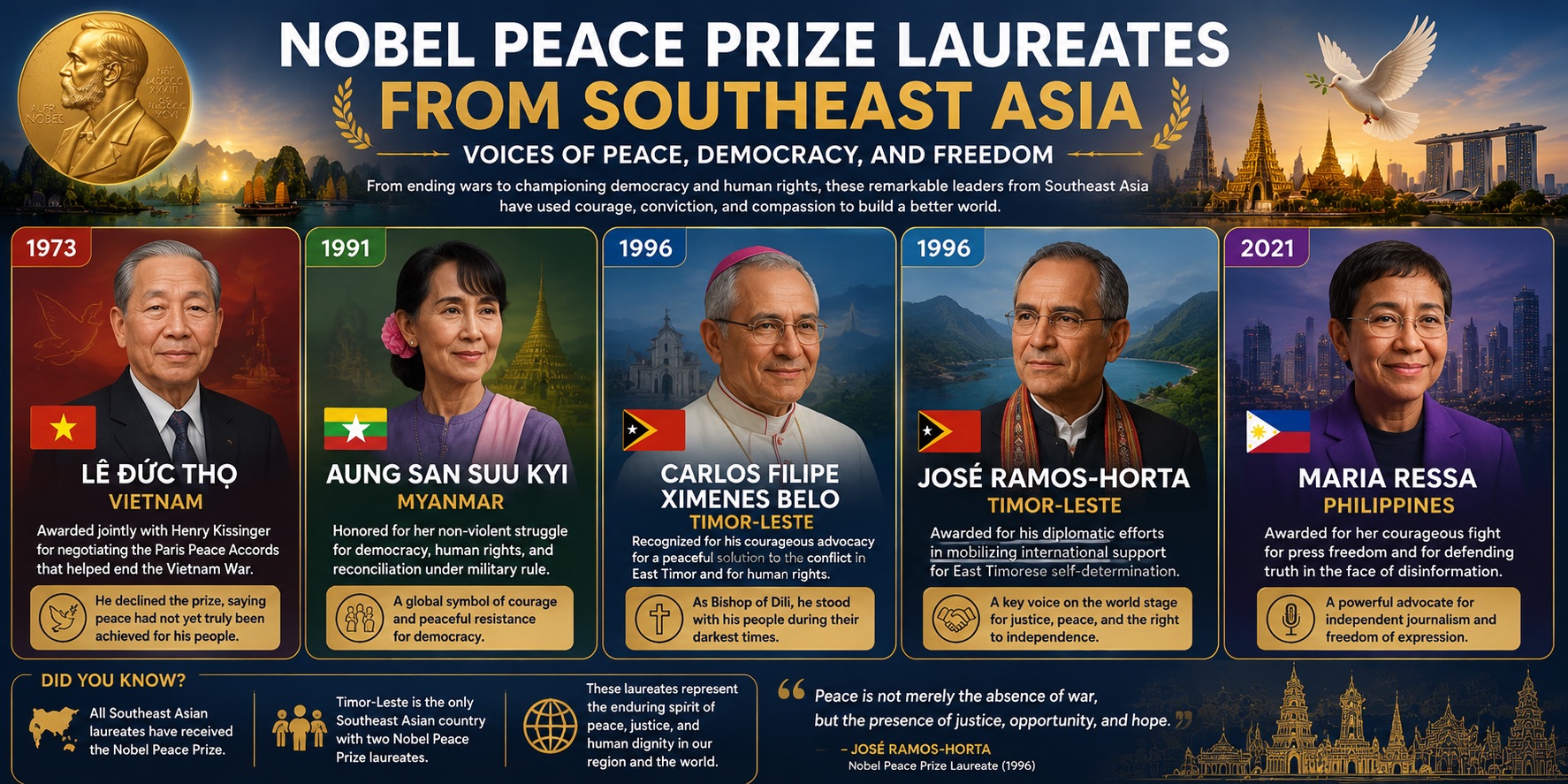
To date, Southeast Asia has produced five Nobel Peace Prize laureates from four countries. Their journeys reflect not only personal conviction but also the broader aspirations of millions across the region seeking dignity, justice, and peace.
From Conflict to Hope
The first Southeast Asian Nobel Peace Prize laureate was Vietnam's Lê Đức Thọ in 1973. Awarded jointly with Henry Kissinger for negotiating the Paris Peace Accords, which aimed to end the Vietnam War, Lê Đức Thọ became the first person from Southeast Asia to receive the prestigious honor. Remarkably, he declined the award, arguing that genuine peace had not yet been achieved in Vietnam. His decision remains unique in Nobel Prize history.
Nearly two decades later, Myanmar's Aung San Suu Kyi received the Nobel Peace Prize in 1991 for her non-violent struggle for democracy and human rights. At a time when Myanmar was under military rule, she became an international symbol of peaceful resistance and democratic aspirations.
In 1996, Southeast Asia witnessed a historic milestone when two leaders from Timor-Leste shared the Nobel Peace Prize. Bishop Carlos Filipe Ximenes Belo and José Ramos-Horta were recognized for their efforts to achieve a peaceful resolution to the conflict in East Timor. Their advocacy helped bring international attention to the Timorese people's quest for self-determination and ultimately contributed to the country's independence in 2002.
The most recent laureate from the region is Maria Ressa of the Philippines, who received the Nobel Peace Prize in 2021 alongside Russian journalist Dmitry Muratov. Honored for defending freedom of expression and independent journalism, Ressa's work highlighted the growing importance of press freedom in the digital age.
A Region's Ongoing Journey Toward Peace
The stories of these laureates are closely intertwined with Southeast Asia's broader history. During the second half of the twentieth century, the region experienced major conflicts, including the Vietnam War, the Cambodian civil war, insurgencies in several countries, and the struggle for independence in Timor-Leste.
Yet Southeast Asia has also become one of the world's most successful examples of regional cooperation. Since the founding of ASEAN in 1967, member states have largely avoided interstate war and developed mechanisms for dialogue and conflict management. Today, ASEAN represents more than 680 million people and one of the world's fastest-growing economic regions.
The contributions of Southeast Asia's Nobel Peace Prize laureates reflect this transformation. Their efforts remind the world that peace is not merely the absence of conflict but the presence of justice, opportunity, and human dignity.
José Ramos-Horta, who later became President of Timor-Leste, once said, "Peace is not merely the absence of war, but the presence of justice, opportunity, and hope." His words resonate far beyond his homeland and capture the aspirations of many communities across Southeast Asia.
A Legacy That Continues to Inspire
The Nobel Peace Prize laureates of Southeast Asia come from different backgrounds—diplomats, religious leaders, democracy advocates, and journalists. Yet they share a common belief that peaceful change is possible even in the most difficult circumstances.
Their stories continue to inspire a region that is home to extraordinary diversity, resilience, and ambition. From the rice fields of Vietnam and the cities of the Philippines to the mountains of Myanmar and the shores of Timor-Leste, their legacies remind future generations that courage, dialogue, and compassion remain among humanity's most powerful forces.
As Southeast Asia continues its journey through the twenty-first century, these voices of peace stand as enduring symbols of the region's capacity to overcome challenges and build a more hopeful future.


