


In Southeast Asia's race toward electric mobility, much of the spotlight has focused on manufacturing giants such as Thailand, Indonesia, and increasingly Vietnam. Yet quietly, on the northern coast of Borneo, Brunei Darussalam is crafting a different kind of electric vehicle success story—one built not on factories and exports, but on adoption, sustainability, and quality of life.
With a population of around 460,000 people and one of the highest income levels in the region, Brunei may be small in size, but its potential as an EV-friendly nation is attracting growing attention.
A Natural Environment for Electric Vehicles
Brunei possesses several advantages that make electric mobility particularly practical. Unlike larger countries where drivers routinely travel hundreds of kilometers between cities, most journeys in Brunei are relatively short. A drive from Bandar Seri Begawan to Kuala Belait, for example, can be completed in just a few hours.
This compact geography significantly reduces concerns about battery range, one of the most common barriers to EV adoption worldwide. For many Bruneian households, a fully charged vehicle can comfortably meet several days of commuting needs before requiring another charge.
Equally important is the country's residential landscape. Many homes have dedicated parking areas, making overnight home charging a convenient and cost-effective option for drivers.
Supporting a Greener National Vision
Brunei's EV ambitions form part of a broader commitment to environmental sustainability. Through the National Climate Change Policy, the government has identified transportation as one of the key sectors for reducing greenhouse gas emissions and supporting a low-carbon future.
In recent years, public charging facilities have gradually appeared in strategic locations across the country. Although the network remains smaller than those found in Singapore or Malaysia, the steady expansion demonstrates a growing commitment to supporting electric mobility.
Minister of Transport and Infocommunications Pengiran Dato Shamhary Pengiran Dato Mustapha has emphasized the importance of sustainable transportation in achieving Brunei's environmental goals, noting that cleaner mobility solutions are an important component of the nation's long-term development strategy.
New Players Accelerating Market Growth
Brunei's EV market is also benefiting from the arrival of new automotive brands. Chinese manufacturers such as BYD, MG, GWM, and Denza have gained visibility among local consumers by offering modern technology, competitive pricing, and vehicle models suited to family-oriented lifestyles.
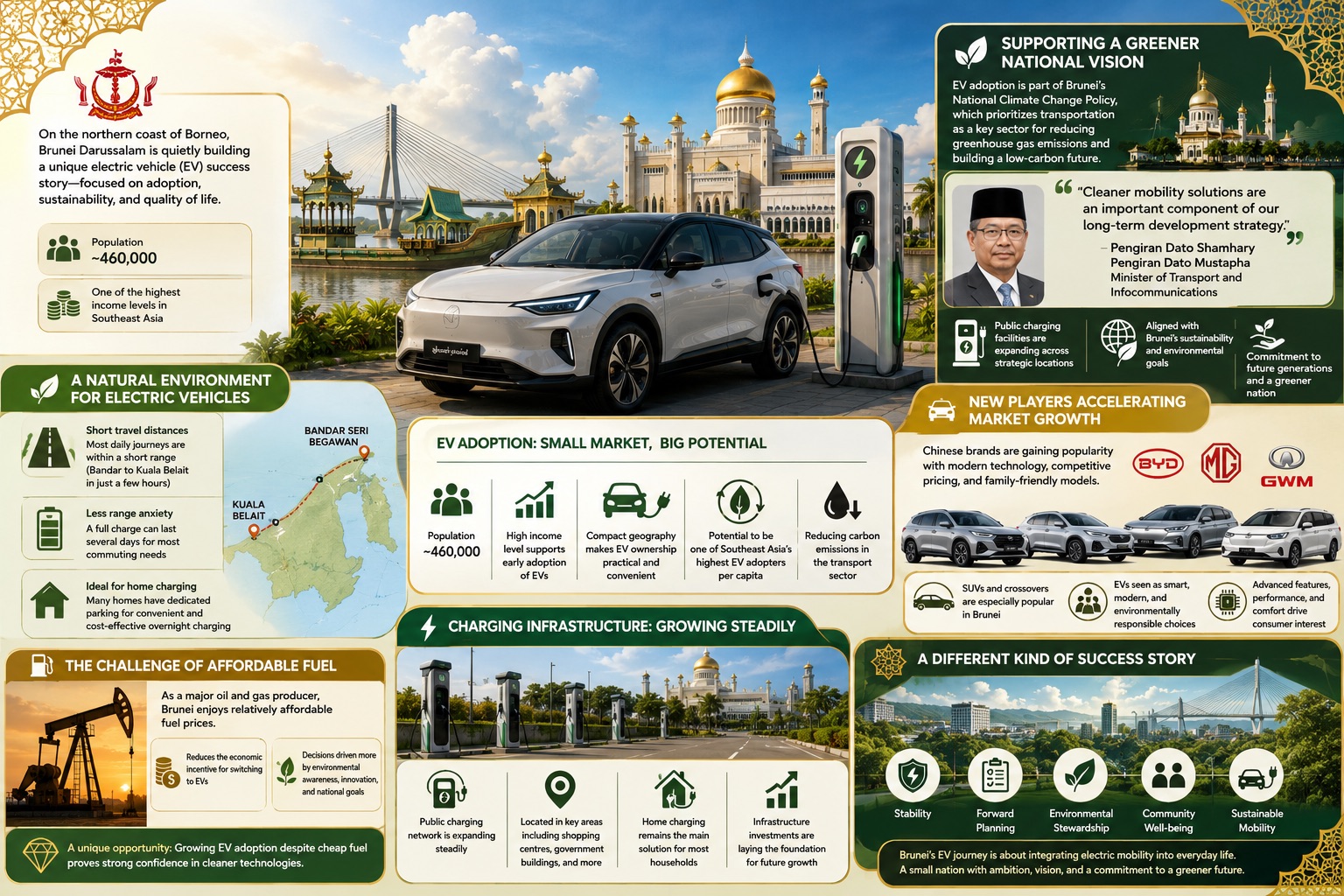
This trend mirrors developments across Southeast Asia, where Chinese automakers have emerged as major drivers of EV adoption. In Brunei, SUVs and crossover vehicles remain particularly popular, aligning well with the product offerings available in the market.
As consumer awareness grows, EVs are increasingly being viewed not only as environmentally responsible vehicles but also as technologically advanced alternatives that deliver comfort, performance, and convenience.
The Challenge of Affordable Fuel
Despite these positive developments, Brunei faces a unique challenge. As one of Southeast Asia's leading oil and gas producers, the country enjoys relatively affordable fuel prices compared to many of its regional neighbors.
This reality reduces one of the strongest incentives for switching to electric vehicles: fuel savings. Consequently, purchasing decisions are often influenced less by economics and more by environmental awareness, technological innovation, and a desire to support national sustainability goals.
Yet this challenge may also create a unique opportunity. If EV adoption can continue growing even in a market with inexpensive fuel, it would demonstrate the strength of consumer confidence in cleaner transportation technologies.
A Different Kind of Success Story
Brunei is unlikely to compete with Thailand's assembly plants or Indonesia's battery industry. Its path will be measured differently—through how seamlessly electric vehicles become part of everyday life.
As charging infrastructure expands and public awareness increases, Brunei has the potential to become one of Southeast Asia's leading EV adopters on a per-capita basis. For a nation known for stability, forward planning, and environmental stewardship, the transition to electric mobility represents another step toward a more sustainable future.
In the years ahead, Brunei's EV journey may prove that size is not the defining factor in innovation. Sometimes, the most compelling success stories come from the smallest places, where ambition, practicality, and vision come together to drive meaningful change.


