


At dawn, Angkor Wat emerges slowly from the darkness, its lotus-shaped towers reflected in the surrounding water. For Cambodia, this is more than a celebrated view. It is a living expression of Khmer creativity, spirituality and resilience that has endured for nearly nine centuries.
A Universe Carved in Stone
Constructed in the early 12th century under King Suryavarman II, Angkor Wat was originally dedicated to the Hindu deity Vishnu before gradually becoming a centre of Buddhist worship. Its design represents the sacred universe: the central towers evoke Mount Meru, while the galleries, walls and expansive moat symbolize the surrounding mountains and cosmic oceans.
The temple lies within the roughly 400-square-kilometre Angkor Archaeological Park, which contains the remains of successive Khmer capitals dating from the ninth to the 15th century. Angkor Wat itself occupies approximately 162 hectares and is widely recognized as the world’s largest religious monument.
Its position on Cambodia’s national flag confirms that Angkor is not confined to archaeology. The temple represents sovereignty, cultural continuity and pride, connecting modern Cambodians with a civilization whose artistic and engineering achievements once influenced much of mainland Southeast Asia.
Water Sustained an Empire
Angkor’s grandeur was made possible by water. Ancient Khmer engineers developed reservoirs, canals, dikes, ponds and spillways to collect monsoon rain, limit flooding and distribute water during the dry season. These systems supported urban communities and surrounding rice fields, earning Angkor recognition as a sophisticated “hydraulic city.”
The Western Baray, one of Angkor’s great reservoirs, measures approximately eight kilometres by 2.2 kilometres and can store an estimated 56 million cubic metres of water. It continues to support irrigation while helping replenish groundwater and preserve the surrounding cultural landscape.
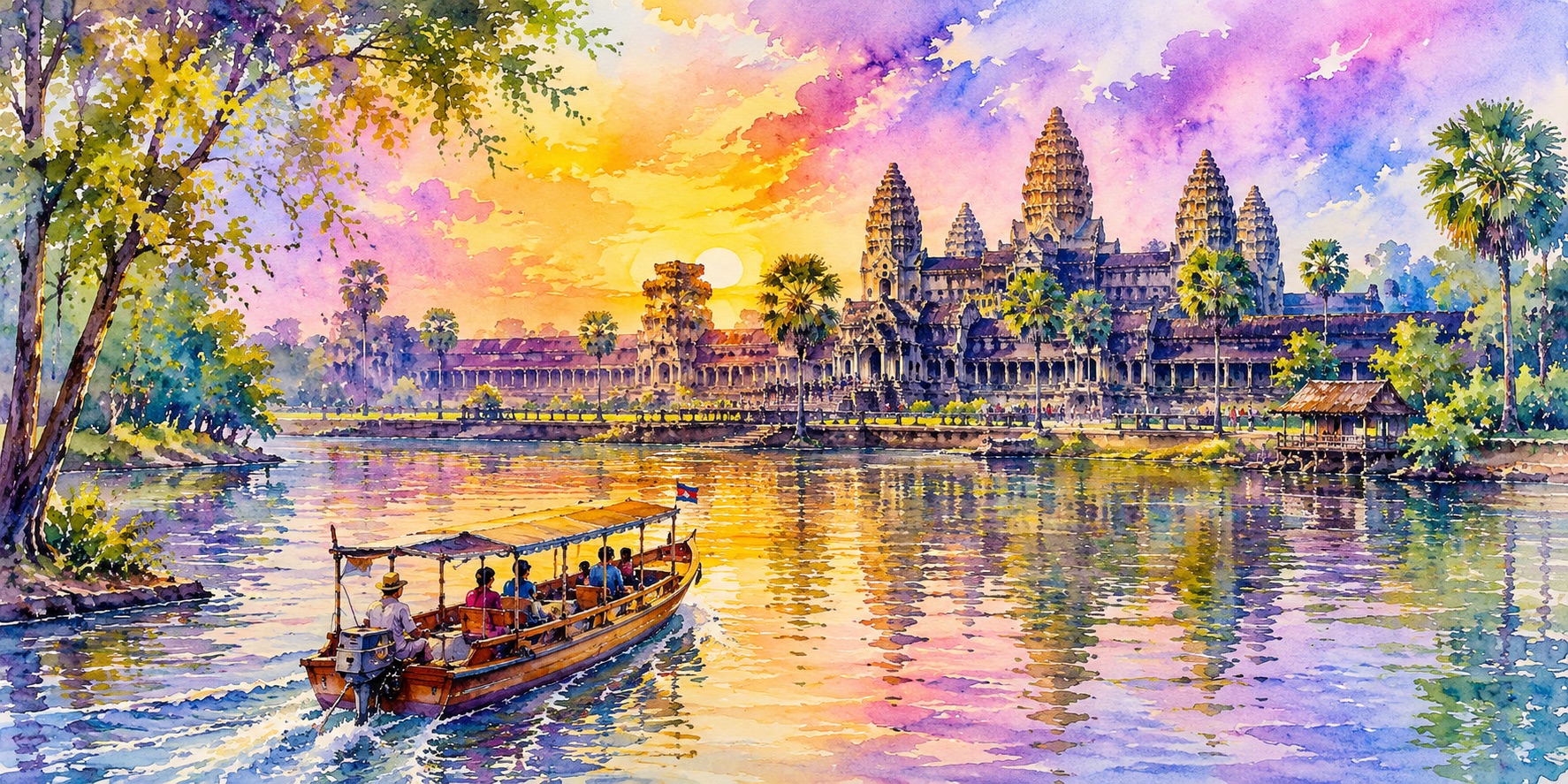
This engineering reflects Cambodia’s wider geography. Across the country’s 181,035 square kilometres, settlement and agriculture remain closely connected to the Mekong River and Tonle Sap Lake. The lake’s seasonal expansion and reversing river flow continue to shape fishing, rice cultivation and community life, echoing the Khmer understanding that water must be respected, managed and shared.
Ancient Art Moves Again
Angkor’s sandstone walls are populated by graceful apsaras and devatas, their elaborate clothing, jewellery and gestures preserved in intricate reliefs. Those figures continue to move through the Royal Ballet of Cambodia, where dancers spend years mastering controlled steps and expressive hand movements rooted in Khmer court traditions.
The connection between sculpture and performance makes Angkor a living cultural source rather than a silent monument. Religious ceremonies, traditional arts and community practices remain part of the surrounding landscape.
Cambodian Minister of Culture and Fine Arts Phoeurng Sackona captured this continuity when she said, “Remembering the past is building the future; abandoning culture is abandoning oneself.”
Heritage as a Shared Responsibility
Angkor survived political upheaval, conflict and the devastating Khmer Rouge period. Its restoration has since become an international undertaking, but its future ultimately depends on Cambodian stewardship, responsible tourism and the participation of communities living around the site.
Long Kosal of the APSARA National Authority has emphasized that “the protection of heritage is the duty of every Cambodian.” That responsibility includes conserving temples, forests and water systems while ensuring that tourism also supports local livelihoods.
Angkor Wat continues to give Cambodia a powerful language of identity. Carved in stone, sustained by water and renewed through living traditions, it reminds the world that the Khmer legacy is not simply something Cambodia inherited—it is something the country continues to carry forward.


