


A few years ago, spotting an electric vehicle on the streets of Phnom Penh was a rare sight. Today, EVs are becoming an increasingly familiar part of Cambodia's urban landscape, from sleek passenger cars navigating the capital's boulevards to electric tuk-tuks quietly transporting passengers through busy neighborhoods.
What makes Cambodia's EV story remarkable is not simply the growth itself, but the speed at which it is happening. In a country better known for Angkor Wat, garment manufacturing, and agricultural exports, electric mobility is emerging as one of the Kingdom's most ambitious transformations.
From a Single EV to a National Movement
Cambodia's EV journey began from an extraordinarily small base. In 2018, only one registered electric vehicle existed in the entire country. Less than a decade later, the landscape looks dramatically different.
By early 2026, total EV registrations had surpassed 16,000 units nationwide. The momentum has been particularly impressive in recent years, with registrations increasing by approximately 127 percent in 2025 alone and nearly 8,000 new electric vehicles added to Cambodian roads within a single year.
Unlike many countries where EV adoption is concentrated among luxury car buyers, Cambodia's market is more diverse. Electric passenger vehicles share the roads with electric scooters and electric three-wheelers, reflecting the practical transportation needs of everyday Cambodians.
Government Policy Driving Change
Behind this growth is a clear national strategy. Under Cambodia's National Policy on Electric Vehicle Development 2024–2030, the government has established ambitious targets that aim to place 30,000 electric cars, 720,000 electric motorcycles, and 20,000 electric tricycles on the nation's roads by the end of the decade.
To support this transition, authorities have introduced significant tax incentives designed to reduce the upfront cost of ownership. Import duties on EVs have been substantially reduced, with many categories benefiting from zero-percent import duties.
Minister of Public Works and Transport Peng Ponea has emphasized that electric mobility forms an important pillar of Cambodia's sustainable transport future and broader environmental commitments. The policy aligns closely with the country's Long-Term Strategy for Carbon Neutrality, which envisions 40 percent of cars and buses, and 70 percent of motorcycles, becoming electric by 2050.
Building the Infrastructure for Tomorrow
Like many emerging EV markets, Cambodia faces the challenge of expanding charging infrastructure fast enough to keep pace with adoption.
While Phnom Penh and other major urban centers have seen a growing number of charging stations, extending access into provincial areas remains a priority. Addressing concerns about driving range and charging availability will be essential to encouraging broader consumer confidence.
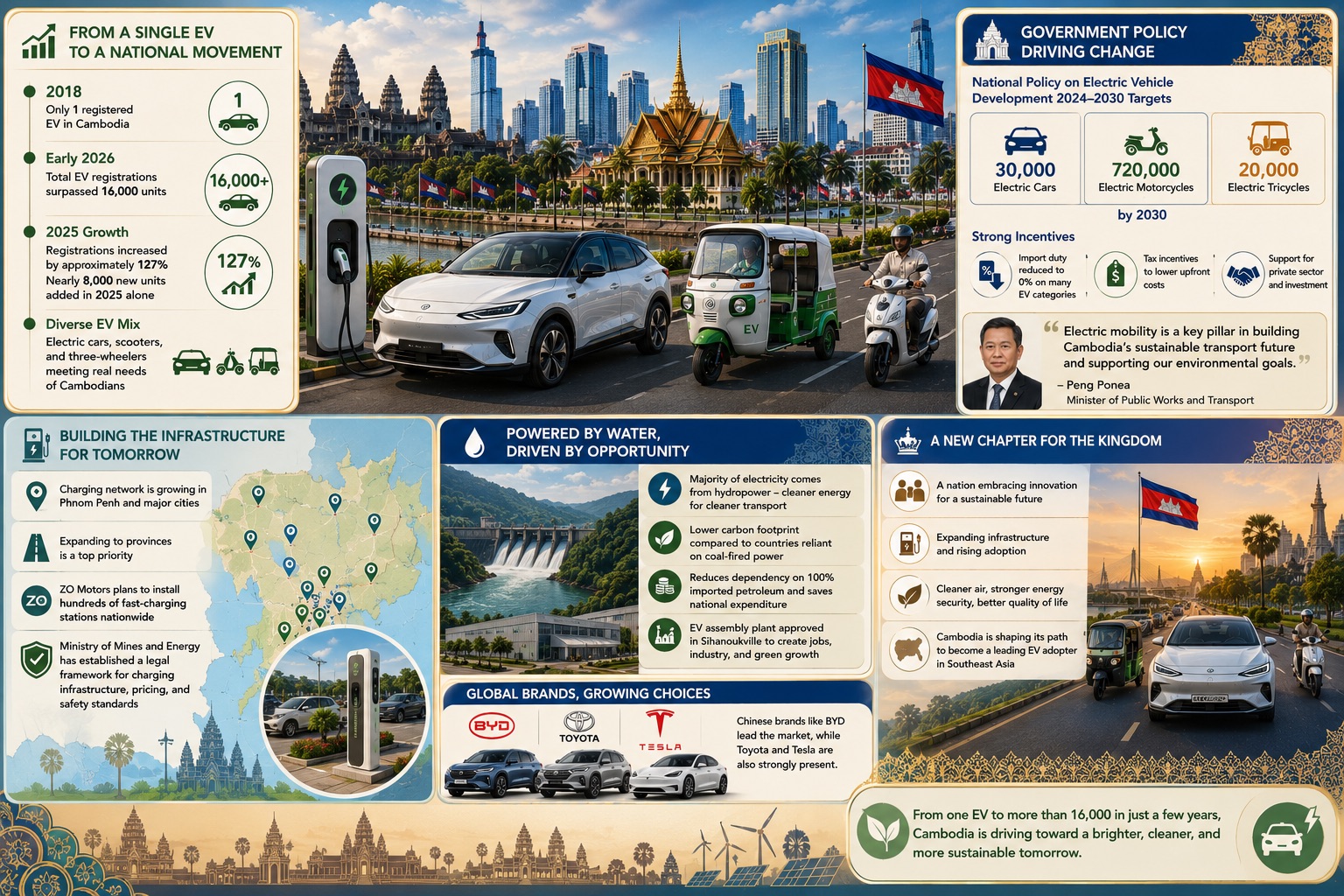
Progress is already underway. Private-sector initiatives, including plans by companies such as ZO Motors to install hundreds of fast-charging stations nationwide, are helping build the foundation for a future electric transport network.
At the same time, the Ministry of Mines and Energy has established a legal framework governing charging infrastructure, including regulations covering public charging stations, pricing standards, and safety requirements.
Powered by Water, Driven by Opportunity
Cambodia's EV transition carries a unique advantage that distinguishes it from many countries around the world.
A significant portion of the nation's electricity is generated through hydropower. This means that electric vehicles can operate with a considerably lower carbon footprint than in countries where electricity production relies heavily on coal-fired power plants.
The economic implications are equally significant. Cambodia imports virtually all of its petroleum fuels, creating a substantial outflow of national expenditure. Expanding EV adoption allows transportation to increasingly rely on domestically generated electricity rather than imported fuel.
Meanwhile, Cambodia is also seeking to develop local manufacturing capacity. The approval of an EV assembly plant in Sihanoukville signals a desire to move beyond vehicle imports, creating new industrial opportunities, skilled jobs, and investment within the green economy.
Chinese manufacturers, particularly BYD, currently dominate the market, while Toyota and Tesla have also established a visible presence among Cambodian consumers.
A New Chapter for the Kingdom
Cambodia's EV story is ultimately about more than transportation. It is a reflection of a nation embracing innovation while pursuing sustainable development and energy security.
From a single registered EV to more than 16,000 in just a few years, the Kingdom has demonstrated how quickly change can happen when policy, investment, and public interest align. As charging networks expand and adoption continues to accelerate, Cambodia is positioning itself not merely as a participant in Southeast Asia's electric future, but as one of its most dynamic emerging success stories.


