


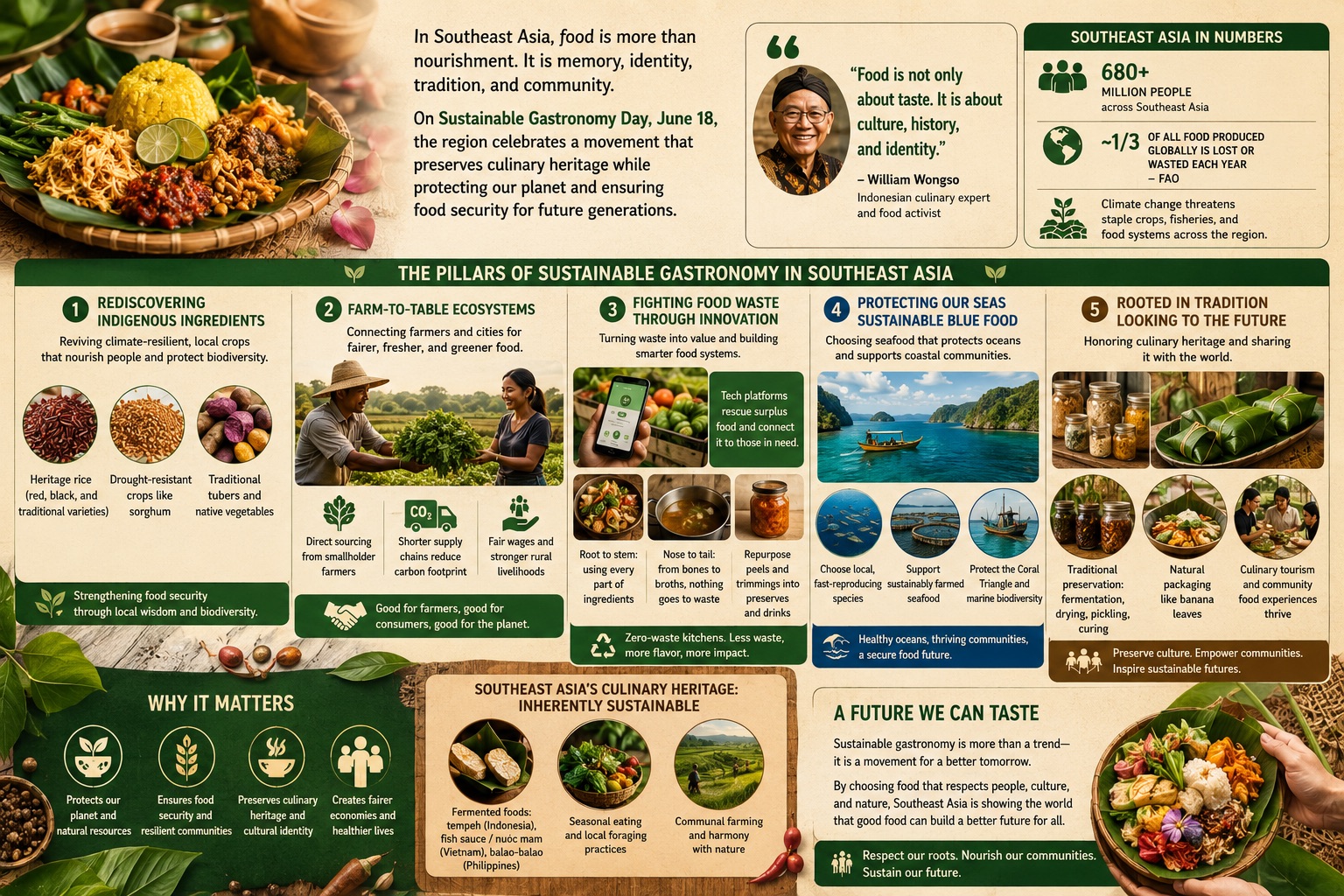
In Southeast Asia, food is far more than nourishment. It is memory, identity, tradition, and community woven together through generations. From the fragrant nasi ulam of Malaysia and Indonesia to Vietnam's steaming bowls of pho and the Philippines' rich regional delicacies, the region's culinary heritage reflects centuries of cultural exchange and environmental adaptation.
Yet as Southeast Asia marks Sustainable Gastronomy Day on June 18, a new question has emerged alongside its celebrated food culture: how can future generations continue enjoying these traditions in a world increasingly affected by climate change, urbanization, biodiversity loss, and food insecurity?
Across the region, chefs, farmers, entrepreneurs, and communities are responding with a growing movement that seeks to preserve culinary heritage while protecting the ecosystems that make it possible.
Rethinking Food in a Changing Climate
Sustainable gastronomy refers to the practice of producing, preparing, and consuming food in ways that respect environmental, social, and economic sustainability. It encourages consumers to think about where ingredients come from, how they are cultivated, how far they travel, and how much is wasted before reaching the dining table.
The issue has become increasingly important in Southeast Asia, home to more than 680 million people and some of the world's most diverse agricultural landscapes. Rising temperatures, changing rainfall patterns, declining fish stocks, and rapid urban expansion are placing unprecedented pressure on traditional food systems.
According to the United Nations Food and Agriculture Organization, approximately one-third of all food produced globally is lost or wasted every year. In many rapidly growing Southeast Asian cities, food waste has become one of the largest contributors to municipal solid waste, creating environmental and economic challenges simultaneously.
At the same time, climate change is affecting the production of staple crops such as rice, coffee, cocoa, and tropical fruits that millions depend upon for both income and nutrition.
Rediscovering Indigenous Ingredients
One of the most promising responses has been the revival of indigenous and climate-resilient ingredients.
Across Indonesia and Thailand, chefs are increasingly showcasing heritage rice varieties such as red rice, black rice, and locally adapted strains that require fewer resources while preserving biodiversity. In parts of Indonesia, sorghum and traditional tubers are returning to menus after decades of being overshadowed by imported commodities.
The movement reflects a growing recognition that traditional crops often possess natural resilience developed through centuries of adaptation to local conditions.
As renowned Indonesian culinary expert and food activist William Wongso once observed, "Food is not only about taste. It is about culture, history, and identity." His words resonate strongly with efforts to preserve local ingredients that tell the story of Southeast Asia's diverse communities.
The return of indigenous ingredients is not merely nostalgic. It is increasingly viewed as a practical strategy for strengthening food security in a changing climate.
Building Stronger Connections Between Farmers and Cities
Another major transformation is occurring through the rise of farm-to-table ecosystems.
In culinary hubs such as Bali, Bangkok, Manila, and Ho Chi Minh City, restaurants are working directly with smallholder farmers to source seasonal produce, herbs, fruits, and livestock. By shortening supply chains, these partnerships reduce transportation emissions while ensuring fairer returns for producers.
Consumers are becoming more interested in knowing who grows their food and how it is produced. Farmers, in turn, gain access to stable markets that encourage sustainable agricultural practices.
Community-supported agriculture initiatives have also expanded in several ASEAN countries, allowing urban residents to purchase produce directly from local farms. These programs strengthen rural livelihoods while helping consumers reconnect with the origins of their meals.
Fighting Food Waste Through Innovation
Food waste has emerged as one of the defining challenges of modern gastronomy.
Across Southeast Asia, innovative startups are developing digital platforms that connect restaurants, supermarkets, and food suppliers with charities and consumers before surplus food is discarded. Meanwhile, a growing number of chefs are embracing zero-waste kitchen philosophies.
Vegetable stems become stocks and sauces. Fish bones are transformed into broths. Fruit peels are repurposed into preserves and beverages. What was once considered waste is increasingly viewed as a valuable resource.
These efforts draw inspiration from traditional Southeast Asian cooking practices, where resourcefulness has long been a hallmark of household kitchens.
Historically, communities throughout the region developed preservation techniques such as fermentation, drying, pickling, and curing to maximize ingredients and reduce waste. Products such as tempeh in Indonesia, fish sauce in Vietnam, and balao-balao in the Philippines reflect centuries of culinary ingenuity rooted in sustainability.
Protecting the Future of Southeast Asia's Seafood
Sustainable gastronomy also extends beyond farms and into the sea.
The Coral Triangle, which encompasses waters surrounding Indonesia, Malaysia, and the Philippines, contains some of the world's richest marine biodiversity. However, overfishing, habitat destruction, and climate change threaten many fish populations that support local livelihoods and food security.
In response, chefs and seafood suppliers are increasingly promoting responsibly sourced seafood. Consumers are encouraged to choose abundant local species and sustainably farmed shellfish rather than endangered or overexploited fish stocks.
These efforts help preserve marine ecosystems while ensuring future generations can continue benefiting from the region's extraordinary aquatic resources.
A Sustainable Future Rooted in Tradition
Perhaps the most encouraging aspect of Southeast Asia's sustainable gastronomy movement is that many of its solutions are not entirely new. They are rooted in traditions that communities have practiced for generations.
Banana-leaf packaging, seasonal cooking, fermentation, communal farming, and local sourcing all existed long before sustainability became a global movement. Today, these practices are being rediscovered and adapted for modern challenges.
As governments increasingly promote culinary tourism and community-based food experiences, visitors are also gaining opportunities to learn directly from farmers, fishermen, indigenous communities, and traditional cooks who have long understood the relationship between food and nature.
Sustainable Gastronomy Day serves as a reminder that the future of food depends not only on innovation but also on wisdom. Across Southeast Asia, protecting culinary heritage and protecting the environment are becoming part of the same journey.
The region's kitchens, farms, rivers, forests, and coastlines are deeply connected. By choosing food that respects people, culture, and nature, Southeast Asia is demonstrating that gastronomy can nourish more than just individuals—it can help sustain entire communities and ecosystems for generations to come.


