


Along the banks of the Mekong River, a quiet transformation is taking place. While many countries pursue electric vehicles as part of climate commitments or industrial ambitions, Laos has embraced electrification for a more immediate reason: economic resilience.
For the Lao People's Democratic Republic, electric mobility is not merely a technological trend. It is a national strategy designed to reduce dependence on imported fuel, strengthen economic stability, and capitalize on one of the country's greatest assets—abundant renewable energy. In many ways, Laos is creating one of Southeast Asia's most unique EV stories.
Turning Crisis into Opportunity
In recent years, Laos has faced significant economic pressures, including inflation, fuel shortages, and currency challenges. As a landlocked nation that imports virtually all of its petroleum products, fluctuations in global fuel prices have had a direct impact on households and businesses.
In response, the government has implemented some of the region's most aggressive EV policies. One of the most notable measures was the suspension of imports of new petrol- and diesel-powered vehicles through the end of 2026, a decision aimed at accelerating the transition toward electric mobility while reducing foreign currency outflows.
To encourage adoption, authorities introduced a range of incentives, including zero-percent import duties on EVs, a low three-percent consumption tax, and significant discounts on annual road taxes. These policies have rapidly transformed consumer interest into real market growth.
Powered by the Mekong's Energy
Laos is often called the "Battery of Southeast Asia," and for good reason. More than 95 percent of the country's electricity is generated from renewable hydropower. Massive dams along the Mekong River and its tributaries supply both domestic consumption and electricity exports to neighboring countries.
This renewable energy advantage gives Laos a unique position in the EV landscape. In many countries, electric vehicles still depend on electricity generated from fossil fuels. In Laos, however, driving an EV is already largely powered by clean energy.
The economic benefits are equally compelling. Studies supported by the Japan International Cooperation Agency suggest that widespread EV adoption could save Laos up to US$940 million annually by 2030 through reduced fuel imports. For individual drivers, electricity costs can be more than 70 percent lower than conventional fuel expenses.
A Market Growing at Remarkable Speed
Although the market remains relatively small compared with regional giants, growth has been impressive. Total EV registrations have surpassed 14,400 vehicles nationwide, compared with fewer than 1,500 units only a few years ago.
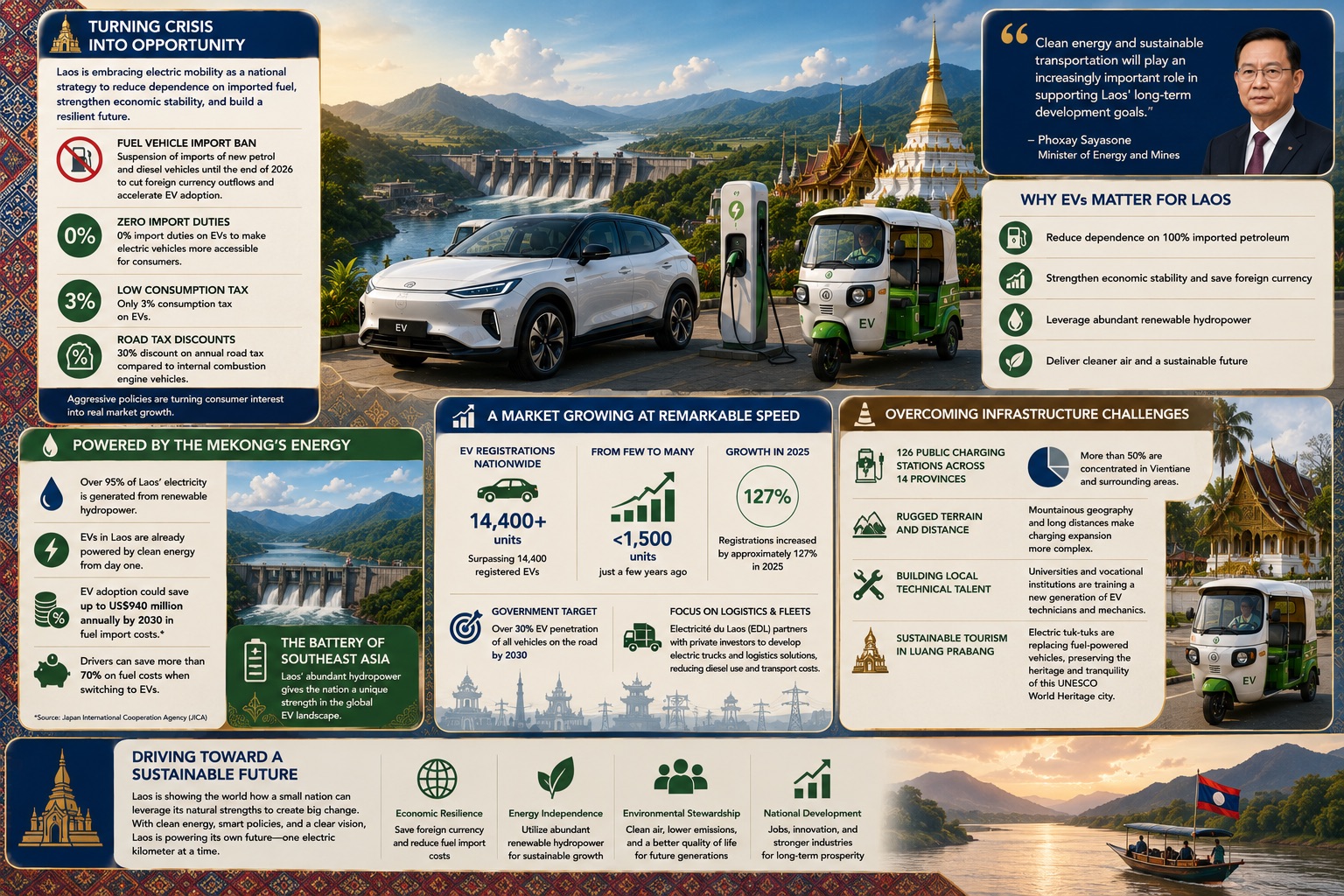
The government aims to increase EV penetration to more than 30 percent of all vehicles by 2030, making Laos one of Southeast Asia's most ambitious electrification markets on a per-capita basis.
State utility Electricité du Laos has also partnered with private investors to develop electric logistics solutions. The transition is particularly important for freight transportation, where reducing diesel consumption can generate substantial savings for businesses and the national economy.
Overcoming Infrastructure Challenges
Despite its momentum, Laos faces significant obstacles. The country's rugged mountainous terrain and dispersed population create challenges for charging infrastructure development.
Of approximately 126 public charging stations currently operating across 14 provinces, a large concentration remains within Vientiane and surrounding areas. Expanding access to northern and southern provinces remains a priority.
The transition also requires a new generation of technical expertise. Universities and vocational institutions have begun training programs focused on EV maintenance and battery technologies, helping mechanics adapt from traditional engine repairs to modern electric drivetrains.
Meanwhile, historic tourism destinations are becoming showcases for sustainable mobility. In Luang Prabang, a UNESCO World Heritage city known for its temples and colonial architecture, electric tuk-tuks are gradually replacing conventional vehicles. Their quiet operation helps preserve the city's peaceful atmosphere while appealing to environmentally conscious visitors.
Driving Toward a Sustainable Future
Laos' EV journey is unlike any other in Southeast Asia. It is not built around automotive manufacturing or export ambitions, but around economic necessity, energy independence, and environmental stewardship.
Minister of Energy and Mines Phoxay Sayasone has emphasized that clean energy and sustainable transportation will play an increasingly important role in supporting the country's long-term development goals. His vision reflects a broader national effort to leverage Laos' renewable energy strengths for future prosperity.
As the country continues to expand charging networks, develop technical expertise, and integrate EVs into daily life, Laos is demonstrating how a small nation can turn its natural advantages into a powerful catalyst for change. In the heart of mainland Southeast Asia, the Battery of Southeast Asia is now beginning to power its own roads as well.


