


For nearly three centuries, a single silver coin could be used to make purchases in the ports of Seville, the markets of Istanbul, the trading centers of the Mughal Empire, and the money-changing tables along the coast of China.
The Spanish called it the real de a ocho, a coin worth eight reales. The rest of the world came to know it as the Spanish dollar, the peso, or the "pieces of eight."
Its silver came from the Americas on a scale the world had never seen before. Between 1500 and 1800, Spain's American colonies produced roughly 150,000 tons of silver.
By 1600, that amounted to more than two-thirds of the world's silver production, and by the late eighteenth century, nearly nine out of every ten tons of silver mined on Earth came from Spanish America. Much of it was minted into the same coin, which became the first currency to truly circulate around the globe.
The extent of its reach can be seen in the direction the silver flowed. In certain years, more silver was shipped across the Pacific to Manila than was sent across the Atlantic back to Spain itself.
A Mountain That Financed an Empire
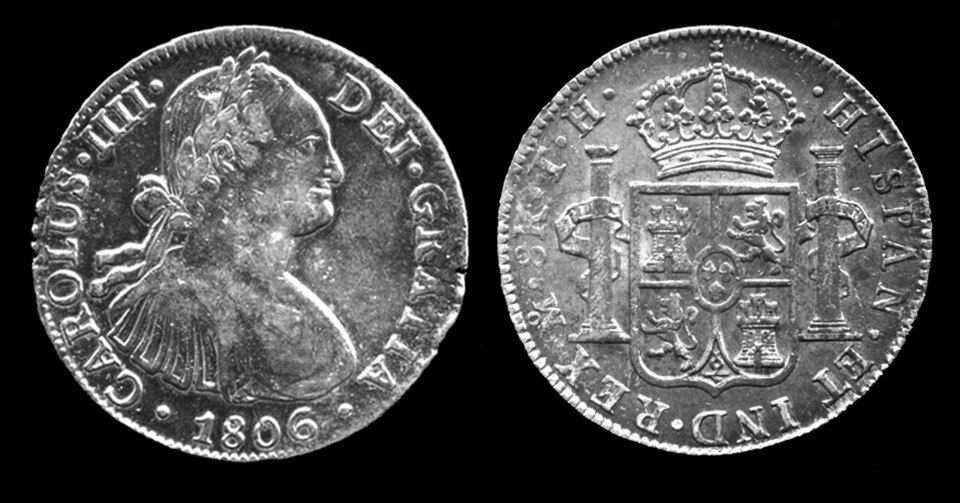
The story of the coin began in the Americas. The Casa de Moneda in Mexico City was established in 1535 and struck its first coins the following year. But the largest source of silver lay much farther south, in the highlands of what is now Bolivia.
In 1545, an Indigenous miner named Diego Huallpa discovered a rich silver vein in a mountain that would later become known as Cerro Rico, or the "Rich Mountain." At its foot grew Potosí, one of the busiest cities in the world during its time.
What transformed Potosí from a mining settlement into a money-producing powerhouse was the arrival of Viceroy Francisco de Toledo in 1572. He established a mint in the city and reorganized the mita, a system of compulsory labor that forced roughly one in every seven Indigenous men to work in the mines. At any given time, around 13,000 workers were assigned to Potosí.
To power the ore-processing mills, an extensive network of dams and canals was constructed between 1572 and 1575. The results were extraordinary: Potosí alone accounted for an estimated 60 to 80 percent of all the silver produced in Spanish America.
It was the coin's consistency that made it so widely trusted. Whether minted in Mexico City, marked with an "M", in Potosí with "PTS", or in Lima with "LM", each coin weighed about 27 grams and contained roughly 90 percent silver.
Merchants on the far side of the world could accept it without having to weigh every individual coin. Although silver standards were revised during the monetary reforms of 1728 and 1772, the underlying principle remained unchanged: one coin, one standard, wherever it circulated.
When Silver Crossed the Pacific
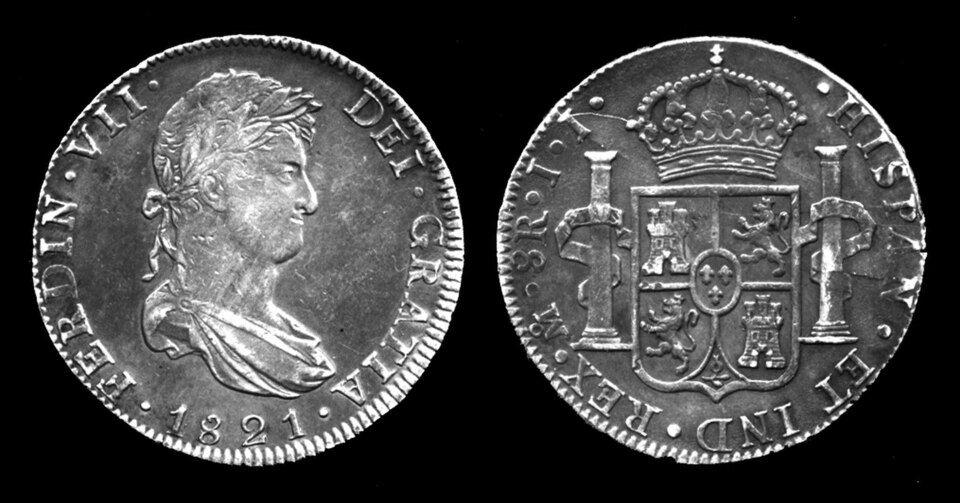
The turning point came in 1571, when Spain established Manila as the trading hub linking Asia and the Americas. From there, the Manila Galleons sailed back and forth between Acapulco and Manila, exchanging American silver for Asian silk, porcelain, and spices.
Historians Dennis Flynn and Arturo Giráldez, writing in the Journal of World History, identify that year as the beginning of truly global trade.
The main magnet at the eastern end of this network was China. When the Ming dynasty's monetary system shifted to a silver standard, the metal suddenly became far more valuable there than elsewhere in the world.
Its value was roughly twice as high because silver exchanged for gold at a ratio of about six to one in China, compared with roughly twelve to one in Europe. This price difference drew silver eastward.
It is estimated that around one-third of all silver produced in Spanish America between 1565 and 1815 reached Asia through the Manila Galleon route, while some estimates place the figure closer to one-half.
Because its weight and purity could be relied upon, the Spanish dollar changed hands almost everywhere—from African ports and Ottoman markets to Mughal trading centers and Japan. The clearest evidence of its widespread circulation, however, can be found in China.
Many surviving coins are covered with chop marks, small stamps applied by local merchants and money changers to indicate that the coin had been inspected and accepted as genuine. A single coin might bear dozens of these marks, serving as a silent record of how many hands it had passed through.
From the Peso to the Dollar
The influence of the Spanish dollar did not end when it ceased to be minted. When the United States established its own currency, Treasury Secretary Alexander Hamilton used the already widespread Spanish dollar circulating in the American colonies as his model.
The Coinage Act, enacted on April 2, 1792, defined one silver dollar as containing 371.25 grains of pure silver, a standard deliberately aligned with the eight-real coin.
The Spanish dollar even remained legal tender in the United States under the law of April 10, 1806. It did not lose that status until the Coinage Act of February 21, 1857, abolished the legal standing of foreign coins. The same monetary model also influenced numerous other currencies, including the pesos adopted by the newly independent republics of Latin America and the Philippine peso.
In Mexico, the eight-real coin continued to be minted until 1897. The silver that once flowed from Cerro Rico to Seville, Manila, and Guangzhou eventually stopped moving. Yet the standard it established, a trusted silver coin of consistent weight and purity, continues to live on in the currencies used around the world today.
References
- Flynn, D. O., & Giráldez, A. (1995). Born with a “silver spoon”: The origin of world trade in 1571. Journal of World History, 6(2), 201–221.
- Lane, K. (2021). Potosí. In New World objects of knowledge. University of London Press. https://read.uolpress.co.uk/read/new-world-objects-of-knowledge/section/8931f828-06b4-495b-8171-38472a1abd0b
- Barragán, R., & Zagalsky, P. C. (Eds.). (06 Mar. 2023). Potosí in the Global Silver Age (16th—19th Centuries). Leiden, The Netherlands: Brill. https://doi.org/10.1163/9789004528680
- UNESCO World Heritage Centre. (n.d.). City of Potosí. https://whc.unesco.org/en/list/420/
- Encyclopaedia Britannica. (n.d.). Potosí, Bolivia. https://www.britannica.com/place/Potosi-Bolivia
- International Institute of Social History (IISG). (2019). Potosí: Producing silver for the world. https://iisg.amsterdam/en/node/718
- American Numismatic Association. (n.d.). Wealth of the New World. https://www.money.org/money-museum/virtual-exhibits-moe-case2/
- United States Mint. (n.d.). Coinage Act of April 2, 1792. https://www.usmint.gov/learn/history/historical-documents/coinage-act-of-april-2-1792
- United States Mint. (n.d.). History of U.S. circulating coins. https://www.usmint.gov/learn/history/us-circulating-coins
- Numista. (n.d.). 8 Reales – Mexico. https://en.numista.com/7394


