Submitting a bid, waiting for the vote, hoping to win, that's roughly how most people imagine a country lands the FIFA World Cup.
In reality, bidding for the world's biggest football tournament is closer to proposing one of the largest national projects a country will ever undertake.
It Starts With Hundreds of Pages, Not a Registration Form
Before a host is chosen, FIFA opens a formal bidding process and publishes detailed bidding regulations and hosting requirements.
For the 2026 FIFA World Cup, candidate hosts submitted comprehensive bid books covering virtually every aspect of the tournament. From stadiums and transportation to security, healthcare, telecommunications, sustainability, and government guarantees.
FIFA even made the complete bid books publicly available, illustrating the scale and complexity of the process.
A World Cup bid is not a simple application. It is a national blueprint explaining how an entire country, or several countries plans to organize the tournament.
Hosting the World Cup Is Becoming Harder
The challenge has grown significantly since the FIFA World Cup expanded from 32 teams to 48 teams beginning in 2026.
The tournament will now feature 104 matches across 16 host cities in three countries, the United States, Canada, and Mexico. The largest FIFA World Cup ever organized.
The increase in teams and matches means more stadiums, more hotels, more transportation capacity, more volunteers, and more supporting infrastructure than previous editions.
This is one reason why joint bids have become increasingly common.
FIFA Specifies Almost Everything
FIFA's hosting requirements extend far beyond football stadiums.
For the expanded 48 team tournament, the opening match and the final require stadiums with at least 80,000 seats, while venues hosting quarterfinals or semifinals must hold at least 60,000 spectators. Other matches generally require stadium capacities of 40,000 seats or more.
Infrastructure requirements also indclude:
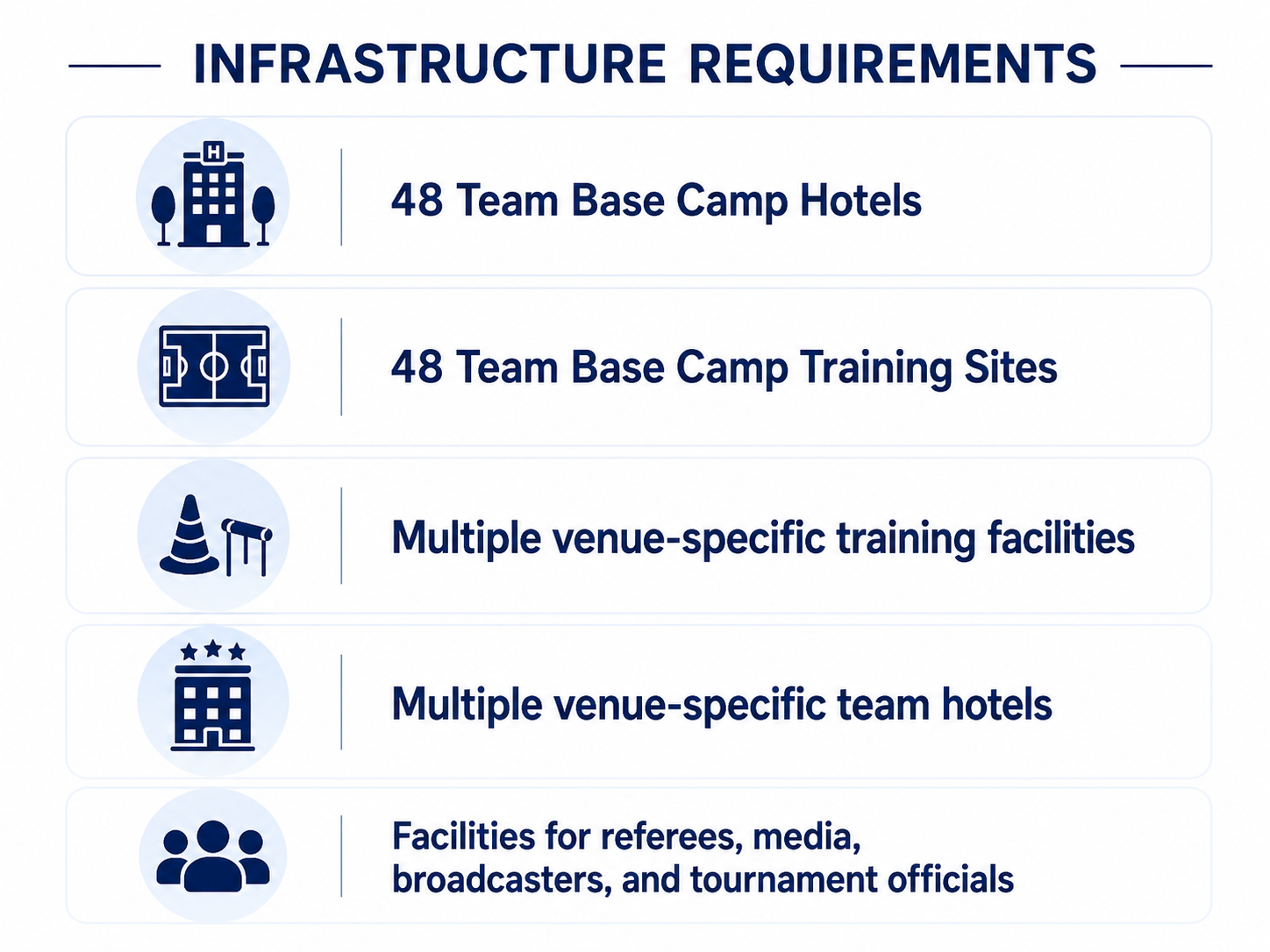
Every proposed venue must also demonstrate adequate transport connections, medical services, security arrangements, and accommodation capacity.
Winning the Bid Doesn't Mean the Work Is Finished
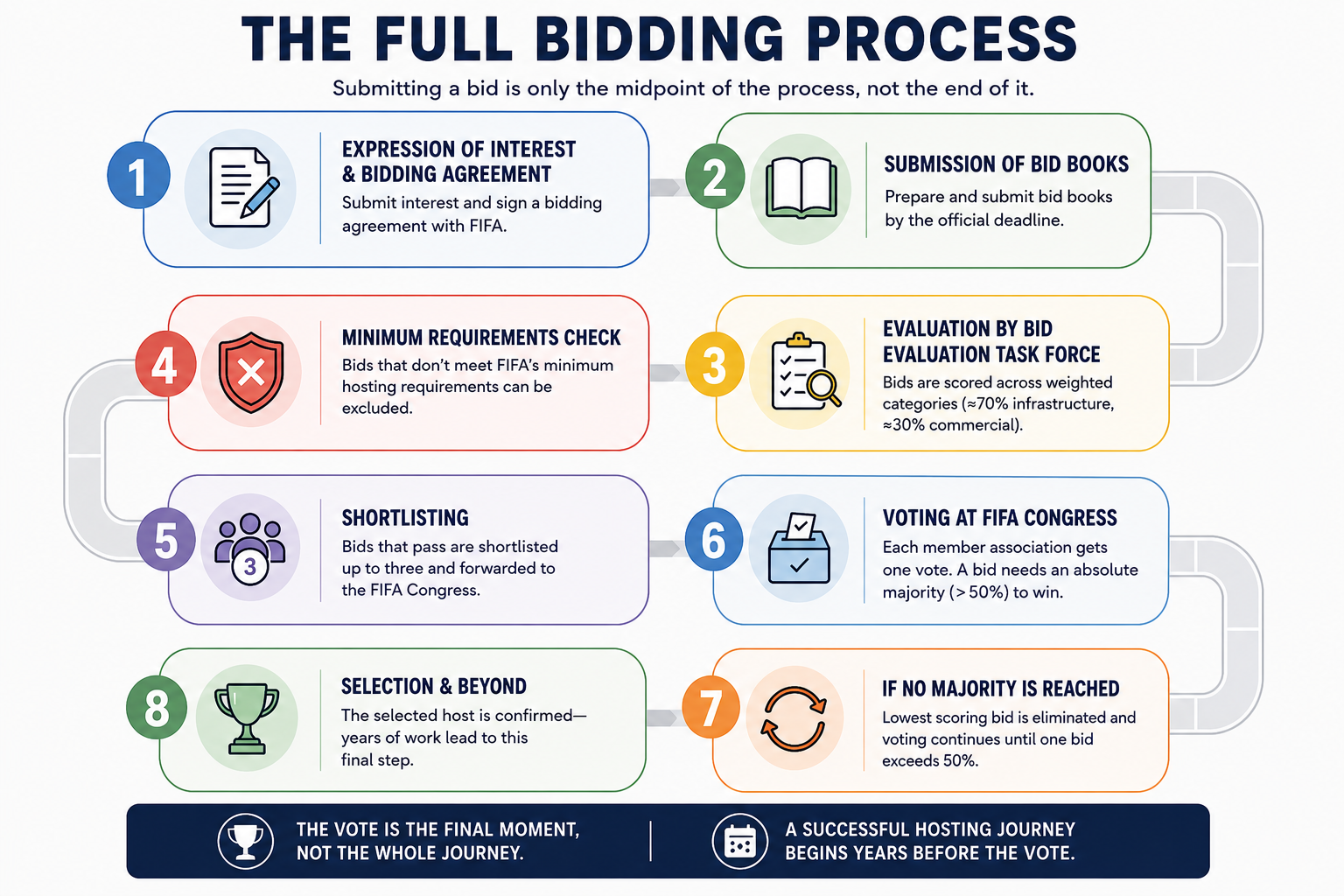
Submitting a bid is only the midpoint of the process, not the end of it.
Before a bid book is even due, candidate hosts must first submit a formal expression of interest and sign a bidding agreement with FIFA, committing them to the process months or years in advance.
Once bid books are in, a dedicated Bid Evaluation Task Force scores each one across weighted categories. Infrastructure typically counts for around 70% of the technical score, with commercial factors making up the rest.
A bid that fails to meet FIFA's minimum hosting requirements at this stage can be excluded from the race entirely, regardless of how the vote might have gone.
Bids that pass are shortlisted up to three, under FIFA's rules and forwarded to the FIFA Congress, where every member association gets one vote. A bid needs an absolute majority to win.
If no bid reaches that threshold in the first round, the lowest scoring option is eliminated and voting continues until one bid crosses 50%.
By the time a country is officially selected, years of planning, negotiation, and evaluation have already taken place, the vote itself is often just the final formality after a process that started long before.
The Tournament Begins Long Before the Opening Match
By the time the first whistle blows at a FIFA World Cup, the real competition has often been underway for more than a decade.
Hosting the tournament is not simply about building stadiums or submitting paperwork. It requires years of national planning, government commitments, technical evaluations, and infrastructure preparation.
Long before a single team qualifies for the competition.