


As remote work continues to reshape how people live and travel, digital nomads are increasingly looking beyond Southeast Asia's established hotspots. While cities like Bali, Chiang Mai, and Ho Chi Minh City remain popular, a growing number of remote professionals are discovering a quieter alternative in the heart of the Mekong region—Laos.
From the UNESCO World Heritage town of Luang Prabang to the steadily modernizing capital of Vientiane, Laos is attracting writers, entrepreneurs, designers, wellness practitioners, and long-term travelers seeking something increasingly difficult to find in today's fast-moving world: peace, authenticity, and space to think.
Luang Prabang: A City That Moves at the Speed of the Mekong
Few places in Southeast Asia embody slow living as naturally as Luang Prabang.
Nestled at the confluence of the Mekong and Nam Khan rivers, the former royal capital has carefully preserved its centuries-old identity. As a UNESCO World Heritage Site since 1995, the city remains remarkably free from towering skyscrapers, flashing billboards, and relentless traffic. Instead, quiet streets are lined with beautifully restored French colonial villas, traditional Lao wooden houses, Buddhist temples, artisan cafés, and riverside gardens.
Each morning begins with the centuries-old Tak Bat almsgiving ceremony, where hundreds of saffron-robed monks silently walk through the streets receiving offerings from local residents. For many digital nomads, this daily ritual has become a reminder that productivity does not always have to be measured by speed.
"The preservation of Luang Prabang's heritage demonstrates that culture can be a powerful driver of sustainable tourism and local development," noted former Lao Minister of Information, Culture and Tourism Bosengkham Vongdara during UNESCO heritage discussions.
Rather than competing with larger cities, Luang Prabang offers something entirely different: a lifestyle centered on mindfulness, creativity, and balance.
Vientiane Offers Urban Comfort Without the Rush
While Luang Prabang attracts creatives and slow travelers, Vientiane provides a more practical base for professionals requiring greater business connectivity.
As Laos' capital, Vientiane has quietly expanded its café culture, boutique co-working spaces, international schools, modern apartments, and healthcare facilities while maintaining one of the most relaxed urban environments in Southeast Asia.
The city's broad boulevards, tree-lined neighborhoods, and French-inspired cafés create an atmosphere that feels distinctly different from the congestion common in many regional capitals.
Reliable internet infrastructure continues to improve, supported by expanding fiber-optic networks and widespread 4G and 5G mobile services. For freelancers, consultants, and entrepreneurs who occasionally require government offices, embassies, or international banking, Vientiane offers convenience without sacrificing quality of life.
Coffee, Creativity, and a New Way of Working
Laos has quietly developed one of Southeast Asia's most underrated café cultures.
Much of this stems from coffee grown on the fertile volcanic soils of the Bolaven Plateau in southern Laos. Specialty cafés serving locally roasted Arabica and Robusta beans have flourished across Luang Prabang and Vientiane, providing welcoming spaces where remote workers can comfortably spend hours writing, designing, coding, or hosting virtual meetings.
Unlike commercial co-working hubs found elsewhere, many workspaces in Laos feel more personal. Riverside cafés overlooking the Mekong, restored colonial mansions converted into boutique hotels, and shaded courtyards filled with tropical gardens have become informal offices for a growing international community.
Travel writer and long-term Southeast Asia digital nomad Nora Dunn, who has written extensively about slow travel, observed that destinations encouraging a slower pace often foster greater creativity and deeper cultural engagement than cities driven by constant activity.
That philosophy resonates strongly in Laos, where work often blends naturally with reflection and exploration.
Nature Remains Part of Everyday Life
One of Laos' greatest advantages is how easily nature becomes part of everyday routines.
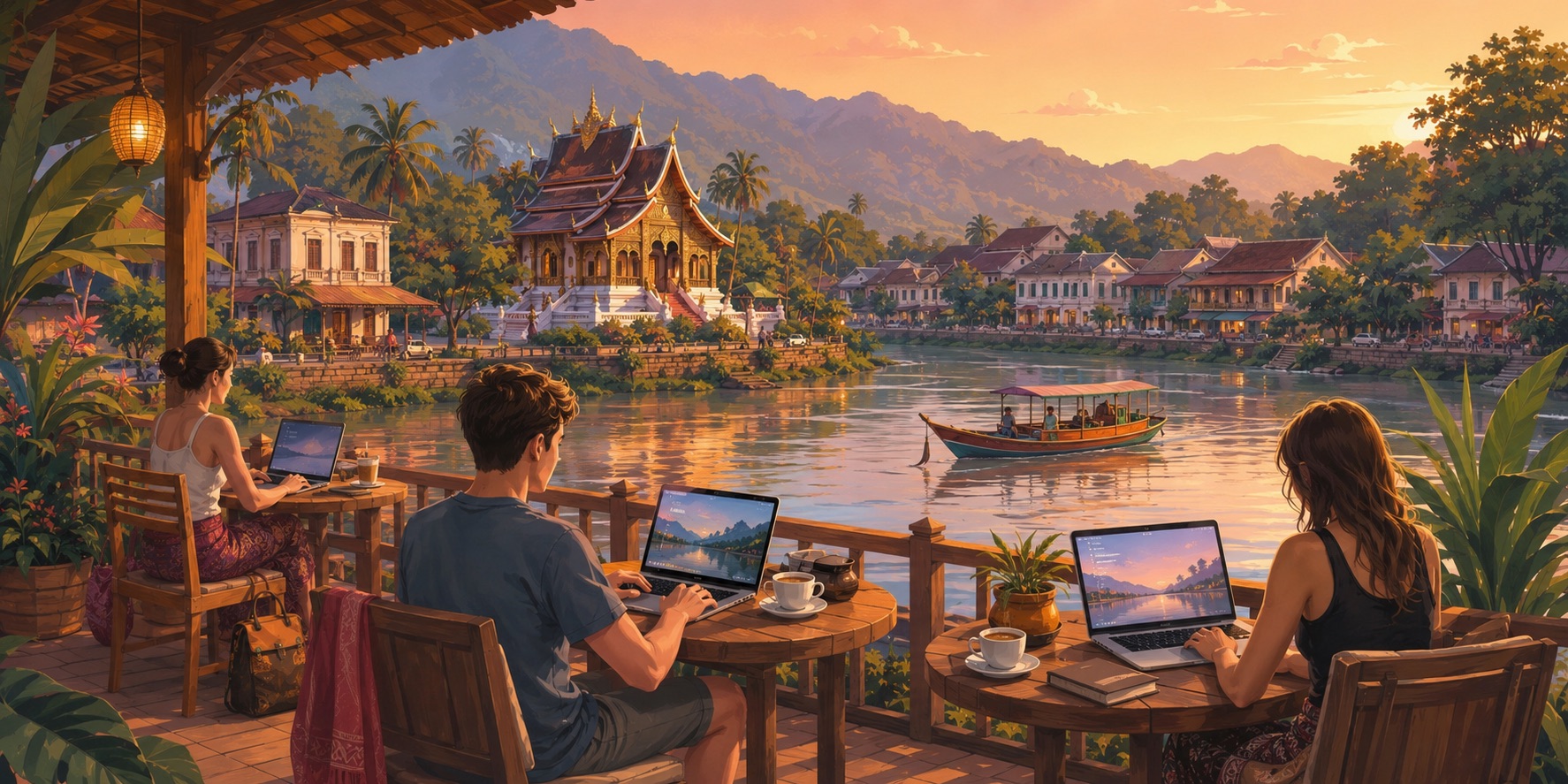
After finishing work, digital nomads can reach the turquoise pools of Kuang Si Waterfalls within an hour, take sunset cruises along the Mekong River, kayak through peaceful waterways, or cycle across bamboo bridges linking traditional villages.
The country's expanding transportation network has also improved mobility. The Lao-China Railway now connects Vientiane, Vang Vieng, and Luang Prabang in just a few hours, making weekend travel faster and more convenient than ever before.
For professionals accustomed to spending long hours behind screens, this easy access to mountains, rivers, and forests has become one of Laos' strongest attractions.
Practical Living in One of Southeast Asia's Most Relaxed Destinations
Living in Laos also comes with practical advantages.
Compared with many neighboring destinations, accommodation, dining, and transportation remain relatively affordable, allowing remote workers to enjoy a comfortable lifestyle without the costs associated with larger regional hubs.
Internet connectivity has improved significantly over recent years, although experienced expats generally recommend keeping a local mobile data plan as backup during heavy monsoon weather. Rather than viewing this as a drawback, many nomads embrace it as part of the country's slower rhythm.
Evenings in Luang Prabang reflect this philosophy. The city's midnight curfew encourages quieter social activities, with riverside restaurants, night markets, cultural performances, and intimate cafés replacing loud nightlife districts.
The result is an environment where work-life balance develops almost naturally.
Tourism Growth Reflects Rising International Interest
Laos' growing appeal is reflected in its tourism recovery.
According to the Ministry of Information, Culture and Tourism, Laos welcomed more than 4 million international visitors in 2024, surpassing expectations and marking one of the country's strongest tourism rebounds. Improved regional connectivity, visa facilitation, and the successful operation of the Lao-China Railway have contributed significantly to renewed visitor growth.
Authorities have also promoted tourism that emphasizes sustainability, cultural preservation, and community-based experiences rather than mass tourism.
As Lao Prime Minister Sonexay Siphandone has emphasized, tourism development should generate economic opportunities while preserving the country's unique cultural identity and natural heritage for future generations.
That approach aligns closely with what many digital nomads increasingly seek today.
Finding Success by Slowing Down
Laos may never compete with Bali's beach clubs or Bangkok's skyscrapers, and that is precisely its greatest strength.
For remote professionals seeking clarity rather than constant stimulation, Luang Prabang and Vientiane offer an increasingly attractive alternative where heritage, nature, and community remain at the center of everyday life. As digital nomadism evolves beyond the pursuit of inexpensive destinations toward a search for meaningful places to live and work, Laos is quietly establishing itself as one of Southeast Asia's most refreshing choices.
Sometimes, the most productive destination is not the busiest one—it is the place that gives you the time and space to breathe, create, and reconnect with what truly matters.


