


For remote professionals searching for a destination that combines reliable infrastructure, cultural diversity, affordability, and tropical living, Malaysia has quietly become one of Asia's strongest contenders. Rather than relying solely on its modern cities or beautiful islands, the country offers something increasingly valuable to location-independent workers: the flexibility to experience multiple lifestyles within a single destination.
From the skyscrapers of Kuala Lumpur to the heritage streets of George Town, Penang, and the beaches of Langkawi, Malaysia has positioned itself as a digital nomad hub supported by the DE Rantau Nomad Pass, one of Southeast Asia's first dedicated digital nomad visa programs. The visa allows eligible foreign remote workers and freelancers earning at least US$24,000 annually to stay for up to 12 months, with the possibility of renewing for another year while bringing eligible dependents.
Kuala Lumpur: Asia's Connected Urban Playground
Malaysia's capital offers everything expected from a global city without the price tag of many other Asian financial centers.
The Petronas Twin Towers, Merdeka 118, efficient rail transit, expanding 5G coverage, and modern residential developments have made Kuala Lumpur attractive to entrepreneurs, startup founders, consultants, and corporate professionals working remotely. Co-working brands such as WORQ, Colony, and Common Ground have become more than shared offices—they are networking spaces where international entrepreneurs, freelancers, and local innovators regularly meet.
English is widely spoken across business, education, and everyday life, making it easy for newcomers to rent apartments, open bank accounts, or simply order coffee without facing significant language barriers.
American entrepreneur and digital nomad Pieter Levels, founder of Nomad List, has often remarked, "Fast internet and a low cost of living are two of the biggest ingredients for a successful remote-work destination." Kuala Lumpur consistently delivers both.
George Town: Where Creativity Meets Culture
A short journey north leads to a completely different rhythm.
Recognized as a UNESCO World Heritage Site, George Town blends colonial architecture, Chinese clan houses, Indian temples, mosques, and colorful murals into one of Southeast Asia's most walkable cities.
For digital nomads, mornings often begin inside restored heritage cafés serving specialty coffee before transitioning into afternoons spent exploring museums, bookstores, galleries, or famous hawker centers.
George Town is frequently described as one of Asia's greatest street food capitals. A remote worker can finish an online meeting before stepping outside for plates of Char Kway Teow, Assam Laksa, or Nasi Kandar—all at remarkably affordable prices.
The slower pace has made Penang especially attractive to writers, designers, photographers, and creative entrepreneurs seeking inspiration beyond the traditional office.
Langkawi: Working Beside the Andaman Sea
For those looking to exchange city skylines for beaches and rainforest, Langkawi provides a dramatically different environment.
The archipelago of 99 islands is recognized as a UNESCO Global Geopark, offering ancient rainforests, limestone cliffs, waterfalls, and white-sand beaches. While life moves more slowly here, reliable internet, beachfront cafés, and eco-resorts allow professionals to remain productive without sacrificing lifestyle.
Langkawi's duty-free status also makes everyday shopping considerably more affordable than many neighboring island destinations.
It is a place where the workday might end with paddleboarding, yoga overlooking the Andaman Sea, or watching the sunset from one of the island's quiet beaches.
A Visa Designed for the Remote Work Era
Malaysia's biggest advantage lies not only in its destinations but also in its policy.
The DE Rantau Nomad Pass offers one of the region's clearest legal pathways for remote workers. Applicants employed by overseas companies or working as independent digital professionals can obtain permission to live and work remotely in Malaysia while maintaining overseas clients or employers. The government continues refining and expanding the program as demand grows.
This institutional approach distinguishes Malaysia from destinations where remote workers often rely on tourist visas despite working online.
One Country, Three Lifestyles
Another reason Malaysia appeals to location-independent professionals is its excellent domestic connectivity.
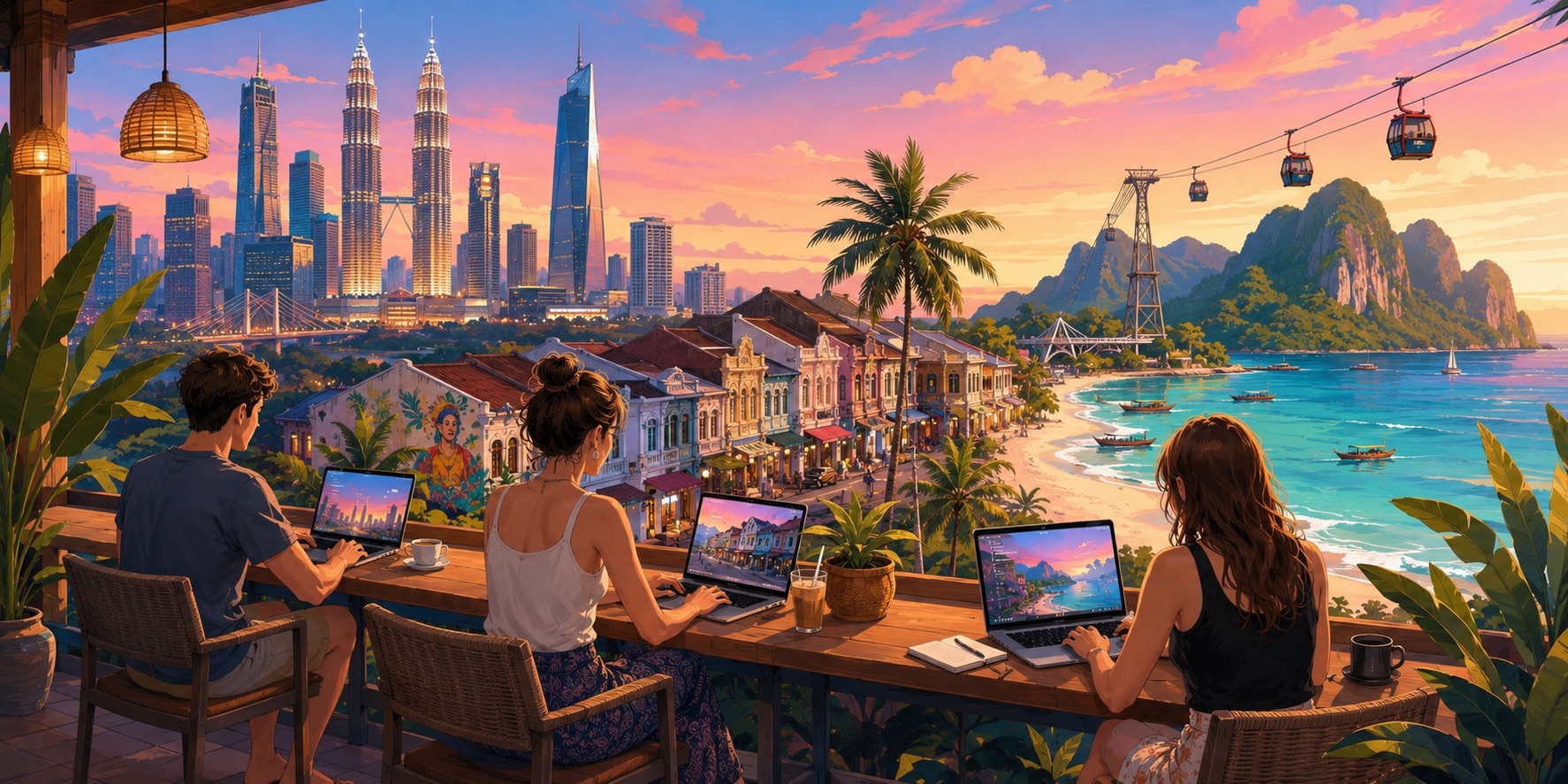
Budget airlines connect Kuala Lumpur with Penang and Langkawi in approximately one hour, while the Electric Train Service (ETS) provides a comfortable rail journey from Kuala Lumpur toward northern Peninsular Malaysia. This makes it possible for nomads to spend several months in the capital before relocating to Penang or escaping to Langkawi without changing countries.
Such flexibility allows professionals to adapt their environment according to project demands, personal preferences, or simply the changing seasons.
Malaysia's Growing Global Appeal
Malaysia's broader tourism and migration trends reinforce its growing international appeal. The country welcomed 42.19 million international visitors in 2025, an increase of 11.2 percent over the previous year, outperforming global tourism growth rates according to government figures.
Malaysia is also home to an estimated 3.38 million non-citizens, reflecting its longstanding role as a regional destination for professionals, students, entrepreneurs, and expatriates.
Malaysia's Minister of Tourism, Arts and Culture, Tiong King Sing, has emphasized that the country's continued growth reflects international confidence in Malaysia as a destination not only for tourism but also for longer-term stays, investment, and international talent.
Finding Balance in Southeast Asia
The rise of digital nomadism has changed what many professionals expect from a destination. Reliable internet alone is no longer enough. Increasingly, remote workers seek places that combine efficiency with authenticity, productivity with well-being, and professional opportunity with cultural richness.
Malaysia delivers that balance through three complementary destinations. Kuala Lumpur offers ambition and connectivity. George Town inspires creativity through history and cuisine. Langkawi provides space to slow down without disconnecting from the world.
Together, they illustrate why Malaysia has become one of Southeast Asia's most compelling homes for the modern remote workforce—and why an increasing number of digital nomads are choosing not just to visit, but to build a lifestyle there.


