Every few months, a headline about China's "artificial sun" goes viral, and every few months people picture the same thing, some glowing baby star locked in a lab, humming away in Hefei. It's a great image, it's also wrong.
China hasn't built a new Sun, nor has it created a tiny star. The so-called "artificial sun" is simply a nickname for a nuclear fusion reactor designed to recreate the same process that powers the Sun, not the Sun itself.
It's a Reactor, Not a Star
A real star exists because of gravity.
The Sun contains about 99.8% of the Solar System's total mass, and its immense gravity compresses hydrogen atoms together so tightly that they fuse into helium, releasing enormous amounts of energy.
Imagine pressing two marbles together with your fingers. Nothing happens because your hands aren't nearly strong enough.
Now imagine squeezing them with the weight of 330,000 Earths. That's the kind of crushing force created by the Sun's gravity. Under that incredible pressure, hydrogen atoms are forced to fuse together, releasing the energy that makes the Sun shine.
Obviously, scientists cannot recreate that kind of gravity on Earth. Instead, fusion reactors take a completely different approach.
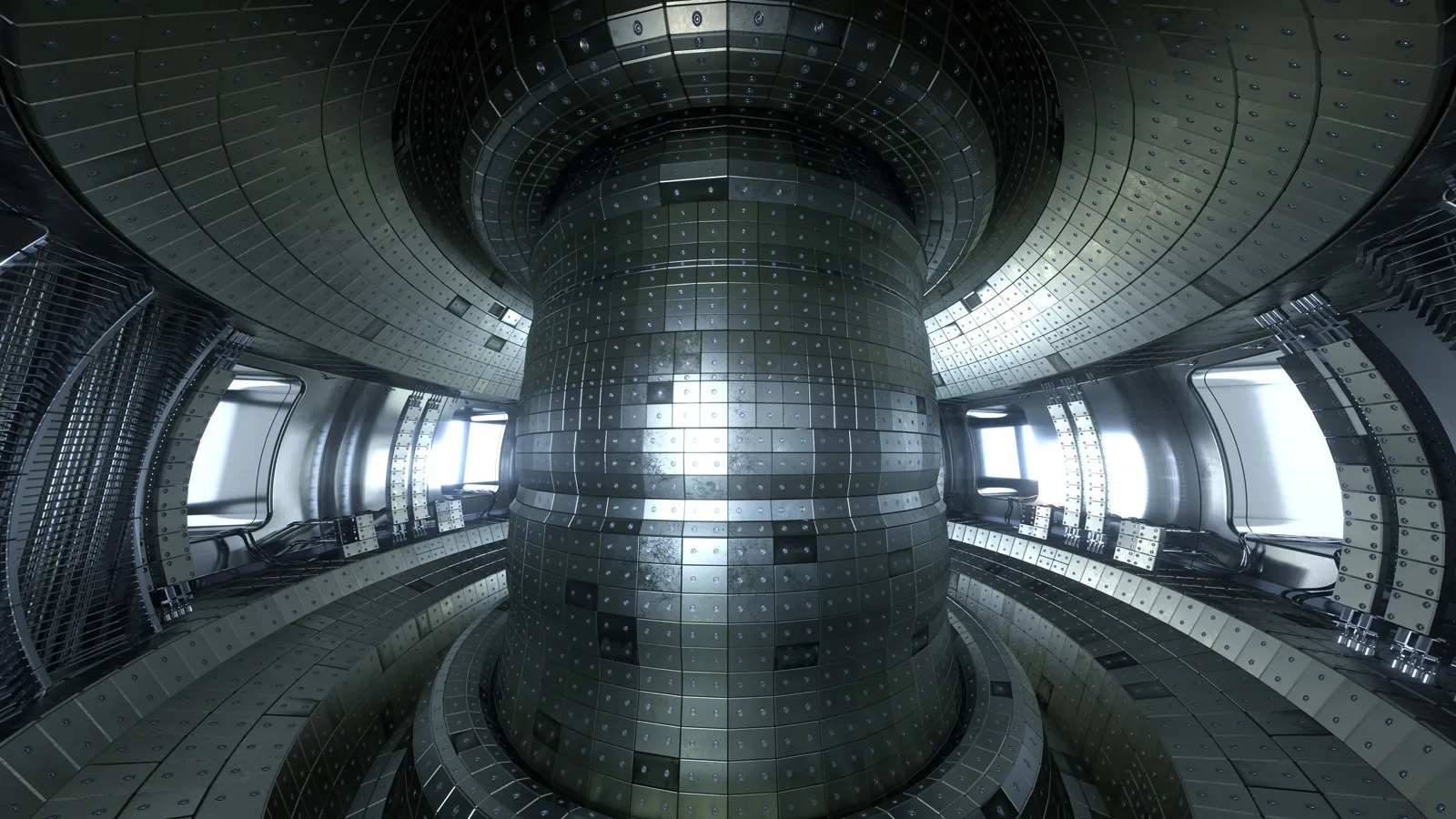
Inside a doughnut shaped chamber called a tokamak, extremely powerful superconducting magnets trap a tiny amount of hydrogen plasma while heating it to extraordinary temperatures. Rather than building a miniature Sun, the reactor simply attempts to reproduce the fusion reaction that naturally occurs inside one.
In other words, it's not an artificial Sun. It's an artificial environment where the Sun's physics can happen.
Hotter Than the Sun
Ironically, fusion reactors must become far hotter than the Sun's core. How is that even possible?
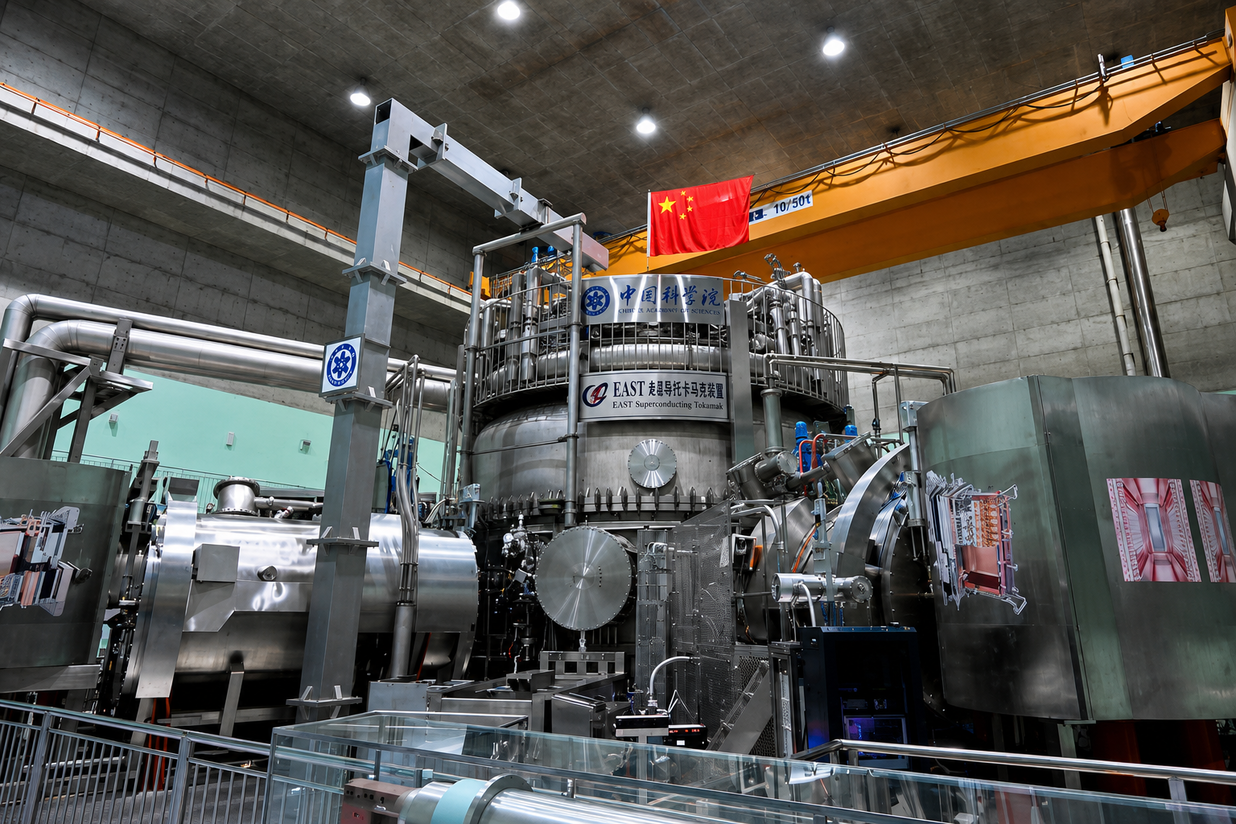
The Sun's core reaches around 15 million°C, but gravity does most of the work by squeezing atoms together. On Earth, there is no such gravity. To compensate, reactors like EAST heat plasma to temperatures exceeding 100 million°C, giving hydrogen nuclei enough energy to overcome their natural electrical repulsion and fuse together.
That sounds unbelievable, but the plasma never touches the reactor walls. Instead, it's suspended by magnetic fields inside a vacuum chamber.
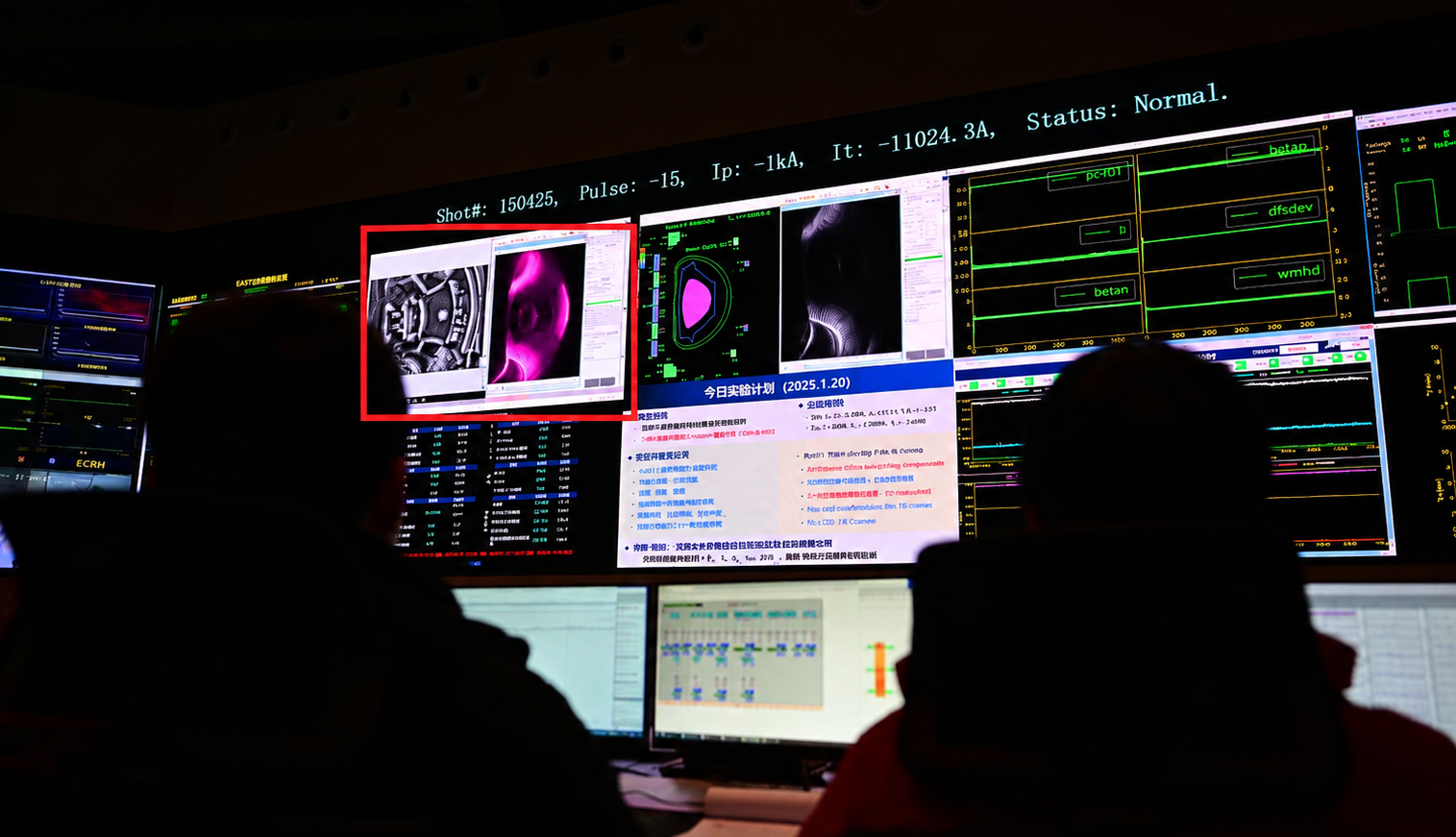
In January 2025, China's EAST reactor set a new world record by maintaining high-confinement plasma for 1,066 seconds, nearly 18 minutes, a major milestone toward sustained fusion.
Imagine trying to stick two magnets together from the same side. They naturally push each other away. Hydrogen atoms behave in a similar way, they don't want to merge. Inside the Sun, gravity is so unbelievably strong that it forces those atoms together anyway.
Here on Earth, scientists don't have that luxury, so they use incredibly high temperatures instead. The hotter the hydrogen gets, the faster the atoms move and the harder they crash into each other, increasing the chance that they'll finally fuse.
Fusion Isn't New. We've Been Using It Since the 1950s
This is where many people get confused.
Humanity has actually known how to create nuclear fusion for decades. The problem is, we've mostly used it in thermonuclear weapons. Hydrogen bombs rely on fusion to produce their enormous explosive power. In fact, a fusion bomb releases far more energy than the atomic bombs dropped during World War II.
So if we already know how fusion works, why don't we have fusion power plants?
Because making fusion explode is much 'easier' than making fusion behave. A thermonuclear weapon only needs the fusion reaction to last a tiny fraction of a second before releasing all its energy at once.
A power plant is the exact opposite.
Instead of producing one massive explosion, it must keep an extremely hot plasma stable, confined, and continuously producing energy for hours, days, or even years. Maintaining plasma at over 100 million°C without letting it escape is considered one of the greatest engineering challenges humanity has ever attempted.
| Thermonuclear Weapon | Fusion Power Plant |
|---|---|
| Goal : Explosion | Goal : Electricity |
| Duration : < 1 second | Duration : Continuous |
| Plasma : No control needed | Plasma : Must stay confined |
| Energy : Released instantly | Energy : Released gradually |
| Success : Bigger explosion | Success : Stable reaction |
In other words, a bomb only needs fusion to happen. A power plant needs fusion to happen under complete control.
Today's Nuclear Power Plants Use Fission, Not Fusion
Fusion reactors are also very different from the nuclear power plants operating today.
Modern nuclear plants use nuclear fission, where heavy atoms such as uranium are split apart to release energy. According to the International Atomic Energy Agency (IAEA), more than 410 commercial nuclear reactors currently supply about 9% of the world's electricity using this technology.
Fusion works in reverse.
Instead of splitting atoms, it combines light hydrogen isotopes into helium. That difference makes fusion fundamentally safer.
Unlike fission reactors, fusion cannot sustain a runaway chain reaction. If the magnetic confinement fails or operating conditions change, the plasma simply cools within seconds and the reaction stops by itself. Fusion also produces significantly less long lived radioactive waste and carries no risk of a Fukushima or Chernobyl style accident.
A Breakthrough Worth Waiting For
Despite decades of research, no fusion reactor has yet become a commercial power plant. Projects like China's EAST, South Korea's KSTAR, Japan's JT-60SA, and the international ITER are still working toward making fusion a practical source of electricity.
If scientists succeed, fusion could provide abundant low carbon energy with far less long lived radioactive waste than today's fission reactors. It's also inherently safer because if something goes wrong, the reaction simply stops instead of spiraling out of control.
China's "artificial sun" isn't a second Sun. It's humanity's attempt to recreate the same reaction that powers the stars, and if it ever becomes commercially viable, it could be one of the biggest technological breakthroughs in history.