


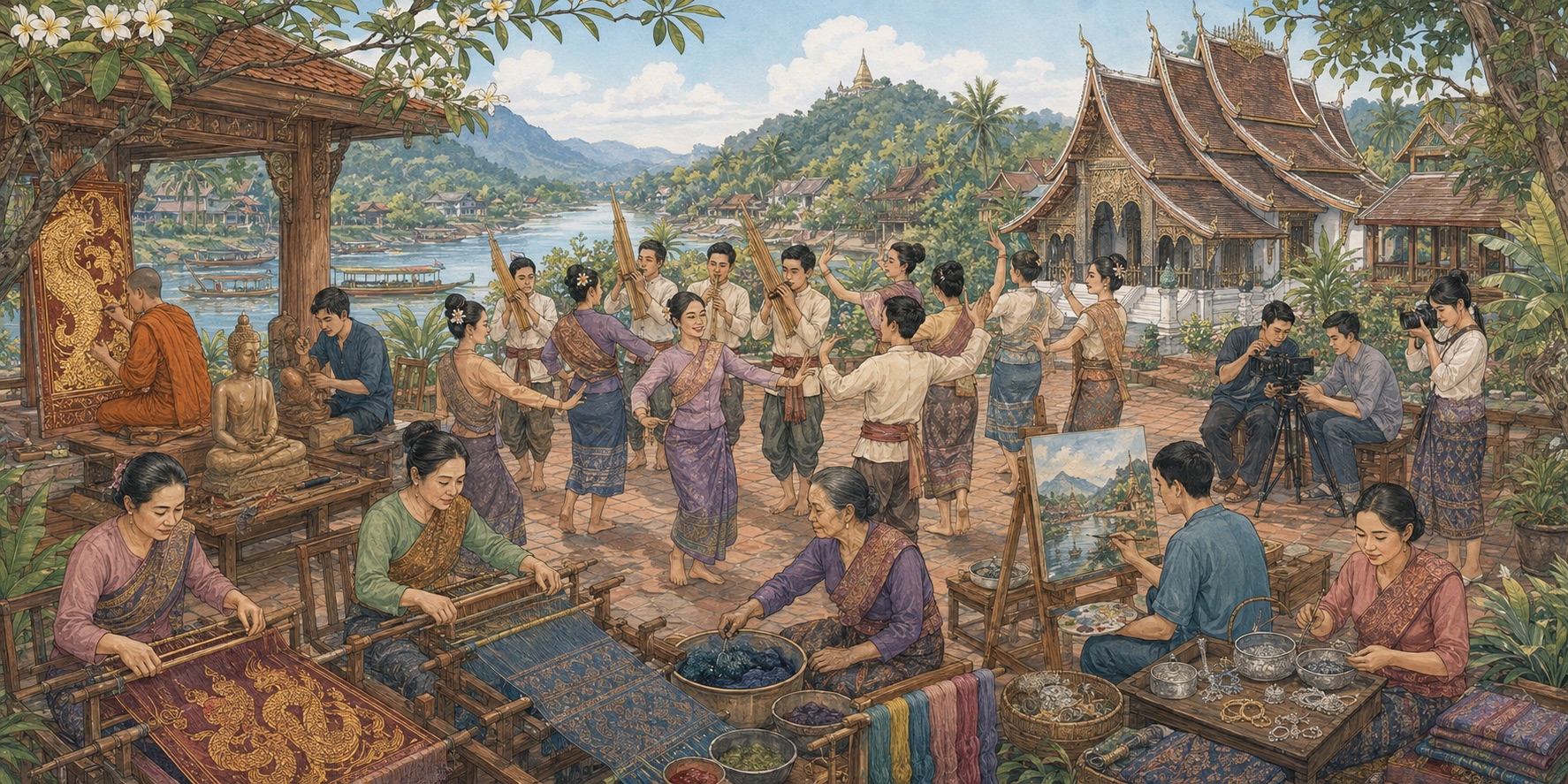
Before Luang Prabang’s streets fill with visitors, wooden looms are already moving in nearby villages. Threads of indigo, red and gold become serpents, birds and geometric symbols, carrying stories from one generation to the next. This quiet exchange between memory and imagination defines Laos’s arts scene: deeply spiritual, locally grounded and increasingly connected to wider audiences.
Stories Woven into Every Thread
Textiles are among Laos’s most sophisticated artistic languages. The traditional sinh, a tube skirt worn by Lao women, can identify a weaver’s community, ethnicity and regional heritage. Its decorative borders frequently feature the Naga, a mythical river serpent associated with protection, water and fertility.
The traditional craft of Naga motif weaving entered UNESCO’s Intangible Cultural Heritage list in 2023, joining khaen music as an internationally recognised Lao tradition. Yet its continuation depends less on recognition than on skills being transferred between mothers, daughters, teachers and village cooperatives.
Ock Pop Tok began in Luang Prabang in 2000 with five weavers and now works with more than 500 artisans across Laos. Its workshops combine heritage techniques, natural dyes and fair-trade production. Co-founder Veomanee Douangmala explains, “Our underlying philosophy and approach to design is that it needs to support the traditions and culture of Laos.”
Sacred Art Illuminates Everyday Life
In Luang Prabang, Buddhist craftsmanship forms part of the city’s daily visual rhythm. Artisans carve wooden Buddha images, cast bronze figures and decorate temple walls with gilded stencils illustrating Jataka stories, flowers and forest landscapes. At Wat Xieng Thong, mosaics and ornamental details demonstrate how spirituality, architecture and storytelling meet within a single sacred space.
Outside Vientiane, Xieng Khuan offers a more unconventional expression. Commonly known as Buddha Park, it contains more than 200 concrete sculptures of Buddhist and Hindu figures. Created by mystic and sculptor Bunleua Sulilat, the park mixes religious symbolism with twentieth-century folk imagination, producing one of the country’s most distinctive artistic environments.
The Khaen Keeps Communities Moving
The sound of the khaen, a bamboo free-reed mouth organ, remains central to Lao cultural identity. Its layered tones accompany storytelling, courtship songs, ceremonies and communal dances. UNESCO inscribed the music of the Lao khaen in 2017, recognising knowledge that includes instrument-making, performance and oral transmission.
At weddings, festivals and village celebrations, the khaen often accompanies the lam vong. Participants move in a circle with measured footsteps and graceful hand gestures, creating a dance that welcomes different generations rather than separating performers from spectators.
Contemporary Voices Find New Spaces
Laos’s emerging contemporary movement is small but increasingly confident. Artists in Vientiane and Luang Prabang are using painting, photography, installation and performance to examine migration, environmental change, unexploded wartime ordnance and the transformation of life along the Mekong.
Marisa Darasavath combines exaggerated human forms, rural landscapes and images of Lao women in vivid paintings. Describing her independence as an artist, she has said, “I want to be a free agent, to have free thoughts and not get caught up in agendas.”
Artists such as Bounpaul Phothyzan, Tcheu Siong and Souliya Phoumivong have also brought Lao perspectives to regional and international exhibitions. At home, initiatives including Mekong Art Initiative, Lao Art Week and independent workshops are creating opportunities for emerging artists, photographers and curators.
Lao cinema is developing alongside the visual arts. Filmmakers such as Mattie Do and Anysay Keola have introduced contemporary Lao stories to international festivals, while Blue Chair in Luang Prabang supports regional screenings, discussions and filmmaking programmes.
Creative Travel Supports Cultural Continuity
The Traditional Arts and Ethnology Centre in Luang Prabang offers an essential introduction to the country’s 49 officially recognised ethnic groups. Since opening in 2006, it has welcomed more than 200,000 visitors and currently supports over 600 artisans and their families across 20 ethnic groups in 13 provinces.
Travellers can continue that journey at the Ock Pop Tok Living Crafts Centre, Vientiane’s galleries and the evening markets of Luang Prabang. Choosing locally documented textiles, saa paper, silverwork and woodcarvings helps ensure that tourism supports genuine makers rather than mass-produced imitations.
Laos may move at a gentler pace than neighbouring creative capitals, but its arts scene is not standing still. Through woven cloth, temple walls, bamboo music and independent cinema, Lao artists are showing that quiet creativity can carry a powerful and enduring voice.


