


Shakespeare’s ageing king arrived in Jakarta not as a distant monarch, but as a vulnerable man surrounded by fading memories. Staged at Gedung Kesenian Jakarta on September 16 and 17, 2026, Tadashi Suzuki’s King Lear turned a landmark tragedy into a timely encounter among Indonesia, Japan and a wider international theatre community.
A Kingdom Reimagined as a Hospital
First created by Suzuki Company of Toga in 1984, this version abandons the familiar grandeur of a royal court. Its world resembles a hospital or care institution, where Lear sits in a wheelchair and moves through memories, fantasies and hallucinations. The change of setting draws attention away from crowns and territory and towards ageing, loneliness, fractured families and the slow loss of control.
Suzuki captures the production’s unsettling premise in six words: “All the world is a hospital.” In Jakarta, that image gave Shakespeare’s story contemporary urgency. Lear’s struggle was presented not as the remote downfall of a legendary ruler, but as an intimate human crisis that could unfold in any country or generation.
Eight Countries, One Physical Language
The 100-minute production, performed without an interval, brought together actors from Indonesia, Japan, the United States, Russia, South Korea, China, Chile and Italy. Their different languages and theatrical backgrounds did not disappear; instead, they became part of the production’s texture.
What unified the ensemble was the Suzuki Method of Actor Training, which places unusual demands on the feet, centre of gravity, breath, voice and concentration. Every step, pause and shift of weight became a shared vocabulary. The result illustrated a practical form of cultural diplomacy: artists did not simply represent their countries beside one another, but submitted to the same discipline and built one performance together.
An Indonesian Lear Takes Centre Stage
At the centre was Yogyakarta actor Jamaluddin Latif, succeeding the late German actor Götz Argus, who had performed the role for many years. Latif’s casting carried significance beyond national pride. It marked the outcome of sustained training, trust and artistic exchange, placing an Indonesian performer at the heart of one of SCOT’s signature works.
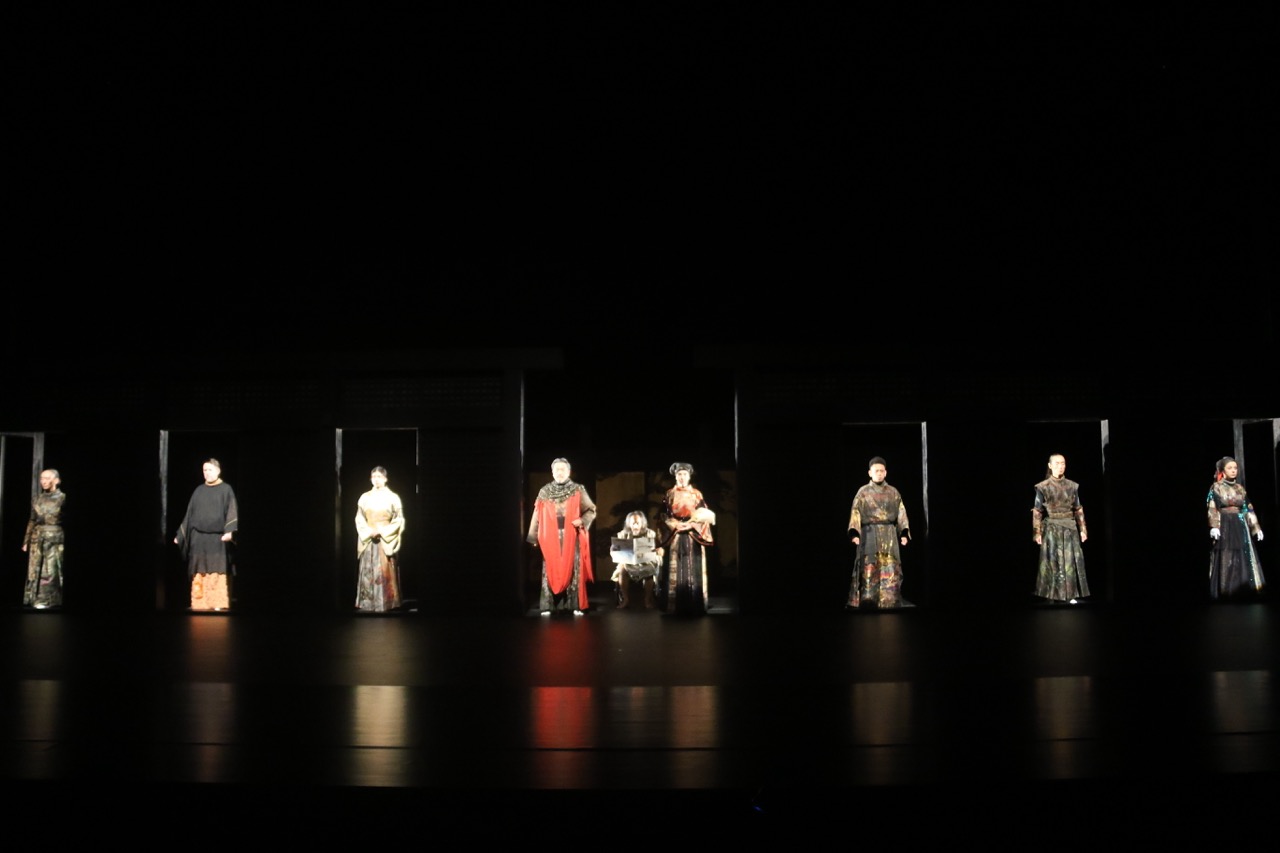
He was joined by Ellen Lauren of the United States as Goneril, Nana Tatishvili of Russia as Regan, Antonina Isidora Valderrama Saez of Chile as Cordelia, Lee Sung Won of South Korea as Gloucester and performers from Japan, Italy, China and Indonesia.
The international casting sharpened the play’s central conflict. Lear’s loss of authority, love and certainty unfolded through bodies and voices shaped by different cultures, yet the emotional journey remained unmistakably shared.
From Exchange to Co-Creation
The Jakarta staging was produced by SCOT and Bumi Purnati Indonesia and presented with The Japan Foundation. Their collaboration dates to 2015 and has already produced Dionysus, Electra and now King Lear. Indonesian performers have trained in Toga, Japan, while previous productions have travelled to major platforms including the Singapore International Festival of Arts and the Theatre Olympics.
This represents a deeper model than importing a finished Japanese production. King Lear was built through years of residencies, rehearsals and personal relationships. A two-hour Suzuki Method workshop at Taman Ismail Marzuki on September 17 extended that exchange beyond the evening performance to local artists and the next generation.
The project also forms part of The Japan Foundation’s WA Project 2.0, a 10-year initiative supporting Japan–ASEAN people-to-people ties. The Foundation has worked in Indonesia since opening its Jakarta office in 1974, giving the institution more than half a century of local cultural engagement.
A Stage for Shared Responsibility
For Bumi Purnati founder Restu Imansari Kusumaningrum, the purpose of performance reaches beyond spectacle. “The performing arts do not exist merely to entertain, but also to educate,” she wrote in the programme. Her statement reflects the production’s wider consequence: cultural partnership becomes strongest when it creates skills, opportunities and relationships that remain after the curtain falls.
King Lear closed in tragedy, but its Jakarta chapter carried a constructive message. In a city accustomed to many languages and identities, eight nationalities found common ground through disciplined performance. The production showed that cultural diplomacy can be more than ceremony; it can be the difficult, patient and deeply human work of creating together.


