Wilson's bird-of-paradise is a member of the order Passeriformes and the family Paradisaeidae. The bird lives endemically in the Raja Ampat Islands, Southwest Papua. Its scientific name is Diphyllodes respublica, which is also known as Cicinnurus respublica. It was first described by a French ornithologist named Charles Lucien Bonaparte in 1850.
In English, the bird is commonly known as Wilson's bird-of-paradise. The common name refers to Edward Wilson, an English bird specimen collector. Meanwhile, the Indonesian name of the bird is cenderawasih botak. The term botak means bald, which refers to the featherless top of its head
The natural population of Wilson's bird-of-paradise is distributed only on Waigeo Island and Batanta Island. Both islands lie off the northwest coast of Papua. Its distribution range covers an area of 10,800 square kilometers. The resident bird inhabits tropical lowland and montane rainforests at elevations from 100 to 1,200 meters above sea level.
Featherless Head Appearance with a Curled Tail
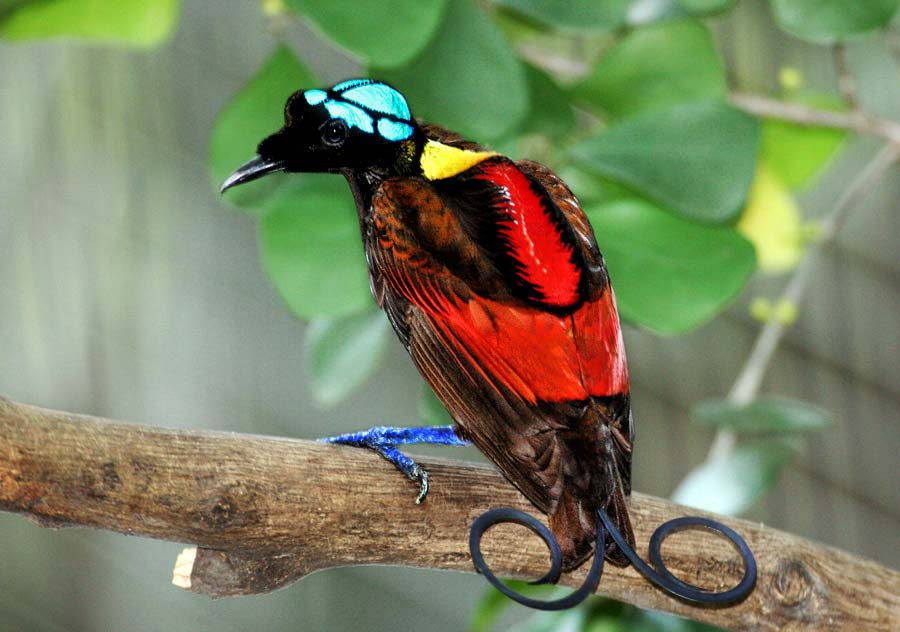
An adult Wilson's bird-of-paradise has a basic body length of around 16 centimeters. Adult males weigh between 53 and 67 grams. In males, the body length increases to 21 centimeters when measured to the tip of the tail.
The top of its head displays bare, bright turquoise-blue skin. On the blue skin surface, thin black lines form a double-cross pattern. The bird has dark brown irises, a blackish bill, and cobalt-blue legs.
The plumage on the male's back is bright red. Its nape is covered with golden-yellow feathers. Its breast features a metallic emerald-green feather shield. Meanwhile, the wings and belly are dominated by dark blackish-brown plumage.
Two central tail feathers of the male grow elongated without webs. The two violet tail wires curve in opposite directions to form circles.
Unlike the male, the female weighs around 52 to 60 grams. The upper parts of the female are dull olive-brown without a green breast shield or curled tail wires. The female's underparts have fine yellowish-brown barring.
The female also has featherless blue head skin. The blue color on the female's head appears darker and covers a smaller surface area than that of the male. In its life cycle, the bird has an average generation length of four years.
The Male's Habit of Clearing the Forest Floor
Wilson's bird-of-paradise inhabits moist hill forests. Aside from primary forests, the bird is also reported to persist in selectively logged forests.
On the forest floor, adult males are territorial and maintain a dedicated display court. The cleared court measures about one meter wide with a small vertical sapling in the center.
The male routinely clears the display area of dead leaves and fallen twigs. The bird picks up leaf litter around the vertical sapling and tosses it away from the court to leave a clean earth surface.
When a female arrives to watch from a branch above, the male begins moving around the vertical sapling. The male expands its green breast shield outward into a flat disk. Along with the movement, the male opens its bill to reveal a yellowish-green mouth lining.
As for food, both male and female Wilson's bird-of-paradise mainly consume fruits. Besides fruits, the bird also feeds on small arthropods.
Reference:
BirdLife International. (2021). Cicinnurus respublica. The IUCN Red List of Threatened Species, 2021, e.T22706202A180775851. https://dx.doi.org/10.2305 IUCN.UK.2021-3.RLTS.T22706202A180775851.en