


As Southeast Asia commemorated World Refugee Day on 20 June 2026, the region was reminded that displacement remains one of the defining humanitarian challenges of our time. Under the global theme “Until Everyone Is Safe,” governments, humanitarian organizations, and local communities reflected on the reality that safety is not simply the absence of conflict, but also the presence of dignity, opportunity, and protection. Across the region, refugee communities continued to demonstrate remarkable resilience while host societies grappled with the responsibility of providing support in an increasingly complex world.
The Rohingya Crisis and the Search for Safety
The largest refugee challenge in Southeast Asia remained the ongoing Rohingya crisis. Forced to flee violence, discrimination, and statelessness in Myanmar, hundreds of thousands of Rohingya sought refuge across neighboring countries, particularly Bangladesh, Malaysia, Indonesia, and Thailand.
While Southeast Asia has long been known for its cultural diversity and traditions of hospitality, many refugee communities continued to live in legal uncertainty. Most countries in the region are not signatories to the 1951 Refugee Convention, creating significant limitations on access to employment, education, and long-term legal protection.
Indonesia, for example, continued to host Rohingya refugees arriving on the shores of Aceh. Local communities, particularly in Aceh, once again demonstrated solidarity by assisting vulnerable arrivals despite facing economic challenges of their own. Similar acts of compassion were witnessed in Malaysia and Thailand, where civil society organizations played a crucial role in supporting displaced families.
From Survival to Contribution
Beyond statistics and policy debates, refugees remained individuals with aspirations, skills, and ambitions. Increasingly, organizations across Southeast Asia sought to shift public perceptions away from viewing refugees solely as aid recipients.
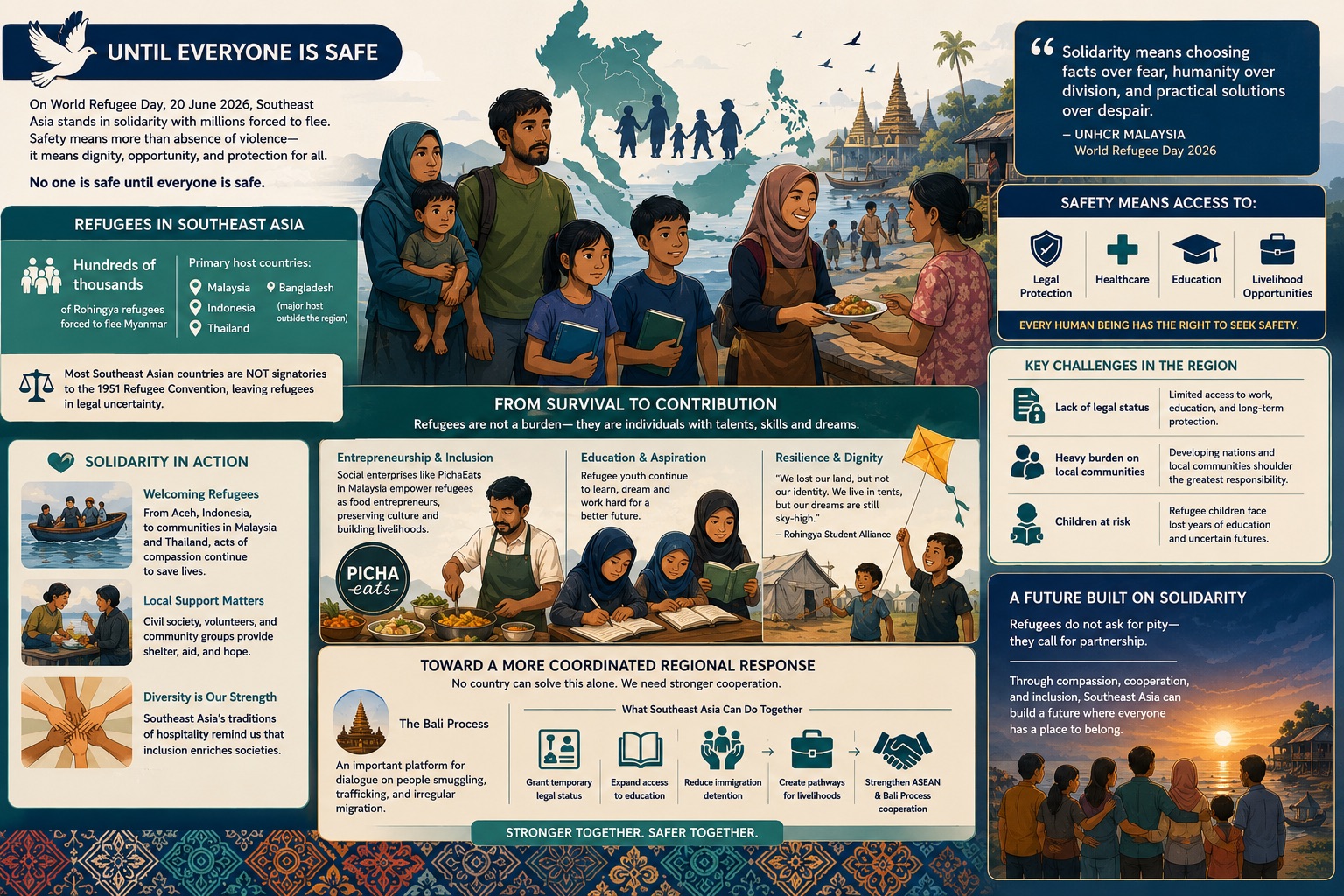
In Malaysia, social enterprises such as PichaEats continued to provide opportunities for refugee communities to share their culinary traditions while generating income and building social connections. Similar community-based initiatives throughout the region highlighted how inclusion could create mutual benefits for both refugees and host societies.
Filippo Grandi, the United Nations High Commissioner for Refugees, previously emphasized that refugees are not merely people in need of assistance but individuals capable of contributing to the communities that welcome them. His message resonated strongly across Southeast Asia, where many refugees have spent years or even decades rebuilding their lives despite uncertain futures.
As one statement from the Rohingya Student Alliance noted, “We lost our land, but not our identity. We live in tents, but our dreams are still sky-high.” The quote reflected a reality often overlooked in public discussions: resilience remains one of the most powerful characteristics of displaced communities.
Toward a More Coordinated Regional Response
The challenges surrounding refugee protection cannot be addressed by any single country alone. Southeast Asia's interconnected geography means that migration, displacement, and humanitarian crises frequently cross national borders.
The Bali Process has provided an important platform for dialogue on people smuggling, trafficking, and irregular migration, but many experts argue that stronger regional coordination is still needed. Discussions increasingly focused on developing practical solutions that would grant temporary legal status, expand access to education, reduce reliance on immigration detention, and create pathways for livelihoods.
UNHCR Malaysia echoed this approach during World Refugee Day 2026, stating that “Solidarity means choosing facts over fear, humanity over division, and practical solutions over despair.” The statement captured the growing recognition that sustainable refugee policies benefit not only displaced communities but also regional stability.
A Future Built on Solidarity
World Refugee Day 2026 served as a reminder that the refugee experience is ultimately a human story—one of loss, resilience, adaptation, and hope. Across Southeast Asia, refugees continued striving for safety, education, livelihoods, and a sense of belonging.
As governments, humanitarian agencies, and local communities looked ahead, one message stood out clearly: refugees do not ask for pity—they call for partnership. In a region built on diversity and shared destinies, the path forward lies not in exclusion but in cooperation. Until everyone is safe, the work of building a more compassionate and resilient Southeast Asia remains unfinished.


