


As dawn breaks over the mist-covered canopy of Borneo, the calls of hornbills echo through ancient trees that have stood for centuries. Beneath the emerald crown of the rainforest, orangutans move silently among the branches, while rivers carry life through landscapes that have sustained communities for generations. These forests are more than natural wonders. They are living systems that regulate climate, protect biodiversity, support livelihoods, and help sustain life far beyond Southeast Asia.
As the world observes World Rainforest Day on June 22, attention turns to one of the planet's most important ecological treasures. Southeast Asia's rainforests, particularly those of Sundaland and Wallacea, are among the oldest and most biodiverse ecosystems on Earth. Yet they also face some of the greatest environmental pressures of the modern era.
The Lungs of Asia
Stretching across Indonesia, Malaysia, Brunei, southern Thailand, the Philippines, and parts of mainland Southeast Asia, the region's rainforests serve as vast carbon sinks that help regulate global weather patterns and absorb billions of tons of carbon dioxide.
Scientists estimate that Southeast Asia contains some of the world's richest concentrations of biodiversity. Indonesia alone is home to approximately ten percent of the world's flowering plant species, twelve percent of its mammals, and seventeen percent of its bird species. Many of these exist nowhere else on Earth.
The forests of Sumatra, Borneo, and Java shelter critically endangered wildlife including the Sumatran orangutan, the Javan rhinoceros, the Malayan tiger, and the Bornean pygmy elephant. Their survival depends entirely on the health of these increasingly fragmented habitats.
As renowned Malaysian environmentalist and social entrepreneur Yasmin Rasyid once noted, "Nature is not separate from us. We are part of nature, and our future depends on how well we protect it." Her words reflect a growing awareness that rainforest conservation is no longer simply an environmental issue but a human one.
Forests Under Pressure
Despite their global importance, Southeast Asia's rainforests continue to face significant threats.
Over recent decades, deforestation driven by agricultural expansion, logging, mining, and infrastructure development has transformed large areas of forest into plantations and industrial landscapes. Palm oil, pulpwood, and timber remain important economic commodities, but their expansion has often come at a cost to natural ecosystems.
Particularly vulnerable are the region's peatland forests. Unlike ordinary soils, peatlands store enormous quantities of carbon accumulated over thousands of years. When drained for agriculture, they dry out and become highly flammable. During severe dry seasons, peat fires can burn underground for months, releasing vast amounts of greenhouse gases while creating transboundary haze that affects millions of people across Southeast Asia.
Habitat fragmentation presents another challenge. Roads, plantations, and infrastructure corridors can divide once-continuous forests into isolated patches, disrupting wildlife migration routes and increasing encounters between humans and endangered species.
Poaching also remains a persistent threat, particularly for rare species such as rhinos, tigers, and pangolins, whose populations have declined dramatically over recent decades.
Communities as Guardians of the Forest
Amid these challenges, encouraging conservation success stories are emerging across the region.
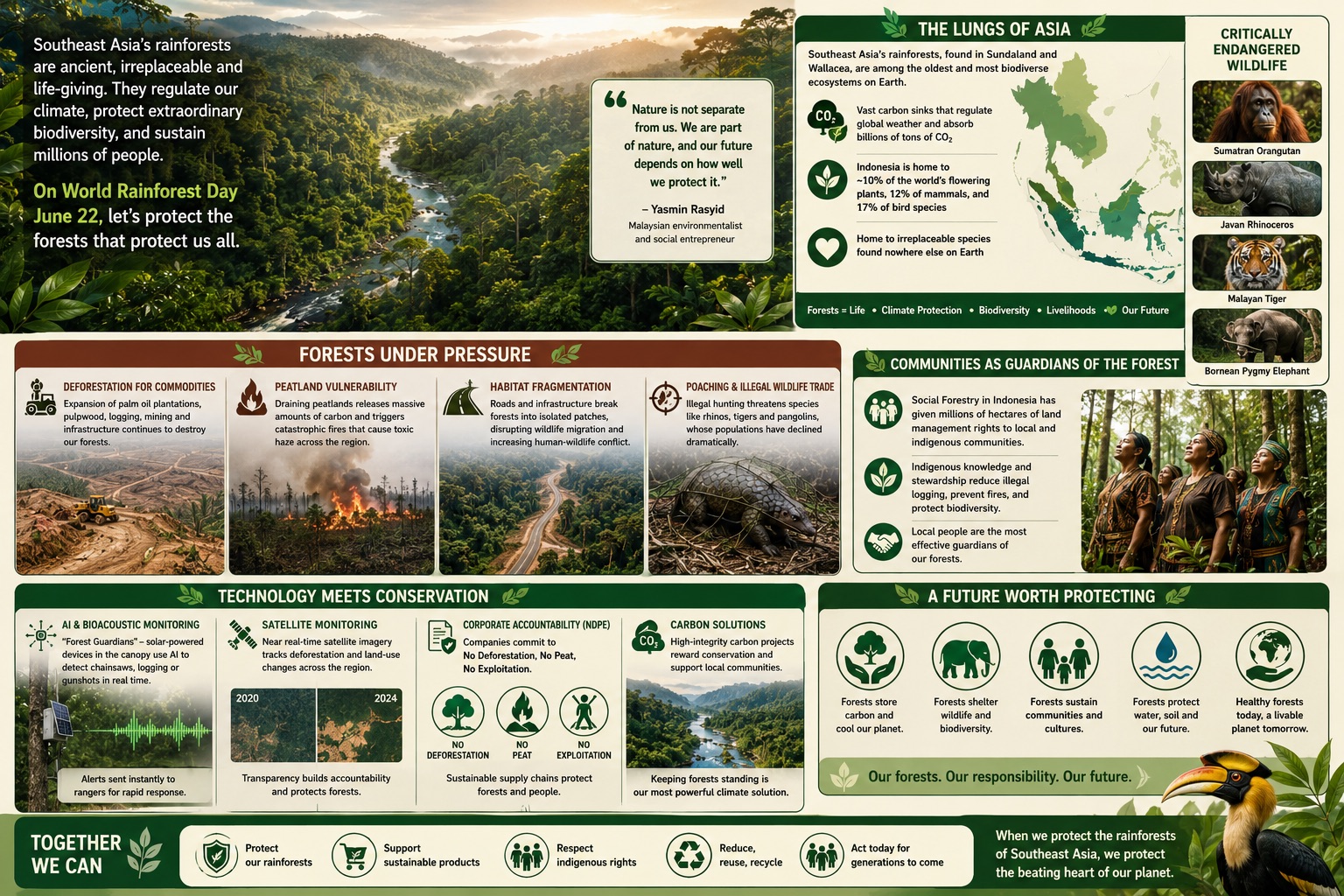
One of the most promising approaches has been the expansion of social forestry programmes. In Indonesia, millions of hectares of forest land have been placed under community management schemes that grant local and indigenous groups legal rights to manage and protect forests sustainably.
These communities often possess generations of ecological knowledge and have demonstrated remarkable success in reducing illegal logging, preventing forest fires, and maintaining biodiversity while supporting local livelihoods.
In Kalimantan and Papua, indigenous forest management systems continue to serve as important models for balancing conservation and economic development. Similar community-led initiatives are gaining recognition throughout Southeast Asia as governments increasingly acknowledge that local people are among the most effective forest stewards.
Technology Meets Conservation
Conservation efforts are also entering a new technological era.
Across parts of Sumatra and Borneo, environmental organizations have begun deploying solar-powered bioacoustic monitoring systems known as "Forest Guardians." Suspended high in the forest canopy, these devices use artificial intelligence to identify the sounds of chainsaws, logging activities, or gunshots in real time.
When suspicious activity is detected, alerts are sent immediately to conservation teams and park rangers, allowing faster intervention before significant damage occurs.
Satellite monitoring has also become a powerful tool in the fight against deforestation. Governments, researchers, and companies now use near real-time imagery to track land-use changes and improve transparency throughout agricultural supply chains.
These innovations complement growing commitments by major companies to implement No Deforestation, No Peat, No Exploitation policies, often known as NDPE standards, which seek to ensure that agricultural products are produced without causing further forest loss.
A Future Worth Protecting
The future of Southeast Asia's rainforests may also depend on creating new economic incentives for conservation.
Carbon credit initiatives and ecosystem service programmes are increasingly allowing governments and local communities to generate income from keeping forests intact rather than converting them for short-term development. High-integrity carbon projects in Indonesia, Malaysia, and other countries are beginning to demonstrate how conservation and economic growth can coexist.
Yet perhaps the most important lesson is that rainforest protection requires cooperation across borders. Rivers, wildlife, weather systems, and carbon cycles do not recognize national boundaries. The health of one forest ultimately influences the wellbeing of an entire region.
As World Rainforest Day reminds us, Southeast Asia's forests are far more than collections of trees. They are reservoirs of life, culture, knowledge, and resilience. They protect biodiversity, regulate climate, support communities, and inspire future generations.
The challenge now is not whether these forests matter. The challenge is ensuring that they continue to stand for centuries to come. In protecting Southeast Asia's rainforests, the region is not only safeguarding its natural heritage—it is helping secure the future of the planet itself.


