


For decades, Thailand earned a reputation as the "Detroit of Asia," producing millions of vehicles and serving as one of the world's most important automotive manufacturing hubs. From the industrial estates of Rayong to assembly lines supplying markets across the globe, the kingdom built its economic success on the internal combustion engine. Today, however, Thailand is embarking on perhaps its most significant automotive transformation yet: the transition to electric vehicles.
Driven by ambitious government policies, rising consumer demand, and fierce international competition, Thailand is no longer simply adapting to the EV revolution—it is positioning itself to lead it.
Rebuilding the Detroit of Asia
At the heart of Thailand's strategy lies a clear objective: remain Southeast Asia's automotive powerhouse in the electric age.
Through its Thailand E-Mobility Mission and the ambitious 30@30 policy, the government aims for at least 30 percent of all domestically manufactured vehicles to be zero-emission vehicles by 2030. The vision extends beyond serving domestic consumers. Thailand wants to become the primary EV production and export hub for right-hand-drive markets throughout Southeast Asia, Australia, and New Zealand.
The Eastern Economic Corridor has emerged as the centerpiece of this ambition, attracting billions of dollars in investment from global automakers, battery manufacturers, and technology suppliers eager to establish a foothold in the region's largest automotive production base.
Subsidies That Sparked a Consumer Boom
Thailand's rapid EV adoption did not happen by chance. Government intervention played a decisive role.
Under the EV 3.0 and EV 3.5 incentive packages, authorities introduced generous subsidies, excise tax reductions, and import duty incentives that dramatically lowered the cost of electric vehicles. These measures helped transform EVs from a niche product into a mainstream option for Thai consumers.
However, the incentives came with important conditions. Automakers that imported fully built electric vehicles were required to establish local production facilities and gradually manufacture multiple locally assembled vehicles for every imported unit sold. This policy ensured that consumer incentives translated into long-term industrial investment rather than short-term imports.
According to Narit Therdsteerasukdi, Secretary General of Thailand's Board of Investment, the country's EV policies are designed not only to stimulate demand but also to create a complete ecosystem encompassing manufacturing, batteries, charging infrastructure, and supply chains.
A Battle for Thailand's Automotive Future
Perhaps nowhere is Thailand's EV transformation more visible than in the changing competitive landscape.
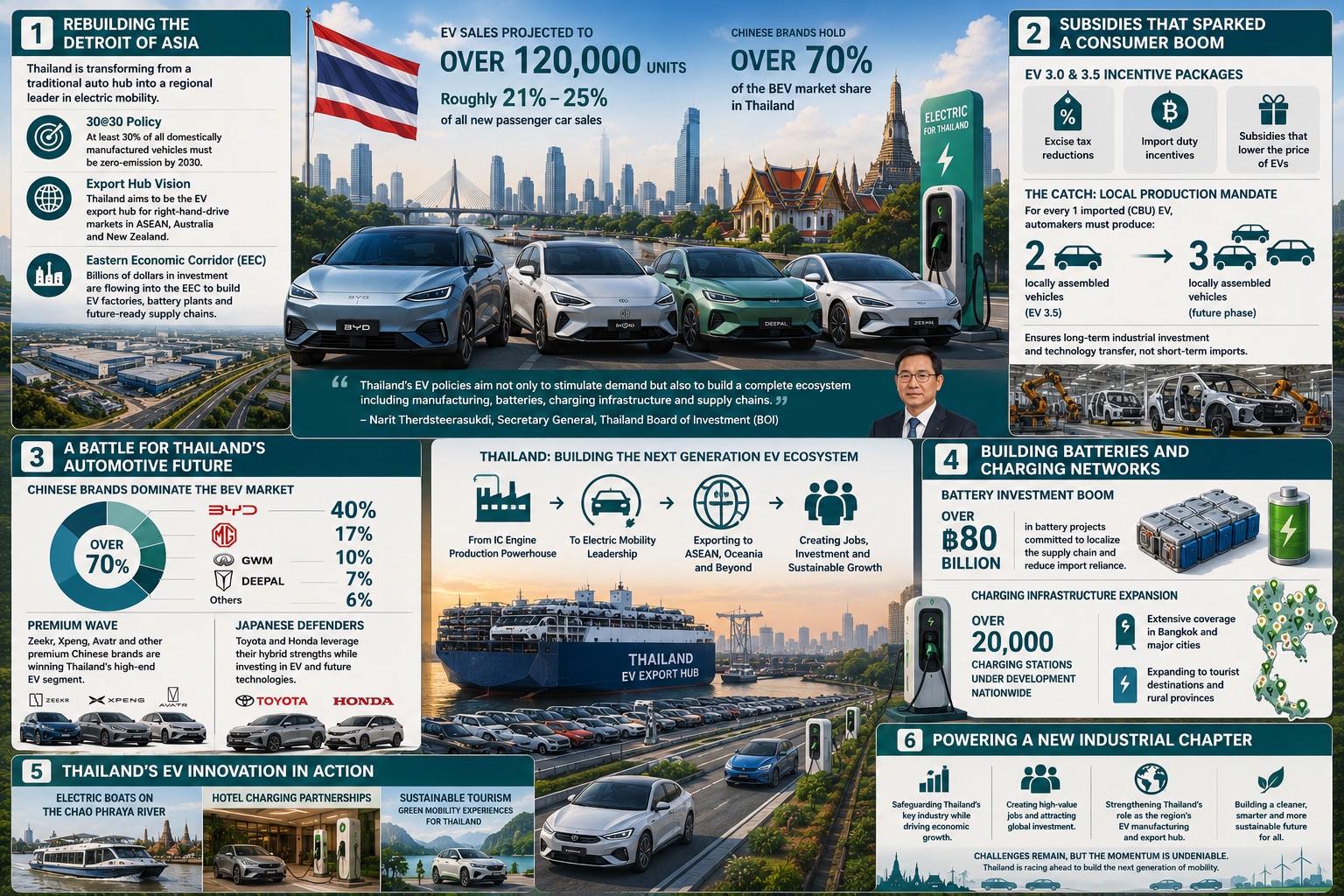
Chinese automakers now dominate more than 70 percent of Thailand's battery electric vehicle market. BYD alone commands roughly 40 percent of the segment, while MG, Great Wall Motor, and Deepal continue expanding their presence across the country.
Meanwhile, premium Chinese brands such as Zeekr, Xpeng, and Avatr are increasingly attracting affluent consumers in Bangkok and other major cities, challenging traditional perceptions of automotive quality and innovation.
The rise of Chinese manufacturers has placed pressure on long-established Japanese automakers. Toyota and Honda, which have historically dominated Thailand's vehicle market, are responding by strengthening their hybrid vehicle offerings while simultaneously investing in future EV production capabilities.
Building Batteries and Charging Networks
Manufacturing vehicles is only part of the equation. Thailand is also investing heavily in battery production and supporting infrastructure.
More than ฿80 billion has been committed to battery-related projects as the country seeks to localize key components and reduce dependence on imports. The objective is to create a fully integrated EV ecosystem capable of supporting both domestic demand and export ambitions.
At the same time, over 20,000 charging stations are being developed nationwide. Bangkok already enjoys extensive charging coverage, while tourist destinations such as Phuket, Pattaya, and Chiang Mai are rapidly expanding their networks.
Thailand's innovation extends beyond passenger vehicles. Electric ferries operating along Bangkok's Chao Phraya River and hotel partnerships offering charging services to travelers demonstrate how electrification is becoming integrated into tourism and daily life.
Powering a New Industrial Chapter
Thailand's EV transition represents far more than a technological upgrade. It is a strategic effort to safeguard one of the country's most important industries while creating new opportunities for investment, employment, and exports.
Challenges remain, particularly in expanding charging infrastructure to rural provinces and ensuring supply chains remain competitive. Yet the momentum is undeniable. EV sales are projected to exceed 120,000 units and account for roughly one-quarter of all new passenger vehicle sales, signaling a profound shift in consumer behavior.
As the Detroit of Asia reinvents itself for the twenty-first century, Thailand is proving that industrial leadership is not about preserving the past. It is about embracing the future and building the next generation of mobility before anyone else does.


