


Along the winding coastal roads of Timor-Leste, a quiet mobility transformation is beginning to take shape. Unlike neighboring countries that are competing to become electric vehicle manufacturing hubs, Southeast Asia's youngest nation is pursuing a different path—one focused on accessibility, community transport, and energy independence.
For Timor-Leste, electric mobility is not about producing millions of vehicles. Instead, it is about improving daily life, reducing dependence on imported fuel, and creating practical transportation solutions for communities across the country. While the industry remains in its early stages, the foundations for a cleaner transport future are slowly being built.
Mobility Designed for Local Communities
The most visible symbol of Timor-Leste's electric future is not the electric car but the electric tricycle, locally known as the tum-tum. These vehicles have become increasingly common in municipalities such as Lautém, Manatuto, and Liquiçá, where relatively flat terrain makes electric transport practical and affordable.
Today, an estimated 1,725 electric tricycles operate across various parts of the country. Serving as taxis, delivery vehicles, and community transport, they provide a glimpse into how electrification can address local mobility needs without requiring expensive infrastructure investments.
Electric two-wheelers and light-duty vehicles have also begun entering the market, primarily imported from China. For many families and small business owners, these vehicles offer lower operating costs compared to traditional fuel-powered alternatives.
Building a National Vision for E-Mobility
Although Timor-Leste's EV market remains small, policymakers increasingly recognize its long-term potential. According to regional assessments, the country's E-Mobility Readiness Index currently stands at around 40 out of 100, indicating both significant progress and substantial room for development.
The government has been working closely with international partners to strengthen its policy framework. Organizations such as the United Nations Economic and Social Commission for Asia and the Pacific have collaborated with the Ministry of Transport and Communications to explore electric mobility strategies tailored to local conditions.
Transport Minister Miguel Marques Gonçalves Manetelu has emphasized the importance of sustainable transportation as part of Timor-Leste's broader development agenda, highlighting the need to modernize mobility while reducing dependence on imported petroleum products.
One proposal under discussion includes pilot electric bus services connecting key economic corridors, particularly between Tibar Port and the capital, Dili.
Infrastructure Remains the Biggest Challenge
Despite growing interest, Timor-Leste faces a significant obstacle: charging infrastructure.
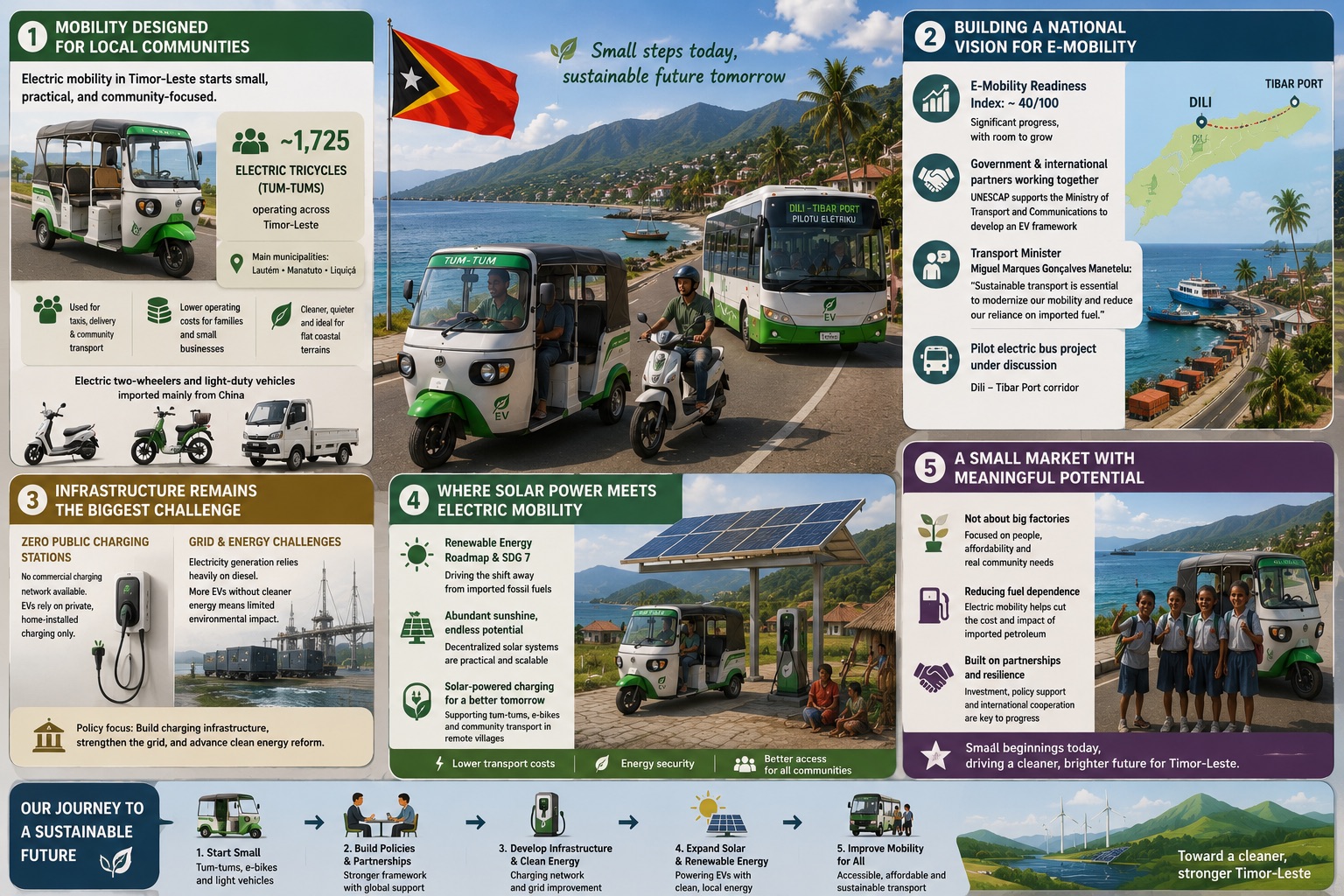
Unlike other Southeast Asian markets, the country currently lacks a public commercial charging network. Existing EV owners depend almost entirely on home-based charging systems.
The challenge extends beyond charging stations themselves. Much of Timor-Leste's electricity generation has historically relied on diesel-powered plants. As a result, simply increasing EV numbers without improving energy generation would deliver only limited environmental benefits.
This reality has encouraged policymakers to think beyond transportation and consider broader energy reforms alongside vehicle electrification.
Where Solar Power Meets Electric Mobility
Perhaps the most promising aspect of Timor-Leste's EV future lies in renewable energy integration.
Under the country's Renewable Energy Roadmap and Sustainable Development Goal 7 commitments, efforts are underway to expand renewable electricity generation and reduce reliance on imported fossil fuels.
For a nation with abundant sunshine throughout the year, decentralized solar energy offers a practical solution. In remote villages where traditional fuel supply chains can be costly and unreliable, solar-powered charging systems could support electric tum-tums, e-bikes, and community transport services.
This approach would not only lower transportation costs but also strengthen energy security and improve access to mobility in underserved areas.
A Small Market with Meaningful Potential
Timor-Leste's EV story is very different from those unfolding in Thailand, Indonesia, or Vietnam. It is not driven by billion-dollar factories, export ambitions, or intense competition among global automakers.
Instead, it is a story about local solutions for local challenges. It is about helping communities move more affordably, reducing fuel dependence, and building a cleaner energy future from the ground up.
The road ahead will require investment, policy support, and infrastructure development. Yet the growing presence of electric tum-tums, expanding discussions on renewable energy, and increasing international cooperation suggest that Timor-Leste is taking its first meaningful steps toward electrification. In a country known for resilience and determination, even small beginnings can lead to transformative change.


