Singapore is positioning itself as Asia's carbon trading hub, without the rainforests, peatlands, or mangroves that usually justify a seat at that table.
It's an odd fit on paper. Carbon credits typically flow from forest-rich countries like Indonesia or Brazil, not from a 735 square kilometer city state with barely any green cover to spare.
The explanation is that Singapore isn't competing to produce credits at all. It's building the marketplace where everyone else's credits get traded.
Why Is Carbon Being Traded?
The idea of buying and selling carbon often sounds confusing.
After all, carbon dioxide is a greenhouse gas that contributes to global warming. Why would anyone pay money for something that's considered pollution?
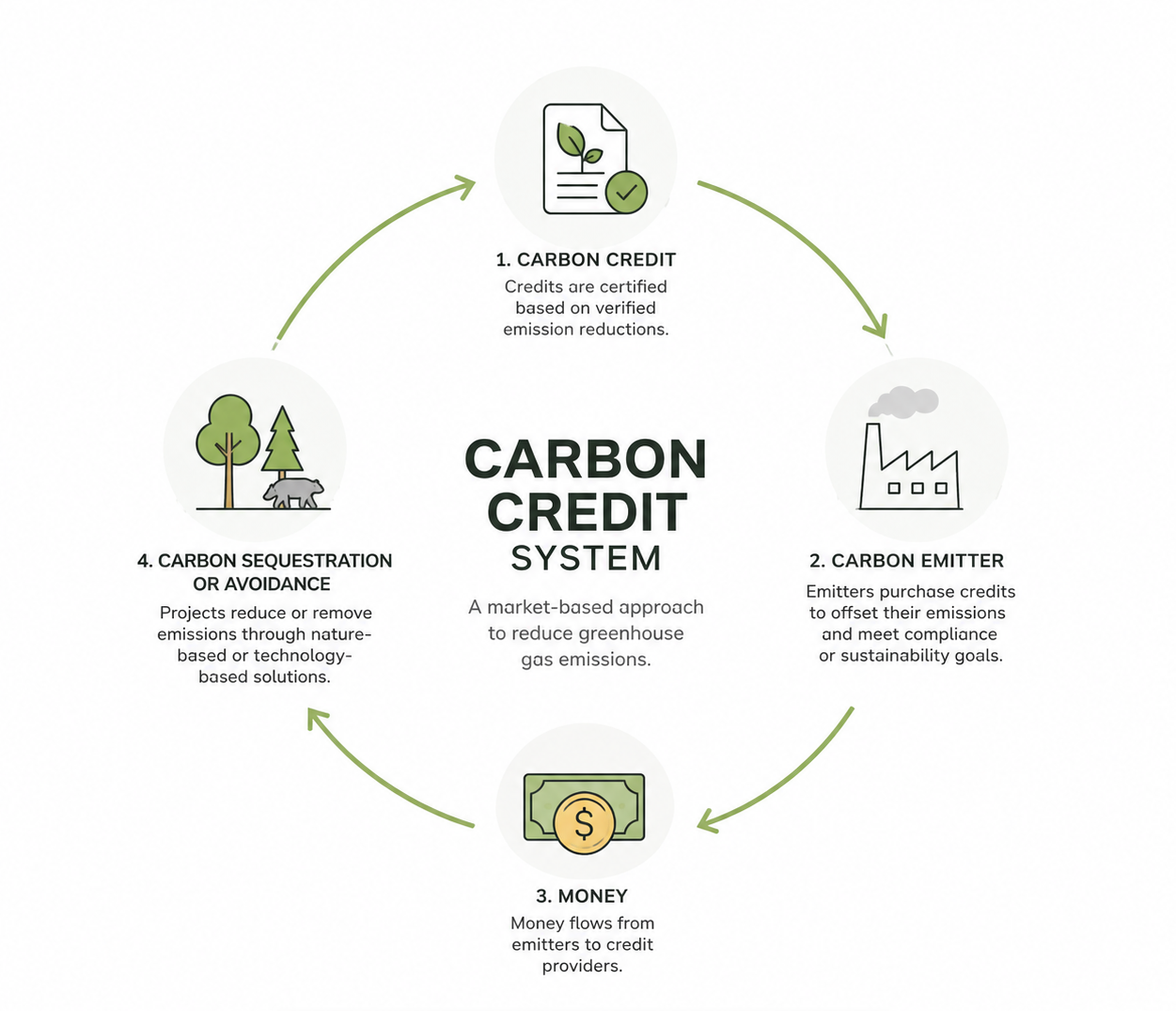
In reality, companies are not buying pollution. They're paying for verified emissions reductions. Imagine a power plant that cannot eliminate all of its emissions overnight. Instead, it finances a project that prevents or removes an equivalent amount of greenhouse gases elsewhere.
For example by protecting tropical forests, restoring mangroves, or developing renewable energy.
Once those emissions reductions are independently verified, they become carbon credits, with one credit representing one metric tonne of carbon dioxide (or its equivalent) reduced or removed.
Companies can then purchase these credits to offset part of their emissions, while conservation and clean energy projects receive funding that might not otherwise exist.
A Market Worth Billions
What began as a climate policy has rapidly evolved into a global industry.
According to the World Bank's State and Trends of Carbon Pricing 2026, 87 carbon pricing instruments are now operating worldwide, covering nearly 30% of global greenhouse gas emissions.
Together, they generated a record US$107 billion in public revenue during 2025, illustrating how carbon pricing has become an increasingly important part of the global economy.
Rather than competing with countries that generate carbon credits, Singapore wants to build the financial infrastructure surrounding them.
Building the Marketplace
Singapore's strategy closely resembles how it became a global trading hub for oil and liquefied natural gas (LNG). It produces almost none of these commodities itself, yet creates value by providing financing, logistics, legal services, and trading infrastructure.
The same model is now being applied to carbon.
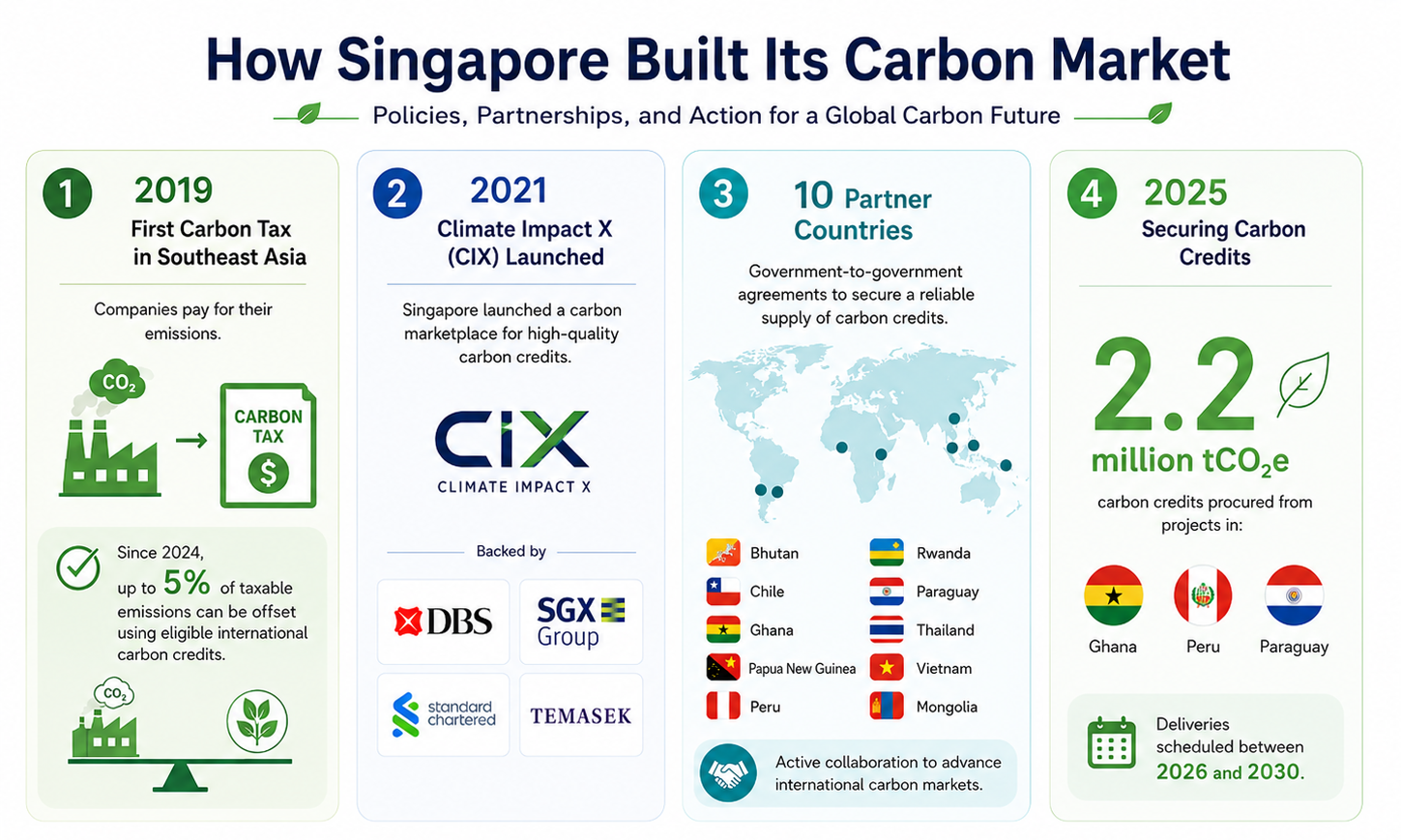
In 2021, Singapore launched Climate Impact X (CIX), a carbon marketplace backed by DBS Bank, Singapore Exchange (SGX Group), Standard Chartered, and Temasek to facilitate the trading of high quality carbon credits.
Singapore also became Southeast Asia's first country to introduce a nationwide carbon tax in 2019. Since 2024, companies subject to the tax have been allowed to offset up to 5% of their taxable emissions using eligible international carbon credits under Article 6 of the Paris Agreement.
To secure a reliable supply of these credits, Singapore has signed government-to-government (G to G) Implementation Agreements with ten countries. Bhutan, Chile, Ghana, Papua New Guinea, Peru, Rwanda, Paraguay, Thailand, Viet Nam, and Mongolia as of late 2025, making it one of the most active participants in international carbon markets under the Paris Agreement framework.
In 2025, the government also completed procurement contracts for approximately 2.2 million tonnes of CO₂ equivalent carbon credits from projects in Ghana, Peru, and Paraguay, with deliveries scheduled between 2026 and 2030.
A Different Role for Southeast Asia
Here's the twist. Singapore's strategy runs on something it doesn't actually have, which is forests.
Its neighbors do. Indonesia, Malaysia, and the Philippines all sit on huge stretches of tropical forest and mangrove, the raw material for nature based carbon credits. Indonesia alone holds the world's largest mangrove ecosystem, which makes it one of the biggest blue carbon players on the planet.
So instead of competing for that role, Singapore is aiming for a different one. Its neighbors can supply the credits. Singapore wants to be the gateway that connects those credits to buyers around the world through trading platforms, financing, verification, and legal services.
Whether that bet pays off is still an open question. Carbon markets have taken a lot of criticism over credit quality, and doubts persist about whether some projects actually cut emissions the way they claim to.
Still, Singapore's wager is straightforwar, In the carbon economy that's taking shape, the biggest winners might not just be the countries producing the credits.
They might be whoever builds the marketplace where those credits get bought and sold.