


For more than two thousand years, Indonesia and India have been connected by the movement of people, ideas, religions, and trade across the Indian Ocean. Today, those ancient ties are evolving into one of Asia's most dynamic strategic partnerships. Indian Prime Minister Narendra Modi's official visit to Indonesia from 6–8 July 2026, following President Prabowo Subianto's visit to India as the Republic Day Chief Guest in January 2025, marked another milestone in expanding cooperation between Southeast Asia's largest economy and the world's most populous democracy.
From Ancient Civilizations to Modern Strategic Partners
Long before the establishment of modern nation-states, merchants and scholars sailed between the Indian subcontinent and the Indonesian archipelago, introducing Hinduism, Buddhism, and later Islam, while leaving a profound cultural legacy that remains visible today.
Indonesia's Wayang Kulit, the Ramayana Ballet at Prambanan, Balinese Hindu traditions, and countless Sanskrit-derived words all reflect centuries of cultural exchange. To celebrate this enduring connection, both countries continue to commemorate the Tagore–Ki Hadjar Dewantara Year, honoring the educational philosophies and cultural dialogue between Nobel laureate Rabindranath Tagore and Indonesia's father of education, Ki Hadjar Dewantara.
As Prime Minister Narendra Modi remarked during his visit:
"India and Indonesia are connected not only by geography but also by centuries of shared history, culture, and civilization."
That historical foundation continues to shape one of Asia's closest bilateral relationships.
A Shared Heritage Celebrated in Yogyakarta
Beyond the bilateral engagements in Jakarta, Prime Minister Narendra Modi and President Prabowo Subianto traveled together to Yogyakarta on 8 July 2026, placing culture and shared heritage at the center of the state visit. Their visit to the Prambanan Temple Complex, Indonesia's largest Hindu temple, highlighted how centuries-old civilizational ties continue to strengthen contemporary relations between the two nations.
At Prambanan, the two leaders witnessed the launch of a new collaboration between Indonesia and India to support the conservation and revitalization of the temple complex, bringing together Indonesian heritage authorities and specialists from the Archaeological Survey of India (ASI). Prime Minister Modi also joined a traditional Shanti Pooja at the Shiva Temple alongside Hindu priests and members of the local community, underscoring the enduring spiritual and cultural connections shared by Indonesia and India.
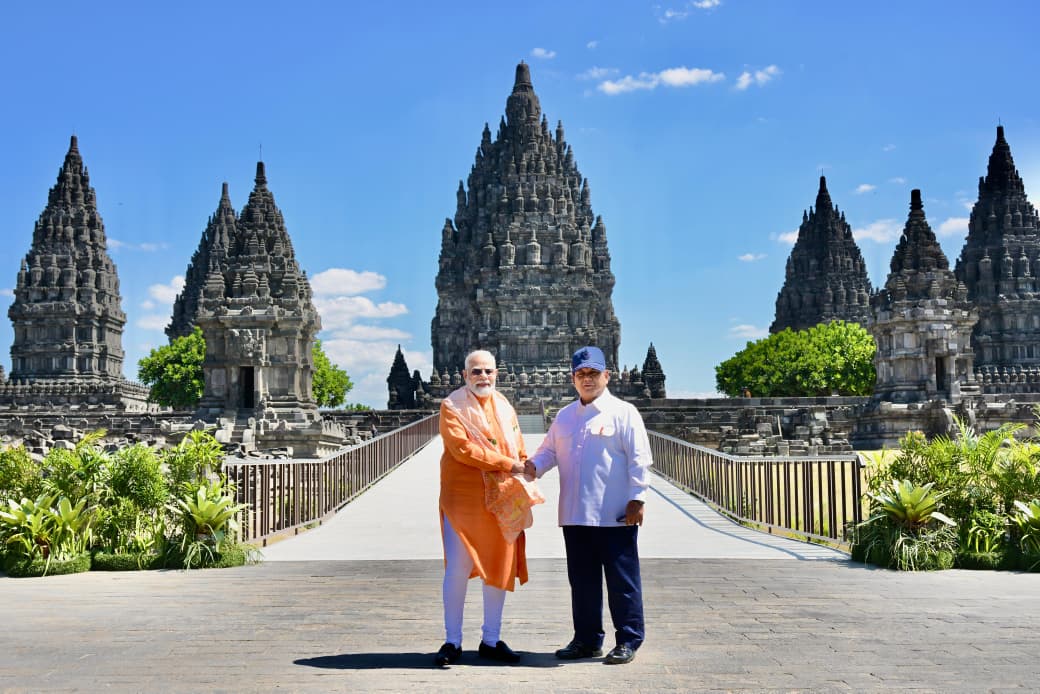
President Prabowo Subianto emphasized the symbolic importance of the visit, stating:
"Prambanan stands as a living symbol of the deep historical and cultural bonds that have united Indonesia and India for centuries, reminding us that our partnership is rooted not only in shared interests, but also in a shared civilization."
A New Momentum in Strategic Cooperation
The Jakarta summit between President Prabowo and Prime Minister Modi reinforced the Indonesia–India Comprehensive Strategic Partnership, which has steadily expanded beyond diplomacy into defense, maritime security, digital transformation, and economic cooperation.
Both leaders reaffirmed their commitment to maintaining a free, open, inclusive, and rules-based Indo-Pacific, recognizing the importance of secure sea lanes that connect the Indian and Pacific Oceans.
Defense cooperation has emerged as one of the partnership's fastest-growing pillars. Indonesia recently advanced discussions on procuring Indian-made BrahMos supersonic cruise missiles and Astra air-to-air missiles, while both countries continue strengthening military exchanges, naval cooperation, and joint maritime exercises.
The strategic development of Sabang Port in Aceh, located near the entrance to the Malacca Strait and close to India's Andaman and Nicobar Islands, further highlights the growing maritime dimension of bilateral relations.
Trade, Technology, and New Economic Opportunities
Economic cooperation continues to deepen alongside strategic engagement.
With bilateral trade exceeding US$30 billion annually in recent years, India has become one of Indonesia's most important economic partners and its second-largest trading partner within ASEAN. Indonesia remains India's leading supplier of crude palm oil (CPO) and a major exporter of coal, while India exports petroleum products, pharmaceuticals, automobiles, steel, machinery, and agricultural commodities to Indonesia.
The partnership is also entering a new digital phase.
Both governments are collaborating on cross-border QR payment connectivity and supporting Indonesia's Indonesia Open Network (ION), inspired by India's globally recognized Open Network for Digital Commerce (ONDC). These initiatives aim to make cross-border transactions more efficient while strengthening digital inclusion for businesses and consumers.
Cooperation is also expanding into critical minerals, renewable energy, electric vehicle supply chains, and industrial manufacturing, including collaboration between India's Steel Authority of India Limited (SAIL) and PT Krakatau Steel.
Shared Leadership Across the Indo-Pacific
Indonesia and India increasingly find themselves working side by side in shaping regional and global governance.
As two of Asia's largest democracies and influential voices of the Global South, both countries support reforms to international institutions, including the United Nations Security Council, while promoting stronger representation for developing nations.
Indonesia also continues to support India's leadership within BRICS, while India remains a steadfast advocate of ASEAN Centrality through its Act East Policy, recognizing Indonesia as a key strategic partner in Southeast Asia.
President Prabowo Subianto emphasized the importance of this cooperation during the bilateral meeting:
"Indonesia and India share a strategic vision for peace, prosperity, and stability in the Indo-Pacific, and we are committed to strengthening cooperation for the benefit of our peoples and the region."
Beyond Diplomacy: A Partnership Between People
The Indonesia–India relationship extends far beyond government agreements.
Thousands of Indian professionals, entrepreneurs, and students contribute to Indonesia's economy, while Indonesian students pursue higher education in India through scholarship and exchange programmes. Cultural festivals, yoga celebrations, Bollywood and Indonesian film screenings, literary collaborations, and academic exchanges continue to strengthen people-to-people ties.
Shared culinary influences—from martabak, curry, and biryani to spices that once drove global maritime trade—serve as everyday reminders of a relationship shaped by centuries of interaction.
As both countries celebrate 75 years of diplomatic relations, cultural cooperation remains one of the strongest foundations of their partnership.
Sailing Toward a Shared Future
Prime Minister Narendra Modi's visit to Indonesia reaffirmed that Indonesia and India are not simply neighbors across the Indian Ocean—they are longstanding partners with shared aspirations for regional peace, sustainable development, and inclusive growth.
From the historic temples of Prambanan to high-level discussions in Jakarta, the visit demonstrated that the Indonesia–India relationship is anchored equally in shared heritage and forward-looking cooperation. Built upon centuries of cultural exchange and strengthened by expanding collaboration in defense, trade, technology, maritime security, and heritage preservation, the partnership continues to evolve as one of the Indo-Pacific's most significant bilateral relationships. As both nations navigate an increasingly interconnected world, their cooperation offers a compelling example of how history, trust, and shared vision can shape a more resilient and prosperous future for Southeast Asia and beyond.


